Mexico Showed Up for Iran’s World Cup Team After the U.S. Refused. Here’s What Happened
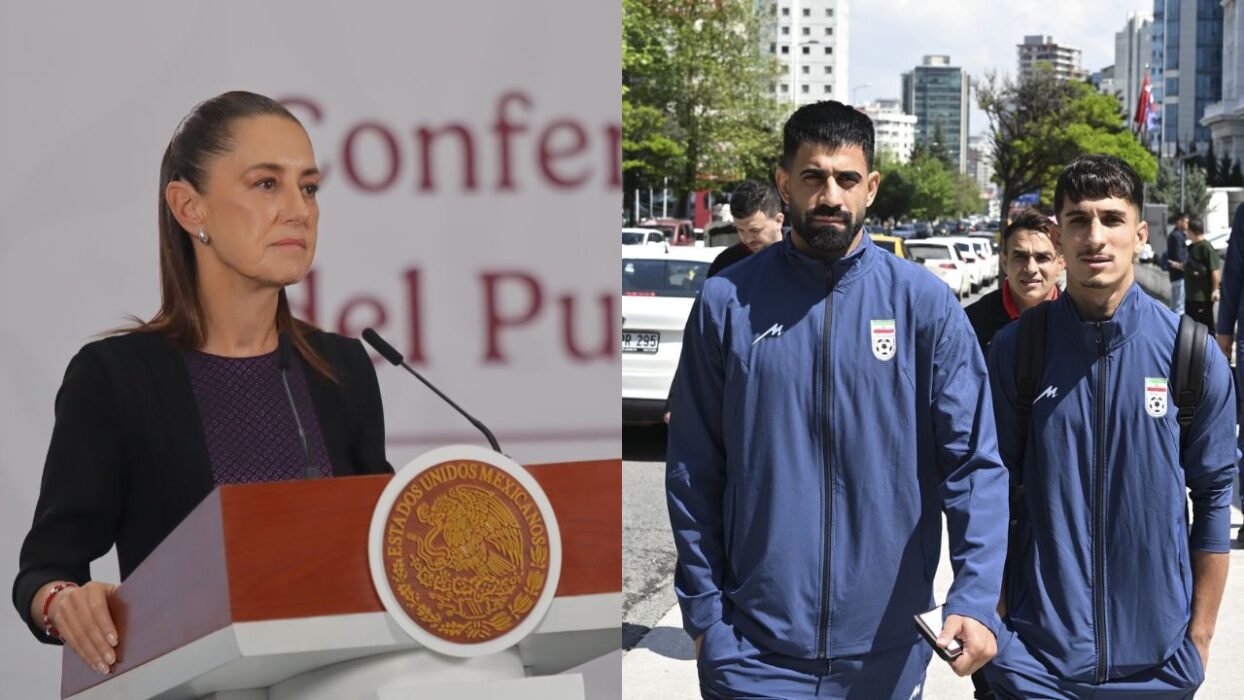
When FIFA asked if Mexico would host the Iranian World Cup team after the United States declined, President Claudia Sheinbaum didn’t hesitate. At her daily press conference on Monday, she laid out the decision with the diplomatic clarity that has defined her tenure: “We have no reason to deny them the possibility of staying in Mexico. The United States doesn’t want the Iranian team to stay overnight, but they’ll play three matches there. So they asked us, ‘Can they stay overnight in Mexico?’ And we said, ‘Yes, no problem. We have no issue with that.’”
With those words, Sheinbaum made a simple but impactful gesture, proving what real diplomacy looks like. She did it calmly and directly, showing that good leadership can mean doing the right thing without making it complicated.
Hosting Iran’s national football team at Centro Xoloitzcuintle in Tijuana during the 2026 FIFA World Cup may seem like a small detail. But it shows how a Latina leader is handling international tensions with determination and calm, as the world watches Mexico’s role in this major event.
When Everything Changed
The Iranian team was originally scheduled to train in Tucson, Arizona, for the World Cup, which runs from June 11 to July 19 across the United States, Canada, and Mexico. But the geopolitical landscape shifted dramatically on February 28, when the United States and Israel launched military operations against Iran, triggering a war that threw uncertainty over Iran’s participation in the tournament.
According to CNN and the Associated Press, FIFA approached Mexico’s government after US authorities made clear they did not want Iran’s squad to stay in the country during the competition, even though the Iranian team is scheduled to play all three of its Group G matches on US soil—against New Zealand on June 15 in Los Angeles, Belgium on June 21, also in Los Angeles, and Egypt on June 26 in Seattle.
The US position was contradictory. According to reports from Al Jazeera and NBC News, President Donald Trump said in March that the Iranian team was welcome to participate in the World Cup. Yet the State Department has not granted the team the necessary visas to enter the United States. Later on, Trump himself cast doubt on Iran’s presence, saying on Truth Social that he did not believe it was “appropriate” for Iran to be in the country, citing concerns for the team’s safety.
Mehdi Taj, head of Iran’s football federation, confirmed on Saturday that the team would relocate its training base from Tucson to Tijuana, a move already approved by FIFA.
Claudia Sheinbaum Steps In
What stood out about Sheinbaum’s response was not just her words, but her approach. She did not seek attention or try to make Mexico look like a hero for helping Iran. She simply treated it as a clear diplomatic decision based on principle.
That clarity and her choice to keep things simple are key parts of Sheinbaum’s leadership. She stated the facts without judgment and explained Mexico’s position without trying to impress anyone.
Marina del Pilar, the governor of Baja California, echoed this sentiment in a message shared on social media. According to reports from CNN, she welcomed the Iranian team to Tijuana, saying: “Tijuana will be the setting for their preparation for the 2026 FIFA World Cup, and Baja California is ready to welcome them as if they were at home.”
The Logistics and the Larger Meaning
For Iran’s team, the move addresses several immediate concerns. According to ESPN and Infobae reporting, staying in Mexico avoids visa complications that have plagued the Iranian delegation for months. Ahmad Donyamali, Iran’s Minister of Sport, told CNN that Tijuana’s proximity to Los Angeles—where the team plays two of its three matches—reduces travel time significantly. “In the previous training camp, the distance between the hotel and the training camp was considerable, but this problem does not exist in the Mexican training camp,” Donyamali explained.
The move also allows the Iranian team to travel directly to Mexico via Iran Air flights, according to reporting from the BBC and Al Jazeera, sidestepping additional complications that would arise from US entry requirements.
But beyond the practical details, there is a bigger point: Mexico’s president made a principled decision during a time of international pressure. She did not take sides or claim moral authority. Instead, she saw that refusing a team access to training facilities because of their nationality, especially when they are required to play in the country, was unfair and inconsistent.
No, It’s Not About an Upside-Down World. It’s About Leadership
While Sheinbaum has received some criticism in her country, it is no small feat to lead a country that neighbors one led by Donald Trump. From the Gulf of Mexico drama to her decision to aid Cuba after the new American blockade, she has shown what leadership looks like when there’s no male ego involved.
At a time when politics often involves showmanship and outrage, Sheinbaum’s response stands out for its basic decency.
For a Latina leading one of America’s most important countries during a tense time, this quiet confidence and clear principles are a powerful kind of leadership.