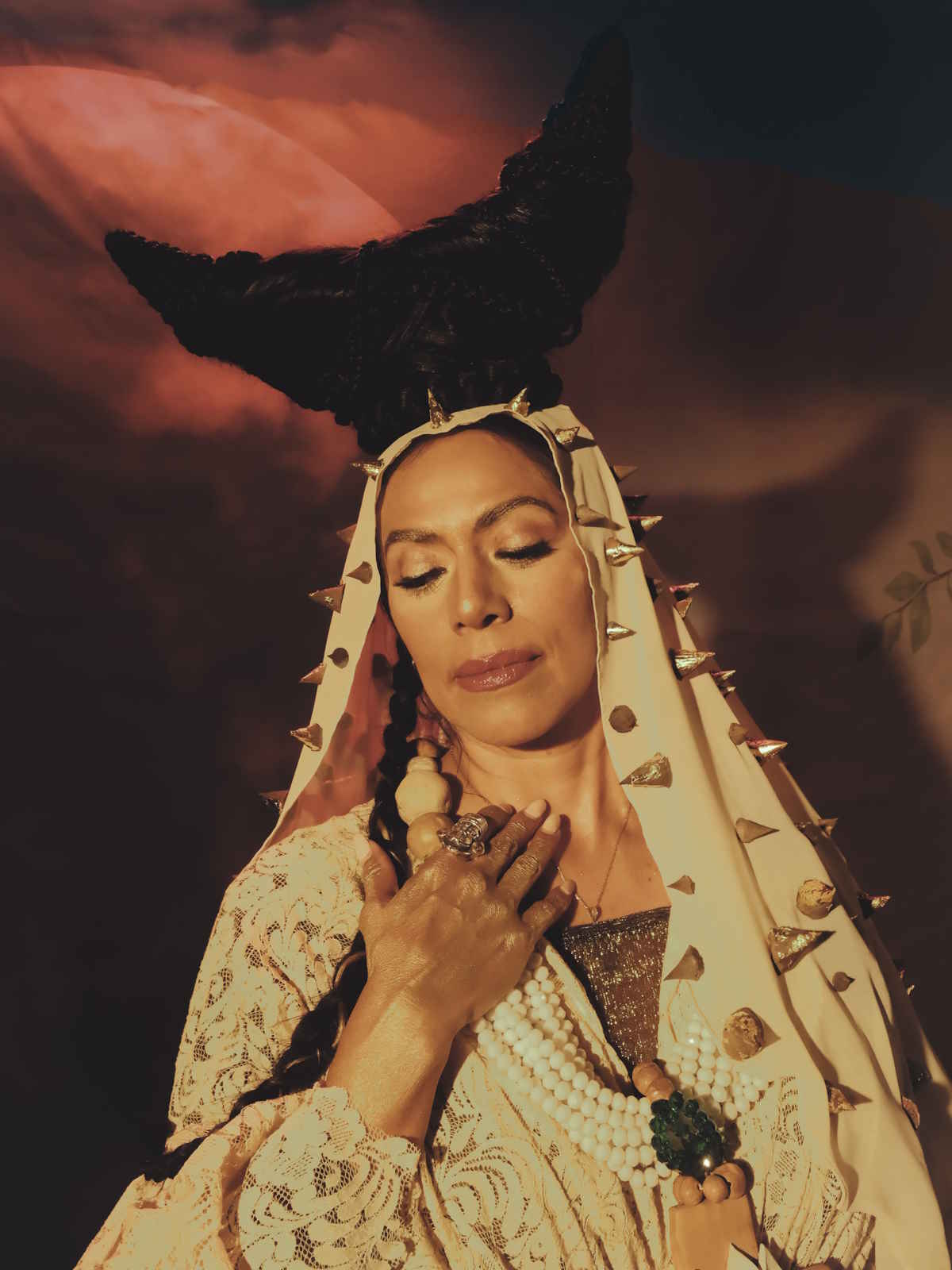
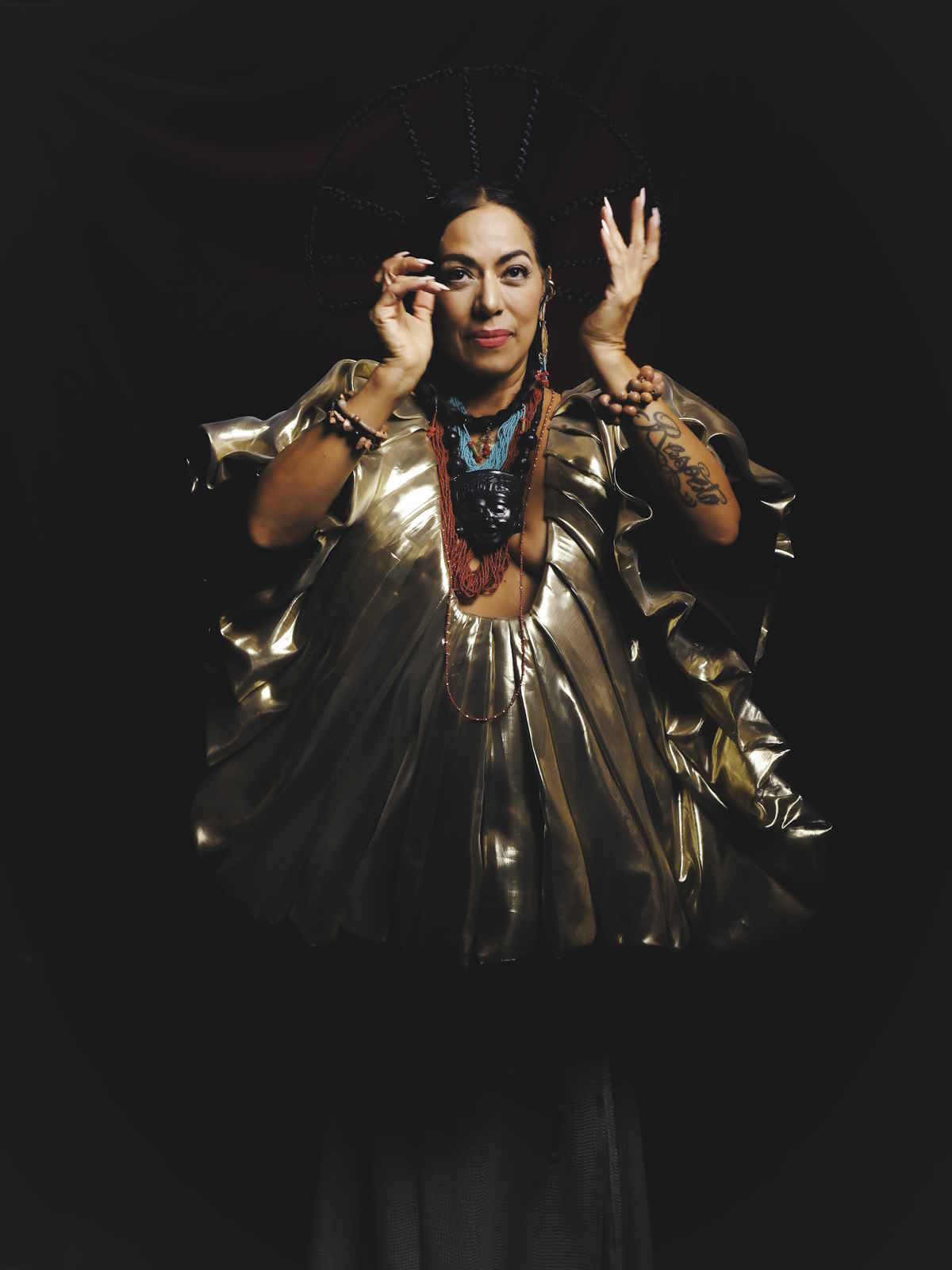
“I had lost my partner of so many years,” she says simply. “And that changed everything.”
They were together nearly thirty years. A marriage that shaped her personal and creative life. Then, just as suddenly as loss arrived, something else did.
“And now, well, love emerged suddenly again and that revolutionized life once more,” she says with a smile. “Imagine.”
It is hard to imagine. Lila Downs, the iconic Mexican-American singer whose voice spans three octaves and whose career has stretched across three decades, whose influence on Latin American consciousness cannot be overstated—she, too, knows what it means to grieve, to be remade by loss, to be surprised by love’s return.
What makes Cambias mi Mundo fundamentally different from everything that came before is that, for the first time in her career, Lila Downs wrote every composition on the album herself.
Well, almost. “There was only one song that my partner from Portugal composed, and we did it a little together,” she says. But the rest—the entire architecture of this record—belongs entirely to her.
This is not to say her previous work wasn’t an exercise in authorship. Lila Downs has been composing since the beginning of her career. She has always brought something of herself to every album. But this time was different.
“I always used to compose about half of the songs that go on the records,” she explains. “But on this occasion, there was more inspiration. So yes, it was the majority. There was more inspiration.”
It is as if the muses couldn’t wait for the songs to come to life.
Any other artist might have chosen to clean up their sound for a return album. To define it, to straighten it, to make it palatable in a single genre.
Lila Downs did the opposite.
Cambias mi Mundo contains ranchera, cumbia, bolero, Cuban influences, and then—suddenly—hip-hop textures and psychedelic effects that make the folklore feel modern, strange, and relevant all at once.
When asked why she refused a unified sound, she is clear: “I believe that I always do a variety of genres in our records. For me, it is necessary. I get bored if I do nothing but boleros or cumbias. I need to have a variety of genres in my life, because that is what turns me on, it is what I like to present live.”
She is, in her own words, the opposite of many artists. She does not make a record and then try to perform it exactly as recorded. She performs first, feels what works, then records.
“I think I am the opposite of many artists, right? [Those who] make their record and already try to [play it live] exactly like the record. What I try to do is sing and present it. In fact, we have already presented most of the [new album’s] pieces and tested with the audiences which songs work, which songs do not, and according to that, we have the record.”
My personal favorite song on the album, “La Pochota,” sounds like a gentle journey from the southern tip of the continent to the shores of the Caribbean. There is something about it—the rhythm, the tradition, the way it carries history in every note—that connects directly to that lineage of women singers who understood that a voice could be both tender and revolutionary.
And Lila Downs knows exactly what she is doing.
“La Pochota is a song, more traditional, regional, we call it in Mexico, because this genre of music is called costeña chilena, and it comes, in part, from the migration of Afromestizos who arrive at the coasts of Oaxaca and mix with my ethnicity, which is the Mixtecs. They came originally from Peru, from Chile, they came to the gold rush to California in the late 1700s, but fell in love with women in Oaxaca, and they stayed here.”
What she is describing is music made of migrations, of transit, and how love can change maps. The song contains the entire history of the borderlands—not just geographical borders but also the borders between cultures, peoples, between what is considered “pure” and what is actually alive and breathing and real.
Then there is “Jardín de Placer,” the single she recorded with Alex Cuba. It is a son, a rumba. It is also a song about garbage.
Yes. Garbage.
For more than ten years, Lila Downs wanted to write a song about trash. She wanted to honor the people who collect it, the workers who are invisible in the city landscape, the hands that touch what everyone else discards. But she could not find the beauty in it. The words felt wrong. The verses felt clunky.
“I made many verses that speak about the plastic bottle, and I said: this is not beautiful, I have to find the beauty,” she explains. “And I think yes, I put myself to remember, because one carries that in one’s bones, right? One grows up listening to that music, and it becomes part of you. So I think it is a little remembering that, that conviction, but in a beautiful way— in beautiful verses.”
When she released “Jardín de Placer,” she thought of Pablo Milanés. She thought of the tradition of protest songs, the songs that refuse to look away. She thought of a way to make dignity visible.
And then something unexpected happened.
“It has been received very beautifully in Mexico. The gentlemen who collect the garbage feel seen, and with that, I feel an enormous joy. My heart opens because I say: Look how it is sometimes necessary to make a small parenthesis in your life about such an important topic.”
Toward the end of our conversation, I ask Lila something that has been building throughout. She grew up following the Grateful Dead across America and was immersed in American culture. She could have stayed in that world. Instead, she reclaimed her Indigenous roots. She built a career that is explicitly political—that centers Indigenous women, that honors Oaxacan culture, that refuses the comfortable distance between personal and political.
Does she believe that love and politics are always connected?
“Yes, yes,” she says with conviction. “In this record, I have realized that [they cannot be separated. It is passion. It is the passion of life, it is the passion of art, the passion that moves mountains, the passion that creates the greatest works, I believe: love.”
When I ask what she hopes will happen when this album reaches the world, she thinks for a moment. Then she speaks about legacy.
“I see the reaction of the public, and I love it,” she says of the experiment of playing the songs first and recording them later. “It makes me feel very proud of all the work of seeds that I have done through the years, because I also see other generations in which I have influenced and it is not that I feel myself the center of attention, but yes I have contributed to that they are more conscious of our clothing, of our tradition, of our poetry, of our women, who with simplicity make us a tortilla made of original corn and give us to eat and it is poetry.”
She is talking about her mother. Her grandmother. The women who cooked in smoky kitchens and fed entire families from ingredients and knowledge passed down across generations.
“And I think that for many in Latin America, we have that root from which sometimes or in the past it gave us shame to speak about it, but now we have been able to come out of the closet. And that is very important because that way we have honored our ancestors.”
She has a career spanning 30 years and has watched the very things that once carried shame become sources of pride.
“I have also seen in the women that we are liberating ourselves more and more, and we are uniting, and that I did not see in my childhood and in my adolescence, so I love to see those changes.”