
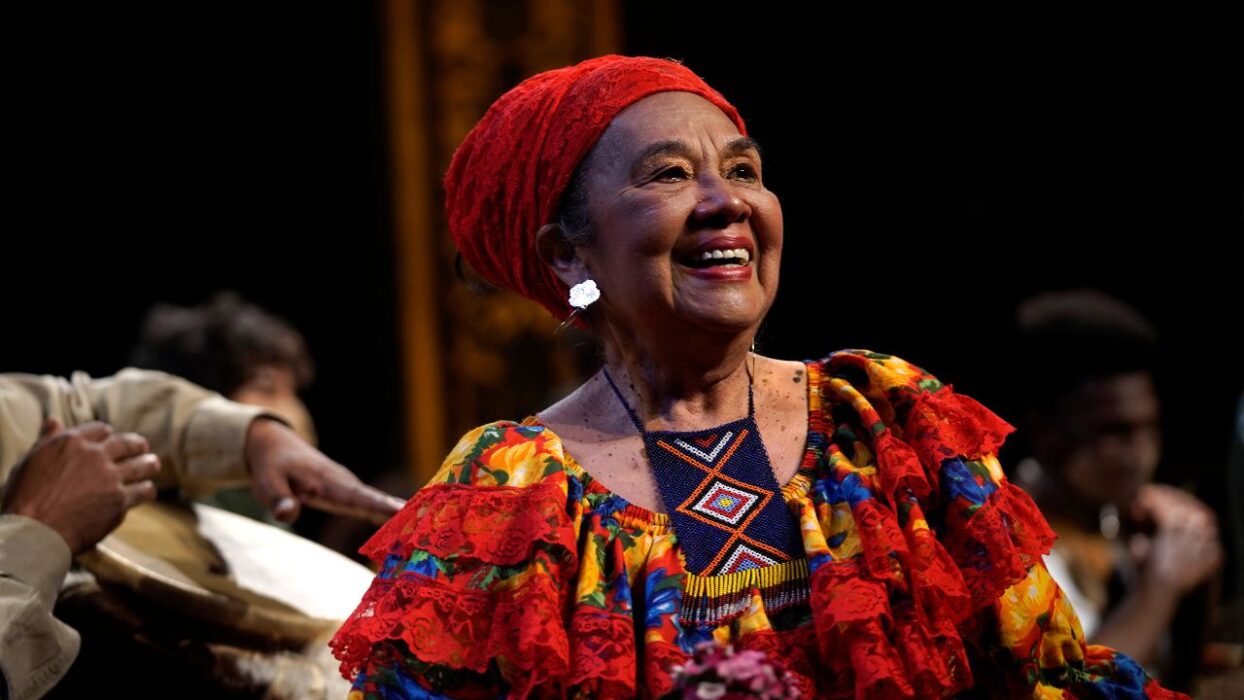
Totó La Momposina, the Voice That Carried Colombia’s Caribbean Soul to the World, Dies at 85
Totó La Momposina, the legendary Colombian singer whose voice became synonymous with the rhythms of her country’s Caribbean coast, died on May 19, 2026, in Mexico at age 85. According to Noticias Telemundo, she died of a myocardial infarction surrounded by her family. Colombia’s Ministry of Culture confirmed her death, calling her “eterna Totó”—the eternal voice who elevated and transformed the traditional music of the Caribbean.
Her real name was Sonia Bazanta Vides. For more than six decades, she moved through the world singing cumbia, bullerengue, porro, and mapalé—the ancestral rhythms of her birthplace—and became an ambassador for Colombian folklore at a time when few outside the country knew these traditions existed.
The Night She Stopped Stockholm
The most iconic moment of her early career came in 1982, when a barefoot singer from the banks of the Magdalena River commanded the attention of European royalty. Gabriel García Márquez had traveled to Stockholm to accept the Nobel Prize for Literature, accompanied by a cultural delegation of more than 200 Colombian musicians and artists. Among them was Totó.
She danced across the marble floors of Stockholm City Hall, singing cumbia and bullerengue before the Swedish Queen and assembled dignitaries. After the performance, a palace official delivered a message from the Queen of Sweden: “Never stop singing.”
“It was as if everyone from Macondo had come down the staircase of Stockholm City Hall,” The City Paper wrote in a 2016 profile.
For more than six decades, she honored that command.
How Totó La Momposina Came To Be
Totó La Momposina was born in August 1940 in Talaigua Nuevo, in the Momposina Depression region of the Bolívar Department. Her father was a shoemaker and drummer; her mother sang, danced, and played the mandola. By age six, she was already performing onstage.
It was her mother, Livia, who taught her and her siblings to play and sing Caribbean music. The family formed a musical group that quickly gained local recognition, eventually bringing their interpretations of Caribbean music to all of Colombia through national television.
As a teenager, Totó traveled from town to town absorbing rhythms born from the collision of African, Indigenous, and Spanish traditions. She studied the cantadoras—women who sang while washing clothes in the river, grinding corn, or tending cassava fields—and transformed those oral traditions into a musical language that would eventually reach audiences around the globe.
Paris and the World Stage
After her family fled violence during Colombia’s mid-century civil conflict and settled in Bogotá, her mother transformed their home into a sanctuary for Caribbean music. Musicians such as Lucho Bermúdez passed through the house, and Totó formed her own group in the 1960s, performing at neighborhood parties and on television.
In the 1980s, she moved to Paris to study at the Sorbonne University, immersing herself in music history, choreography, and stage production while singing in metro stations, restaurants, and street corners throughout the French capital. France would become a second home—and the launching pad for international recognition.Her breakthrough arrived when Peter Gabriel heard her perform and invited her to record at Real World Studios. The resulting 1993 album, La Candela Viva, according to The City Paper, introduced global audiences to songs such as “El Pescador” and cemented her place on the world music stage.
She performed at European festivals and achieved something uncommon for a Colombian folk artist: entering world music circuits alongside African, Caribbean, and Latin American figures. She reportedly appeared more than 300 times at New York’s Radio City Music Hall. Her influence stretched far beyond folk music circles. Later on, artists including Manu Chao and Timbaland sampled her work.
Totó La Momposina, The Guardian of Tradition
Throughout her career, Totó La Momposina was recognized as one of the leading guardians of the traditional rhythms of Colombia’s Caribbean region. Unlike other performers of commercial tropical music, according to Colombia One, she always defended traditional roots and the communal nature of the rhythms she performed.
Even in her seventies, she continued performing with fierce energy, appearing at events tied to Colombia’s peace process and receiving honors including the Latin Grammy Lifetime Achievement Award and France’s Order of Arts and Letters. Similarly, she received the Latin Grammy Lifetime Achievement Award in 2013 and was nominated six times for the Latin Grammy Awards.
Despite all the accolades, Totó resisted celebrity detached from tradition. “The stage is a temple,” she told The City Paper. “You must respect it. I give my heart to the audience. It is a commitment.”
In September 2022, Totó La Momposina announced her retirement due to neurocognitive complications. She retired after performing at the Festival Cordillera in Bogotá. Days later, her son Marco Vinicio told Colombian media that the singer had spent recent months in palliative care.
Tributes and Legacy
Her children—Marco Vinicio, Angelica Maria, and Euridice Salome Oyaga Bazanta—said in an Instagram post that she died surrounded by family and that “with her voice and extraordinary dedication, she carried the culture and memory of the Colombian people to the corners of the world.”
For his part, President Gustavo Petro described her as “excelsa del arte y la cultura caribeña colombiana” (supreme in Caribbean Colombian art and culture) and wrote: “Que vuele alto hasta las estrellas” (May she fly high to the stars).
Similarly, the Ministry of Culture wrote: “To the eternal master who traveled the world to the rhythm of cumbias, porros, mapalés, and bullerengues born in the heart of our land. To the eternal woman from Mompox who spoke about the traditional music of the Caribbean, strengthened it, and enriched it for decades to write an entire chapter in the cultural history of our country.”
A tribute will be held on May 27 at the Capitolio Nacional, where her remains will be brought from Mexico.