What Drives Latinos to Join the Military in the First Place?
The contradiction is hard to ignore.
At a moment when stories keep surfacing about Latino service members’ wives and relatives being detained, threatened, or treated as disposable by the very state their families serve, a deeper question returns with force: why do Latinos keep joining the U.S. military in the first place?
The easy answer could be patriotism. The lazier one is poverty. Neither is enough.
According to the Texas Observer, Latinos make up about 18 percent of the active-duty force. And the share is even higher in the Marine Corps, where Hispanics account for 24 percent of active-duty members. A 2022 Department of Defense report, the Observer noted, found that Latinos were the fastest-growing segment of the military. Team Rubicon similarly reported that Hispanics make up 16 percent of all active-duty personnel. While the Latin Times placed the total at roughly 314,000 Latinos in active duty and 1.3 million veterans.
Those numbers tell a story about recruitment, class, citizenship, family, masculinity, and belonging. They also tell a story about a country that has long asked Latinos to prove their loyalty in uniform while continuing to treat them, and often their families, as suspects outside it.
So why do Latinos join the military at all?
For many Latino families, military service arrives wearing several faces at once.
According to the Texas Observer, recruiters began aggressively targeting communities of color, including Latinos, after the draft ended in 1973. At that time, the United States shifted to an all-volunteer force. Irene Garza, a historian of U.S. militarism and Latinidad, told the Observer that the military learned from Vietnam that Latinos were “a previously ignored, historically marginalized community.”
From there, the strategy became more aggressive. Spanish-language advertising expanded. Recruiters intensified their presence in high schools with large Latino populations. Educational benefits, signing bonuses, and, for immigrants, fast-track citizenship became central selling points.
Still, reducing Latino enlistment to manipulation alone would miss something important. The Journal of Veterans Studies offers a much fuller picture. In Anita Casavantes Bradford’s study of Latinx veterans, military service emerges as “simultaneously pragmatic, personal, and patriotic.” That triad explains why enlistment cannot be read as either false consciousness or pure idealism. For many Latinos, it is both a survival strategy and an emotional outlet.
It can be a way to pay for school, leave a violent neighborhood, or gain citizenship. But it can also be a way to honor a family legacy, and assert belonging in a country that keeps questioning it.
The economics are real, and so is the pressure
One of the clearest reasons Latinos join the military is material.
According to the Texas Observer, even high-achieving students in poor communities often cannot afford college. This makes the military’s promises hard to ignore. In Laredo’s Lyndon B. Johnson High School, which the Observer described as about 99 percent Latino and about 90 percent poor, teacher Michael Carrillo said students often see the military as a path toward stability and education. “They want to be able to provide for their families,” Carrillo said. “There’s a lot of need in our area. And a lot of them take on very mature roles at such a young age where they’re taking care of all of their younger brothers and sisters. It gives them that opportunity where they see that college can be paid for.”
Therefore, for many working-class Latino students, enlistment is not a vocation per se, but a responsibility.
The Texas Observer also noted that the Army raised bonuses for recruits who ship to basic training within 45 days of signing a four-year contract. And critics quoted in the piece were clear about what this means. David Morales of Project YANO argued that recruiters “prey on young people who maybe come from the background that I did and who have limited opportunities.” He added, “It’s completely predatory to target students who are in debt and to risk their lives to help pay back some of this debt.”
Jessica Lavariega Monforti, coauthor of Proving Patriotismo: Latino Military Recruitment, Service, and Belonging in the US, told the Observer that this dynamic reflects what some call the “poverty draft.” Recruitment, she said, was strongest in schools with higher poverty rates, particularly in places like the Rio Grande Valley.
And yet even she complicates the story. “The story that we have been told is that the military is the last option for people who didn’t have other opportunities,” Lavariega Monforti said. “[But] the recruiters aren’t going after at-risk students; they are going after students who are seen as role models, who are doing well in school, who do have other options.”
For many Latinos, service also becomes a way to prove they belong
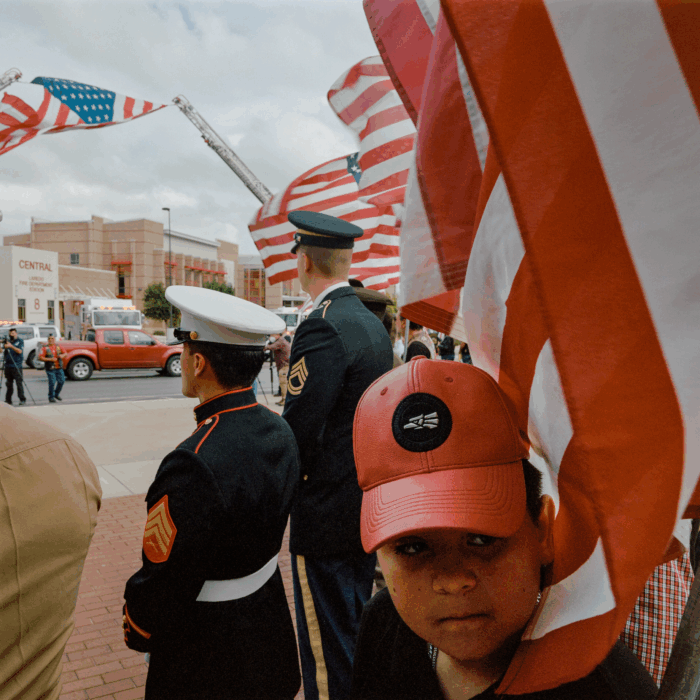
The Texas Observer quoted Garza saying, “It is through laboring in the uniform that you prove your citizenship.” That sentence cuts directly to the emotional core of Latino military service. For immigrants, the military can offer an expedited route to naturalization. For U.S.-born Latinos, especially children and grandchildren of immigrants, service often functions as proof of Americanness in a country that still treats Latinidad as foreignness.
The Journal of Veterans Studies gives this dynamic a name: “outsider patriotism.” Bradford argues that many Latino veterans live in the borderland between two dominant American myths. On one side sits the idealized veteran, usually imagined as white, straight, native-born, and male. On the other hand, the racialized Latino is cast as foreign, illegal, lazy, suspect, or not fully American.
Military service, in that framework, becomes a means of forcing recognition.
Her interviews are revealing. One veteran, Alejandro, said, “I wanted to prove my belonging here in society … I know how to name it now. But you know, we struggle with imposter syndrome always, you know, like we’re not good enough.” Another, Carlos, admitted that service helped him gain “street cred” with people who might otherwise question his belonging because of his skin color or family history. Diego, another veteran, said that when people see him, “they see me as being Brown. They won’t say, hey, this could be a vet.” Still, he insisted he would “never see myself as less of an American than those that have been here for generations and have never lifted a finger to do anything for the country.”
The path to citizenship is part of that story, too, though not in the clean way recruiters often suggest.
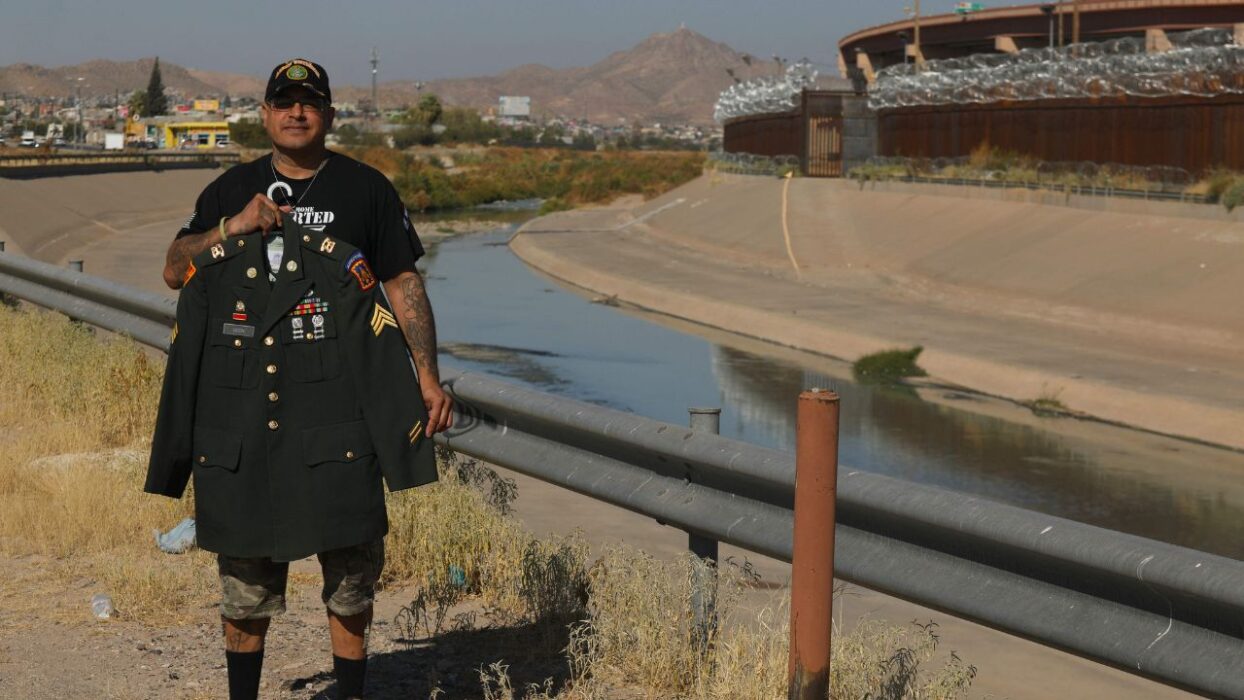
The Texas Observer reported that the Air Force and Army have reestablished or streamlined programs that allow some trainees and legal permanent residents to become citizens faster. The Journal of Veterans Studies similarly notes that between 2001 and 2013, 67,781 permanent resident and unauthorized immigrants, most of them Latinos, used military service as a route toward naturalization. At the same time, the journal also cautions that military service has never guaranteed citizenship. It also adds that structural racism and bureaucratic exclusion have left some immigrant veterans deportable or deported even after service.
Family sits at the center of this story
A lot of writing about the military in the United States still defaults to the lone hero narrative. The Latino story is usually more collective than that.
According to the Latin Times and English-to-Spanish Raleigh, family remains one of the clearest cultural reasons many Latinos join the armed forces. “The Hispanic culture prioritizes family,” The Latin Times argues. The article explains that many Latino men and women enlist because military service “directly enables them to protect and serve their families,” especially through benefits for spouses, children, and future children. English to Spanish Raleigh makes a similar point, arguing that the military’s appeal to Latinos cannot be understood without “cultural relevancy,” particularly the centrality of family in Latino life.
That is one reason stories of ICE detaining military spouses or relatives feel like a punch in the gut. They do not simply expose immigration cruelty. They rupture the family bargain that helped make enlistment feel honorable in the first place.
The Journal of Veterans Studies also reflects this family logic. In Bradford’s interviews, many participants said they joined to uphold a family legacy of service, honor parents or grandparents, or become providers. Others described service as a path toward “belonging” within something larger than themselves. Eduardo, a mixed Mexican, Native, and Euro-American veteran, described joining the Marine Corps as part of a search for “a place where I would be accepted, regardless of my skin or background.” Another participant, Mateo, even argued that undocumented immigrants who risk death to come to the United States show a kind of patriotism themselves.
There is also a long Latino military tradition, and it is older than people think
Latino enlistment is not new. It is woven into the military history of the United States itself.
Latino soldiers fought in the Revolutionary War nearly 250 years ago, and Latino Americans have served in every major U.S. conflict since. The organization points to the Rough Riders during the Spanish-American War, the mostly Puerto Rican 65th Infantry Regiment, later known as the Borinqueneers, and the Arizona Bushmasters of World War II, whose troops included Mexican Americans and Native Americans from 20 different tribes. Team Rubicon also notes that between 400,000 and 500,000 Hispanic Americans served in World War II, and that 13 Medals of Honor went to Hispanic soldiers during that war.
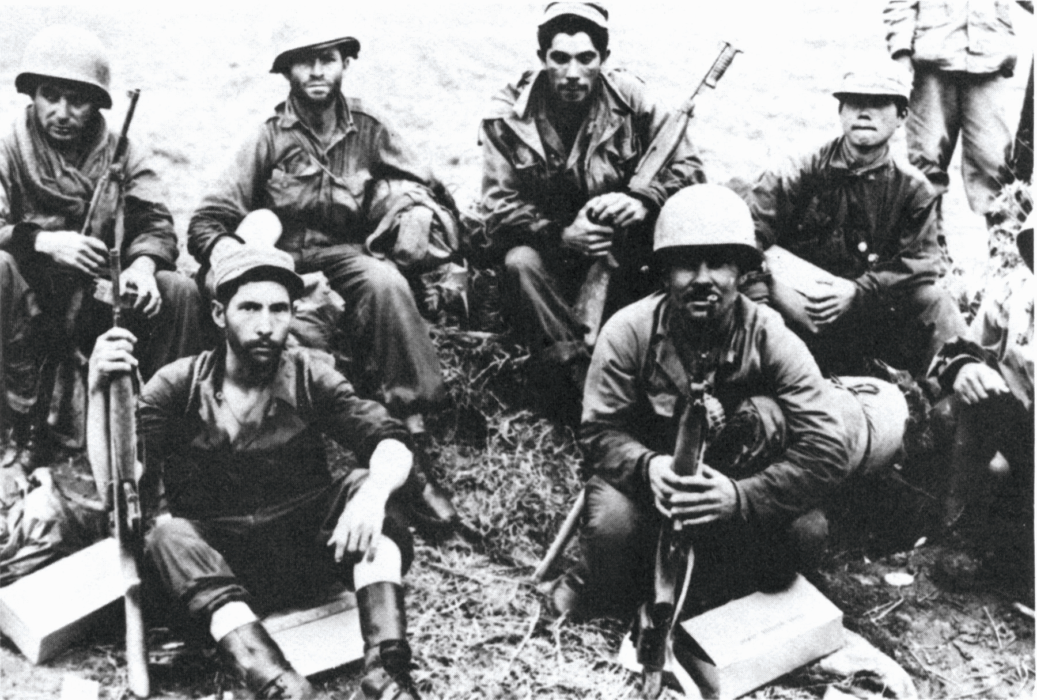
This way, Latino military service is “interwoven into American heritage.” In fact, the Department of Defense estimated that over 9,000 Hispanics fought in the Civil War, more than 4,000 served during World War I, and more than 500,000 served during World War II.
The Journal of Veterans Studies underscores this point too. Bradford writes that U.S. and foreign-born Hispanic and Latinx people have served “freely and coerced, as volunteers and as conscripts, for more than two centuries.” Some have resisted military service, especially Chicano anti-war activists in the Vietnam era. Others have embraced it as a route toward rights, recognition, and civil belonging.
Still, the military does not offer the same thing to everyone
The Texas Observer is clear that the institution many Latinos join for discipline, family support, education, and belonging can also expose them to sexism, harassment, exploitation, and death. Ana Yeli Ruiz, a former Marine and member of Project YANO, described the culture she experienced in the military: “It’s pretty common to be verbally or sexually harassed, kind of like it was almost the norm.” She added, “They pretty much told me that it was my fault and kind of just gaslit me. That culture of toxic sexual culture and harassment was just normalized, and nobody batted an eye.”
The Observer also notes Department of Defense data showing a 13 percent increase in sexual assaults in the military from fiscal year 2020 to 2021.
Then there is the cost after service. The Latin Times cited a Veterans Affairs report showing a 41 percent increase in suicide risk among Hispanics. The Texas Observer points to the Brown University Cost of War Project, which estimates that around 7,000 American service members died in the post-9/11 wars, with another 30,000 veterans and service members later dying by suicide.
So why do Latinos keep joining?
Because the reasons are real, even when the bargain is cruel.
Some join for college, others for healthcare, housing, steady pay, or trade training. Some join because recruiters know exactly where to find ambition under pressure. And others because a grandfather served, or because a parent crossed a border and taught them to be grateful, or because the uniform feels like a route toward recognition in a country that keeps treating them like guests.
One thing is clear: Latinos do not join only because they are poor, and they do not join only because they love the flag. They join where economics, family obligation, aspiration, masculinity, citizenship, and belief all meet.