Latino Listeners Helped Build the Podcast Boom. So Why Don’t We Own More of It?
When people talk about the podcast boom, they usually talk as if the growth just appeared out of nowhere. A medium gets hot, a host becomes an influencer, advertisers rush in, and suddenly everyone acts like they discovered the future. But that version leaves something crucial out: who helped build the audience in the first place.
According to Axios, Black and Latino listeners are “among the fastest-growing groups in podcasting,” helping push podcasts past talk radio in share of spoken-word listening. And yet, the people driving that growth still do not control enough of the infrastructure that turns attention into long-term power.
Podcasts are growing fast because Black and Latino audiences showed up
Axios reported that Black and Latino listeners have been “some of the biggest drivers behind podcast consumption growth,” citing Gabriel Soto of Edison Research. Soto also told Axios that Latino audiences tend to over-index on podcast listening in part because the population skews younger. Similarly, Black audiences report spending “about an hour more per day with audio than the rest of the U.S. population.”
The numbers on the Latino side are especially hard to ignore. According to Edison Research‘s Latino Podcast Listener Report 2024, 43% of U.S. Latinos age 18 and older are monthly podcast listeners, up 72% from 25% in 2020. The same report found that women now make up half of Latino podcast listeners, a notable shift in a space that had previously skewed more male.
That growth is also changing how podcasts get consumed. Edison found that 86% of Latino podcast listeners listen to monthly podcasts, while 72% still consume audio-only podcasts. YouTube has become the top platform for Latino podcast listening at 40%, up from 28% in 2020. Social media now matters much more in discovery, too. The report found that 47% of Latino podcast listeners first discovered podcasts through social platforms, up from 30% in 2020.
That tells you two things at once: first, Latino audiences are not trailing the medium. They are helping define where it goes next. Second, the future of podcasts looks a lot more bilingual, visual, and platform-flexible than the old audio gatekeepers might prefer.
The podcast economy is booming, but the power still sits elsewhere
Here’s the dark side of that moon. Because even as Black and Latino audiences help drive listening, distribution, and monetization remain concentrated in the hands of a few giant platforms. Axios points to Apple Podcasts, Spotify, and YouTube as the dominant players. Even major podcast networks still rely on those platforms to reach audiences and make money.
So yes, the medium looks more mainstream than ever. But mainstreaming does not automatically mean equity. It can just mean a bigger machine with the same power imbalance that we see in other industries like film or TV.
Juleyka Lantigua, founder of LWC Studios, told Axios: “Ownership is destiny. The only way to secure a long-term future for an idea is to own the means of production and distribution.” In other words, visibility and ownership are not the same thing. You can generate enormous cultural value and still capture only a fraction of the wealth that value creates.
And Lantigua is not speaking from theory alone. Edison’s Latino podcast research has repeatedly involved LWC Studios as a sponsor and partner, which also makes Lantigua’s place in the industry notable. She is one of the few Latina owners operating at the production-company level in a business where too many creators still depend on infrastructure they do not control.
For Latino podcasts, culture is part of the growth
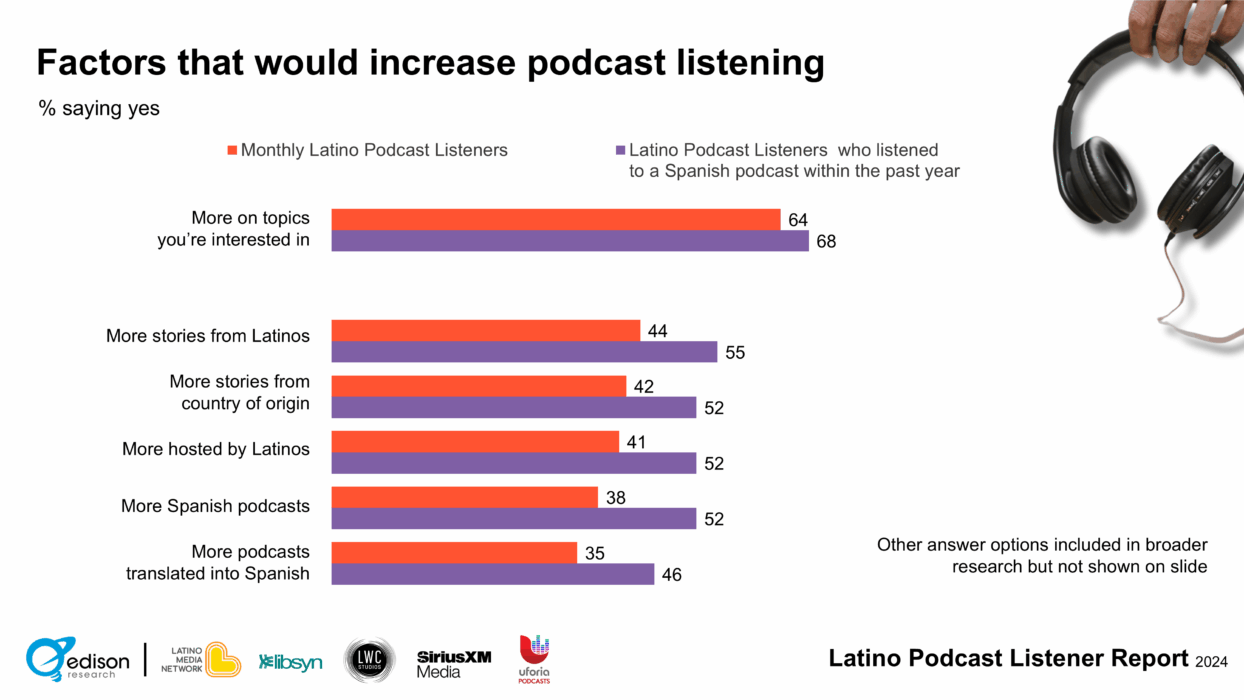
That ownership question gets sharper when you look at what Latino listeners are actually asking for. Edison Research reported in September 2025 that among Latinos who listened to a Spanish-language podcast in the past year, 55% said more stories from Latinos would increase their listening. Fifty-two percent said more stories from their country of origin, more podcasts hosted by Latinos, and more Spanish podcasts would also increase their listening. Another 46% said more podcasts translated into Spanish could boost their listening time.
Put differently, Latino podcast growth is not just about demographics. It is also about a cultural appetite that has not been fully met.
The broader Edison report makes that clear, too. Sixty-four percent of Latino monthly podcast listeners said having more podcasts about topics they are interested in would increase their listening. And among Spanish-language listeners, culturally connected factors play an even bigger role.
That is a major clue about where the market still falls short. Latino audiences are already here; they are already listening. The next logical step should be to give them stories, hosts, languages, and points of view that actually reflect how they live.
Ownership is the fight inside podcasts now
That is why Black and Latino founders building their own networks matter so much. Axios points to Charlamagne Tha God, who founded the Black Effect Podcast Network in 2020 to create what he called the “BET of podcasting,” a long-term home for Black-owned shows. The network has since grown into a major presence, with its annual Black Effect Podcast Festival serving as both a visibility engine and a statement about who should control Black audio storytelling.
Axios also highlights Washington-based entrepreneur Angel Livas, who launched Alive Podcast Network in 2022 with two shows and now hosts more than 100 podcasts across platforms, including Apple TV, Roku, Fire TV, and Samsung TV. The network uses a subscription model where half of the $4.99 monthly fee goes to a creator selected by the listener, and Livas is opening Alive Studios as a production hub in downtown Washington.
Livas told Axios, “We’ve spent years helping creators build their shows. Now the focus is making sure they have a platform where they can actually own what they create.” Then she added, “The future of podcasting isn’t just distribution. It’s ownership.”