Here’s Everything About Coachella’s History You Didn’t Know (But Probably Should)
When people say “Coachella,” they usually mean the festival. The outfits, the brand activations, the annual discourse about whether it is still about music or just content with a wristband.
But the history of Coachella is more interesting and revealing than that flattened internet version suggests.
This festival did not begin as a luxury rite of passage for influencers. It began, in part, because Pearl Jam was fighting Ticketmaster. It almost collapsed financially in its first year. Its name began as a typo, and its identity was built in a desert valley where tourism and agriculture sit side by side. Where wealth and labor are pressed up against each other, often uneasily. And over time, it turned from an anti-Woodstock experiment into one of the most profitable and culturally powerful festivals on earth.
So if Coachella now feels like a giant machine, that is because it is. But it is also a machine with a history, and that history says a lot about how culture gets made, monetized, mythologized, and remembered.
Coachella exists because Pearl Jam tried to get away from Ticketmaster
This is probably the most important origin story people still do not know.
According to Coachella’s documented history, the festival’s roots date back to November 5, 1993, when Pearl Jam performed at the Empire Polo Club in Indio amid a dispute with Ticketmaster over service fees. The band refused to play at Ticketmaster-controlled venues, and that show proved the Polo Grounds could handle a massive crowd. Paul Tollett, who booked the site through Goldenvoice, later said that the concert planted the seed for what Coachella would become. In fact, without that Pearl Jam boycott, there may not have been a Coachella as we know it.
Funny, isn’t it? How the most commercialized festival in America was born out of a fight against one of the most resented power brokers in live music?
The name itself was a mistake, and the festival is not even in Coachella
The second weird fact is linguistic.
NPR reported last year that “Coachella” itself was effectively born from a typo. Early developers had reportedly intended to call the town “Conchilla,” but a printing error changed it to “Coachella,” and the name stuck. Over time, the valley adopted it too. The festival later borrowed that regional identity, even though it is not actually held in the city of Coachella. It is held in Indio, at the Empire Polo Club, inside the broader Coachella Valley.
As NPR noted, the valley’s economy is not just celebrity rentals and music tourism. It is also agriculture, especially dates and other produce, and a large farmworker population, much of it immigrant. That means the image of Coachella as a glittering cultural playground has always sat atop a place with a much harder labor history, including the 1965 Coachella Valley grape strike that helped define the farmworker movement.
Put differently, the festival’s name has always floated above a real region with real workers, real poverty, and real class contradictions.
The first Coachella was a financial mess, and it almost died immediately
Now for the part that feels impossible if you only know Coachella as a giant cash cannon.
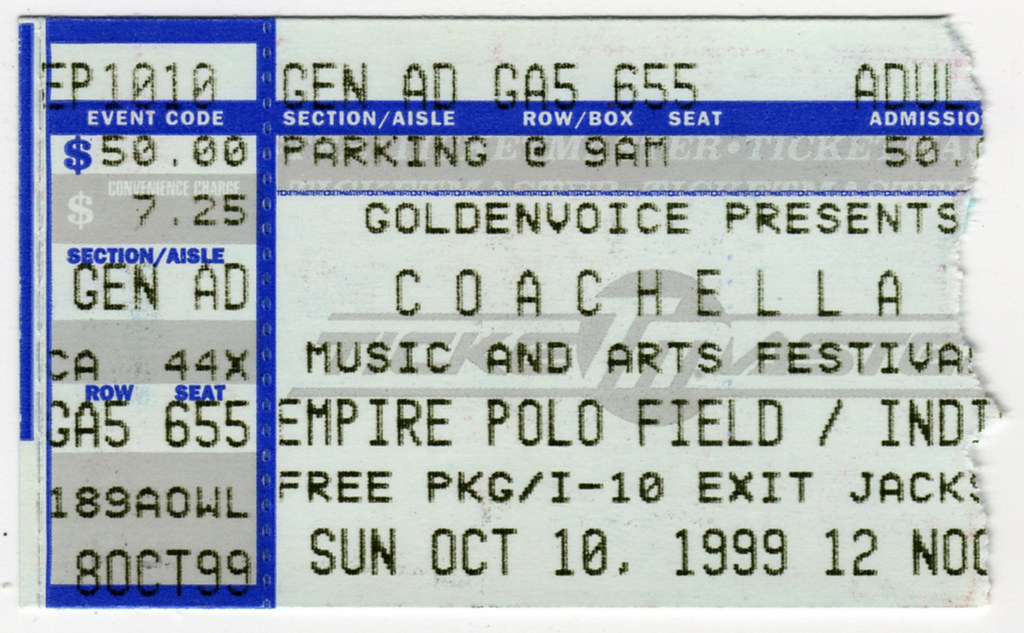
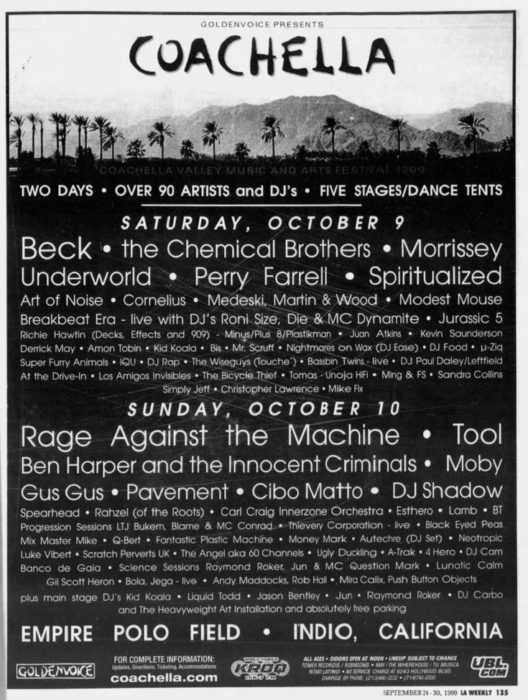
The first festival, held on October 9 and 10, 1999, drew respected headliners such as Beck, Tool, and Rage Against the Machine, along with acts including Morrissey, Underworld, and Jurassic 5. Tickets cost $50 a day. It was critically admired, and Pollstar named it the festival of the year. But financially, it was a bloodbath. Goldenvoice lost roughly $850,000, and the company had to fight to survive. Tollett later called the decision to announce and stage the festival just two months after Woodstock ’99 “financial suicide.”
That collapse was partly about timing. Coachella arrived right after Woodstock ’99, whose violence, looting, arson, and sexual assaults had made the very idea of a new American festival feel risky and suspect. In fact, it was a moment when the world knew the idea of music festivals as a celebration of love and peace was officially dead. After 1999, insurance costs rose, advance ticket sales dropped, and Goldenvoice had already been struggling financially against bigger promoters. Coachella was supposed to feel like the opposite of Woodstock: safer, cleaner, more art-forward, more European in spirit. The promoters advertised free water fountains, ample bathrooms, and misting tents. They were trying to build a “high-comfort festival experience” before that language became marketing boilerplate.
The festival skipped 2000, returned in 2001 as a single-day event, then slowly rebuilt.
Coachella became iconic because it booked artists before they became inevitable
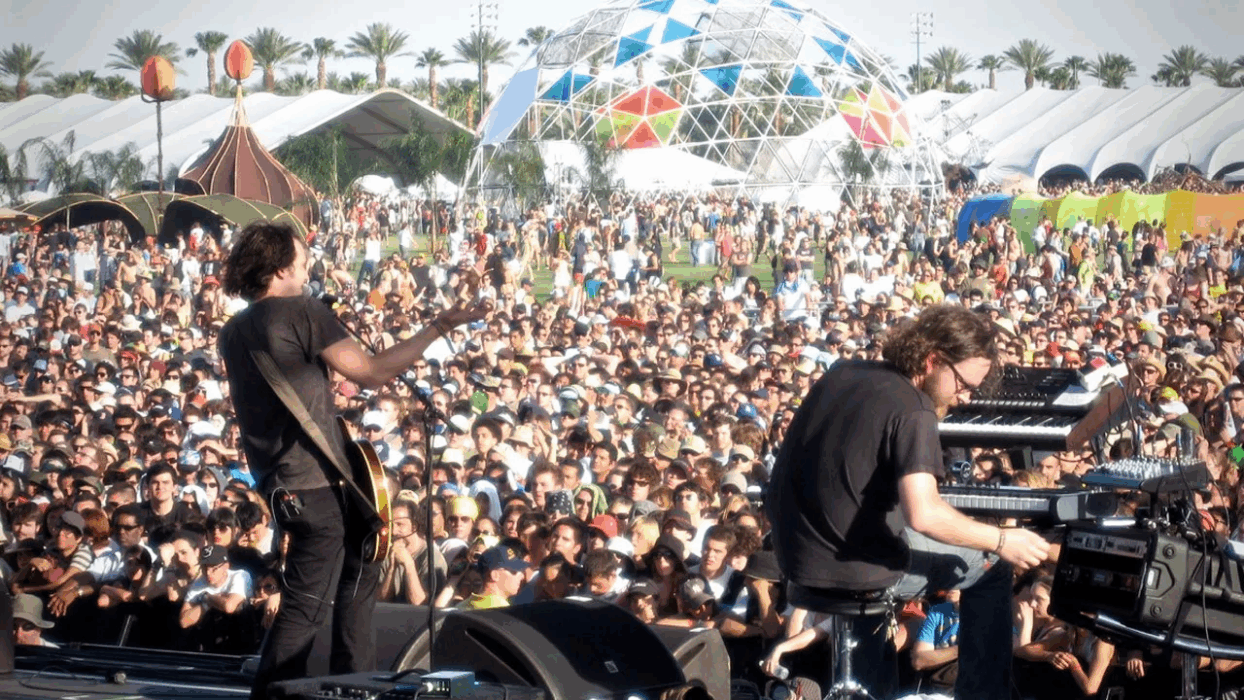
One reason Coachella mattered so much in the 2000s is that it was not built around obvious chart logic. Tollett’s original instinct was to combine “trendy artists who were not necessarily chart successes” and turn the curation itself into the magnet. That is a huge part of why the festival developed so much credibility with musicians and fans.
The 2004 edition is often described as the true turning point. It was the first sellout, drew 110,000 people across two days, and featured Radiohead, the Cure, and a reunited Pixies. The Los Angeles Times later called that year defining, and Tollett himself credited booking Radiohead with elevating the festival’s stature among artists and audiences.
Then came the run of now-mythologized moments. Daft Punk’s 2006 pyramid set became one of the most cited performances in Coachella history. Björk became the first female headliner in 2007. Madonna performed at the dance tent during that era and caused a frenzy. Prince headlined in 2008. Jay-Z, Paul McCartney, and Kanye West all followed. Beyoncé’s 2018 headlining set became a landmark not just for the festival, but for American live performance more broadly. She was the first Black woman to headline Coachella, and Billboard, the Grammys, and the New York Times all treated the show as historic.
Then it got bigger, more expensive, and much more than music
Of course, the more culturally central Coachella became, the less it could remain the scrappy tastemaker people wanted it to be.
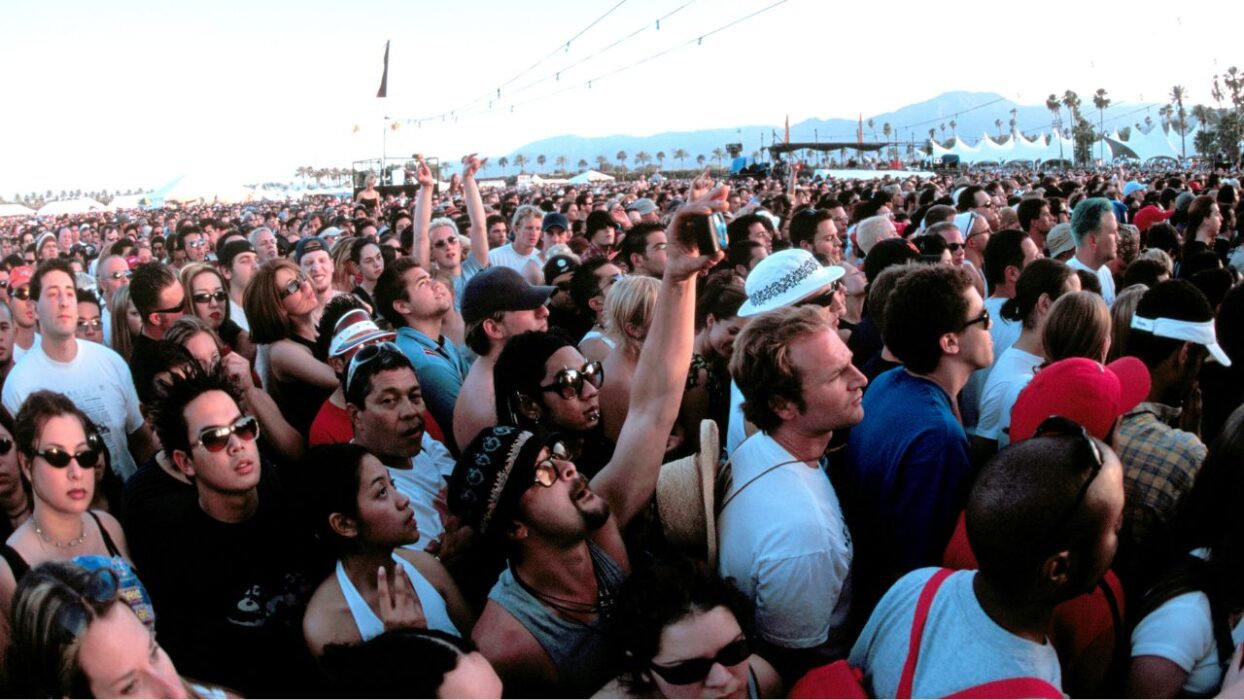
The festival expanded from one weekend to two in 2012. Attendance and revenue exploded. By 2017, Coachella drew around 250,000 attendees and became the first recurring festival to gross more than $100 million in a single year. Ticket prices that once sat at $50 a day now live in a totally different universe. The event also evolved into an ecosystem of sponsorships, livestreams, branded experiences, camping culture, fashion theater, and social media symbolism. NPR described it as one of the most popular and profitable festivals in the world.
And yes, this is where some people feel the soul slipped.
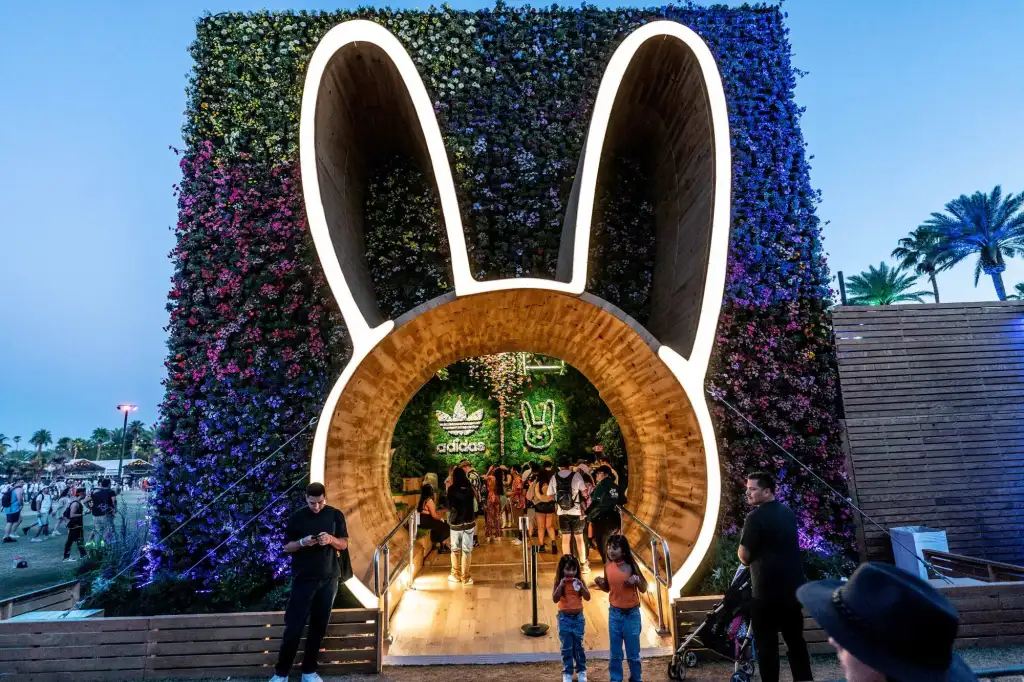
The festival that once resisted sponsorships now works with a dense network of corporate partners. What began as a music-first gamble now includes Heineken House, branded domes, fashion collaborations, livestream integrations, VR experiences, and a whole influencer-facing infrastructure. You can call it the most evident irony inside the music industry.
That does not mean the music stopped being good, though. It means Coachella turned into something broader and more industrial: a place where music, marketing, celebrity, and algorithmic visibility all meet.
Behind the mystique, Coachella runs on ruthless business rules
This part of the festival’s history is less glamorous, but maybe more important.
According to The New Yorker, Tollett starts booking artists as early as the previous August, and lineup placement is so consequential that talent agents fight over font size because a higher line on the poster can raise an artist’s future asking price. Tollett himself said that one-point differences have caused real battles. The same profile reported that 2017 headliners were earning roughly $3 million to $4 million each, while lower-line acts could be paid under $10,000. Billboard has also reported that many non-headline acts fall somewhere between $500 and $100,000.
Then there is the radius clause.
A lawsuit filed by Soul’D Out Productions revealed how aggressive Coachella’s booking restrictions could be. Artists playing Coachella were barred from playing other North American festivals in a set window, restricted from announcing certain regional shows before the lineup reveal, and prevented from publicizing performances in several Western states until after Coachella’s announcement. NPR reported the clause was accused of “sucking the oxygen” out of the wider festival world.
So yes, Coachella is a dream factory, but it is also a power center. And one reason it stays powerful is that it controls timing, exclusivity, visibility, and price with a level of precision that smaller festivals simply cannot match. After all, they learned through experience.
Coachella has also had real, human problems
Any honest history of the festival has to make room for this, too.
In 2018, Teen Vogue published a report describing “rampant” sexual harassment and assault at Coachella, including the author’s own account of being groped 22 times in 10 hours. In response, Coachella launched its “Every One” initiative in 2019, aimed at preventing and responding to sexual misconduct and other harmful behavior on the grounds. The Los Angeles Times and the Grammys both covered the rollout.
Coachella’s brand has long depended on fantasy, beauty, freedom, and self-expression. But like many huge events, it has also had to reckon with the fact that scale and intoxication can create space for harm, and that “festival culture” has often failed women and marginalized attendees in deeply predictable ways, especially when it grew from the ashes of previous disasters like Woodstock ’99.
Coachella became so culturally central that Hollywood started filming inside it
At a certain point, Coachella stopped being just a setting and became shorthand.
Lady Gaga and Bradley Cooper filmed scenes for A Star Is Born on the festival grounds in 2017. The 2024 film The Idea of You also used Coachella as part of its romantic and cultural scaffolding. Even beyond film, YouTube’s giant streaming deal and the expansion of all-stage livestreaming turned Coachella into a media product with a parallel virtual audience.
That is a big part of why the word now functions the way it does, and how the experience of live music has changed so much since the early years of mud, sweat, love, and folk protest songs. “Coachella” no longer just names a festival. It names a visual language deeply ingrained in American culture. Coachella thus became a season and an odd kind of aspiration—a temporary city of music, heat, money, dust, and performance.
Latino history at Coachella did not begin with Bad Bunny, even if that was the watershed moment
Now for the part that matters most to our community.
The easiest version of this history starts in 2023 with Bad Bunny, because that was the landmark headline. He became the first Latin American artist and the first Spanish-language solo artist to headline Coachella, a major shift in what the top of the poster could look and sound like. NBC and other outlets treated it as a breakthrough moment, and rightly so.
But Latino history at Coachella starts much earlier.
At the inaugural 1999 festival, Zack de la Rocha was already there as the frontman of Rage Against the Machine, one of the headliners of the first-ever Coachella. HOLA! rightly framed that as a pivotal moment for Latino representation, even if the festival world at the time did not yet know how to talk about Latinidad outside rigid genre boxes.
Over time, that representation widened. Julieta Venegas, Calle 13, Café Tacvba, J Balvin, Becky G, Anitta, Los Ángeles Azules, and others all helped expand what Latin music could look like on those stages. In 2019, Los Tucanes de Tijuana became the first norteño and regional Mexican group to play Coachella, while J Balvin became the festival’s first reggaetón act. Those dates pushed Latin presence beyond token inclusion and into genre disruption.
In the end, and as is often the case with our community, Latino representation at Coachella has never been only about showing up. It has been about forcing the festival to admit that Latin music is not a niche side stage category. It is rock, cumbia, reggaetón, norteño, indie pop, political rage, stadium ambition, and global pop power.
By the time Bad Bunny headlined, the door had already been kicked open by years of artists proving that the old categories were too small.