Gallo Pinto Is Arroz y Frijoles, But With a Backstory That Hits
Everyone likes rice. We all like beans. And we definitely all love rice and beans. That’s why it’s so prevalent in the cuisine of every region of Latin America, in one form or another.
However, few versions are as culturally rich as Costa Rican Gallo Pinto.
Read on to learn about its history and how to make it at home.
Where Gallo Pinto Really Comes From
Gallo Pinto sits at the intersection of three worlds. Indigenous America, Europe, and Africa.
According to historical records, the beans came first. Indigenous communities across Central America had cultivated and eaten beans for thousands of years. Rice arrived later, introduced to Spain by Arab traders and brought to the Americas by Spanish colonizers during the 15th and 16th centuries.
The technique of cooking rice and beans together, however, traces back to Africa. African communities had the knowledge of combining grains and legumes into sustaining meals long before colonization. When enslaved Africans were brought to the Americas, they carried that knowledge with them.
According to food historians, enslaved Africans were often fed rice and beans during forced transatlantic voyages and early settlement. Over time, those ingredients merged with local crops and regional flavors, forming dishes that are still enjoyed across the Americas today.
Why Gallo Pinto Became a Staple Across the Americas
Rice and beans show up everywhere for a reason. They last. They stretch. And they feed people through instability.
According to culinary historians, similar dishes emerged across Latin America and the Caribbean under different names. Cuba has moros y cristianos and congrí. El Salvador and Honduras have casamiento. Brazil has feijoada. Peru has tacu tacu. The southern United States has Hoppin’ John.
In Costa Rica and Nicaragua, that combination settled into Gallo Pinto. Similarly, in Ghana and parts of West Africa, rice and beans remain a traditional breakfast. In Senegal, a similar preparation is known as thiebou niebe.
Different names. Same logic: Feed people with what you have.
So, Why Is It Called Gallo Pinto?
The name itself carries more myth than documentation.
According to linguistic research, the most common explanation is based on appearance. White rice mixed with black or red beans resembles the speckled feathers of a painted rooster. Gallo pinto literally translates to spotted rooster.
There are also anecdotal stories in Costa Rican oral history about festival meals in which rice and beans replaced scarce meat, leading people to joke that they had eaten Gallo Pinto even when no rooster was served.
No single theory has been definitively proven. What matters is that the name stuck. And once it did, it became inseparable from identity.
Gallo Pinto varies in Costa Rica Depending on Where You Are
Gallo Pinto shifts depending on geography, climate, and culture.
According to regional culinary documentation from Costa Rica’s Ministry of Culture, the Central Valley version tends to be moist and lightly seasoned with onion, sweet pepper, cilantro, and often Salsa Lizano. That sauce has become closely tied to Costa Rican Gallo Pinto and appears in many family recipes.
In Guanacaste, the preparation changes. Cooks use more fat, often pork lard, and toast the rice more deeply. Garlic replaces cilantro. This version reflects early Spanish and African influence through the Nicoya region, where rice cultivation expanded in the 18th century.
On the Caribbean coast, especially in Limón, Gallo Pinto becomes rice and beans cooked with coconut milk and chile. According to historical records, this version arrived with Afro-Caribbean immigrants from Jamaica and other islands during the construction of the Atlantic railroad in the late 19th century. The dish connects directly to Jamaican rice-and-peas traditions.
Nicaragua’s Gallo Pinto Tells a Parallel Story
In Nicaragua, Gallo Pinto uses red beans, often called frijoles rojos or seda beans, which are known for their high iron content. According to Nicaraguan culinary historians, the beans give the dish its deeper color and stronger flavor.
The preparation usually includes white long-grain rice and sautéed onions cooked in vegetable oil. Like Costa Rica, Nicaragua considers Gallo Pinto a national dish and eats it at any time of day.
On Nicaragua’s Caribbean coast, the dish again transforms into rice and beans cooked with coconut milk, mirroring Afro-Caribbean traditions across the region.
Gallo Pinto Turned Into the Casado
Eventually, Gallo Pinto stopped standing alone.
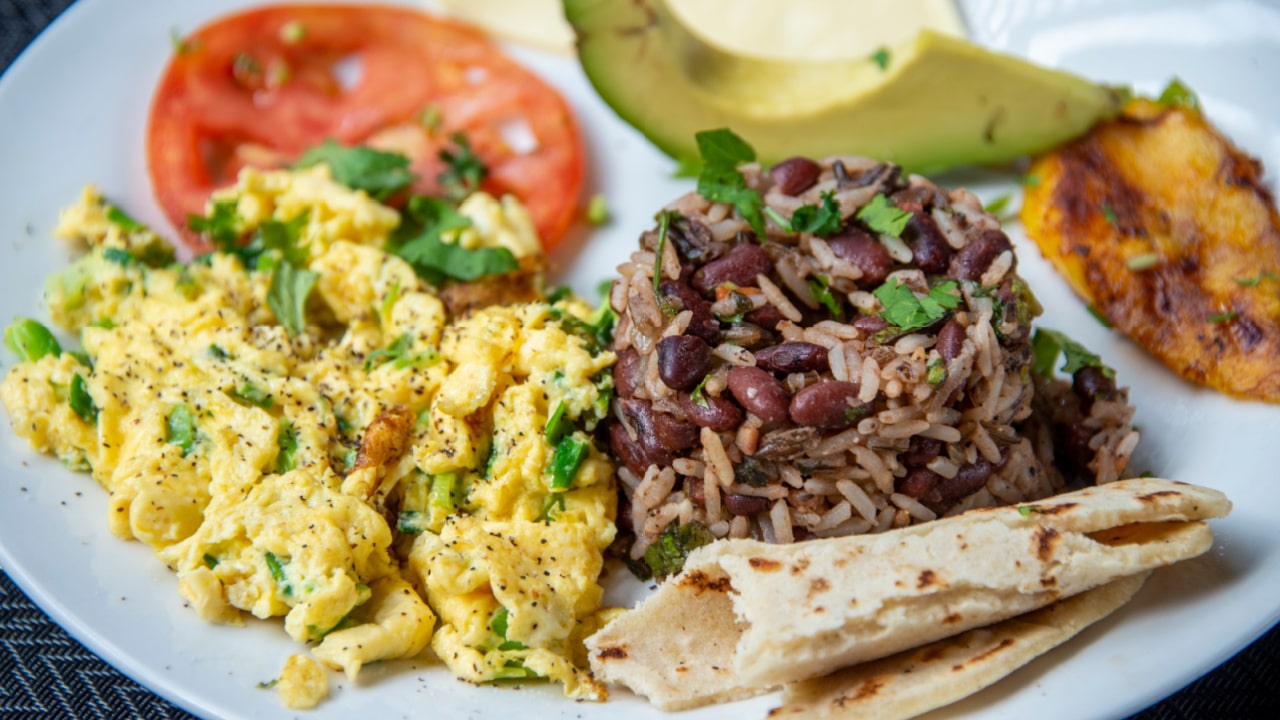
According to Costa Rican food historians, the casado emerged in mid-20th-century urban sodas and worker cafés. It paired rice and beans with protein, plantains, salad, and sides to create a full plate that felt like home.
There are several theories about the origin of the name casado. Some say the ingredients are married on the plate. Others say the meal resembled what married men expected at home. Regardless of origin, the casado became one of Costa Rica’s most recognizable meals, with Gallo Pinto at its center.
How to Make Gallo Pinto at Home
Ingredients
- 3 cups cooked white rice preferably day old
- 3 to 4 cups cooked black beans
- 1 onion finely chopped
- 1 sweet pepper finely chopped
- ¾ cup chopped cilantro
- 3 tbsps Salsa Lizano
- 1 tbsp olive oil
Instructions
- Heat the oil in a large skillet over medium heat.
- Sauté the onion and sweet pepper until softened.
- Add the beans and Salsa Lizano. Stir until heated through.
- Fold in the rice and cook for about five minutes, stirring gently until evenly mixed.
- Remove from heat and add cilantro.
- Serve with eggs, ripe plantains, tortillas, or avocado.