Pupusas, A Hair Stylist in Pico Rivera, and More Good News That Kept Us Sane This Week
The economy is crushing people, ICE raids are terrorizing communities, democracy feels fragile, and some days it’s hard to remember that people are still showing up for each other, still building something better, still finding ways to care. That’s why every Friday we share stories that move and inspire us.
These are the ones that don’t make the headlines but absolutely should.
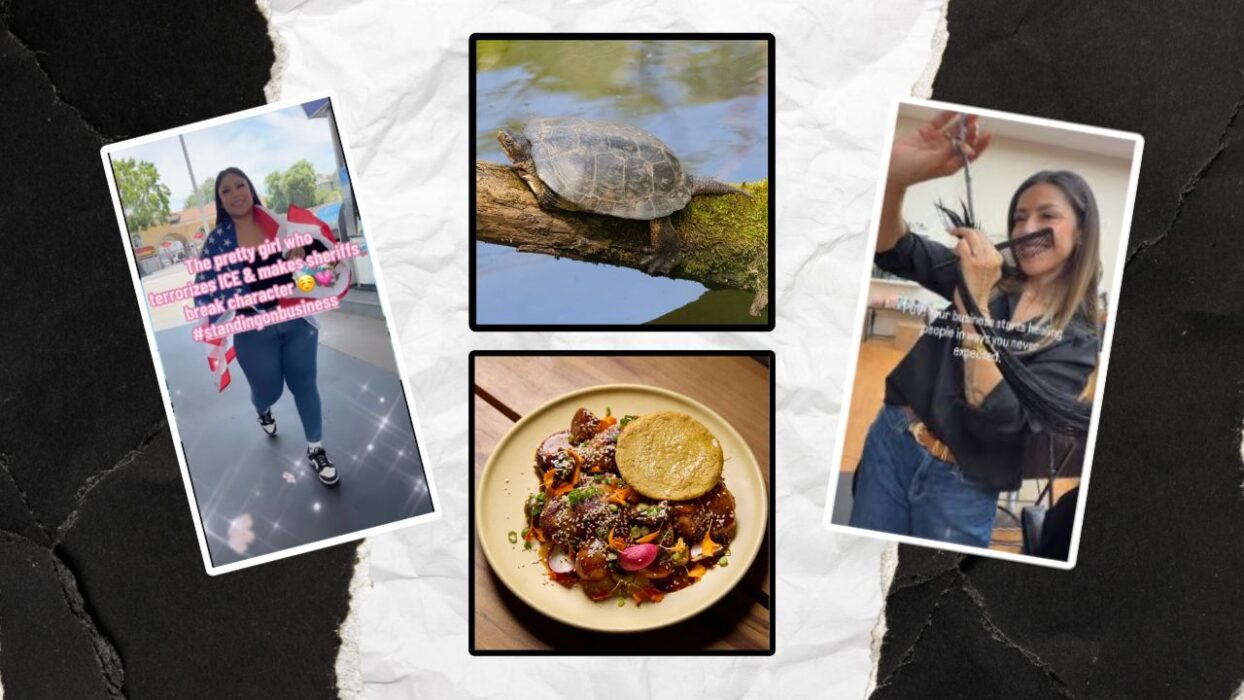
A Hair Stylist in Pico Rivera Is Bringing Back Bartering—and It’s Changing Her Community
Kristal Mendoza owns a salon in Pico Rivera, and one day she decided to try something radical. She posted on Instagram: “If getting your hair done is not in your budget, here is what I’m taking as a form of payment.” According to CBS LA, she wasn’t sure what would happen. She was overwhelmed by the response.
People started showing up offering to trade their skills. Cleaning. Laundry. Cooking. Car washing. Electrical work. Personal training. Mendoza realized something that the economy tries to hide from us: there are people everywhere who want to look and feel good, who want to take care of themselves, but can’t afford it. Especially single mothers. Some had never stepped foot in a salon because their budget simply didn’t allow it.
“When I posted it, I couldn’t believe the amount of love and people who reacted positively,” Mendoza said. What started as a post became a movement. She’s planning to do 5 barterings a month and encouraging other business owners to trade their skills with people in their communities.
Court Protects Black Voters in Alabama After Years of Fighting
Two weeks ago, Alabama tried to return to a congressional map that a federal court had already ruled was intentionally discriminatory against Black voters. The state lost. According to the ACLU Alabama, a three-judge district court blocked Alabama from using that map and reinstated a court-drawn map with two Black opportunity districts.
This is the third time a court has had to tell Alabama no. In 2021, voting rights groups challenged a congressional map that diluted Black political power. The Supreme Court struck it down. In 2023, Alabama drew another map. The court found that the legislature had intentionally set racial targets, deliberately violated the previous Supreme Court ruling, and even sought to protect a white community based on its “French and Spanish colonial heritage” at the expense of the large Black community in Alabama’s Black Belt. The court struck down that map, too.
This month, the Supreme Court sent the case back to the district court. Alabama saw an opening and tried again. The district court said no again. The Milligan plaintiffs—Evan Milligan, Khadidah Stone, Letetia Jackson, Shalela Dowdy, Greater Birmingham Ministries, and the Alabama State Conference of the NAACP—have been fighting for fair representation for years. They won. For now, Alabama’s 2026 elections will use a fair map. The court has ordered the case ready for retrial no later than January 2027, but voters can breathe. This fall, they’ll vote under a map that actually counts their voices.
A California Latina Mom Is Turning the Tables on ICE
Angelica Vargas lives in Downey, California, and she’s become something unexpected: the person ICE agents dread seeing in their rearview mirror. According to The Nation, Vargas is a mental health professional, a mother of two student athletes, and a self-described soccer mom who drives a fast Mercedes. She’s also become famous on TikTok for something else entirely: chasing ICE vehicles down the street.
It started in June when her mother called in a panic. Vargas’s sister, a US citizen, was trapped at an ICE raid at a Home Depot. There was tear gas, chaos, and fear. Vargas drove to the scene, pushed through the barriers, and convinced the federal agents to let her sister leave. She was one of the only people allowed out. “I’d seen what I could do,” Vargas said. “I really made me see how privileged I am to be a US citizen.”
So she decided to use that privilege. She started tracking ICE raids in her community, and when she spotted them, she’d follow. Her TikTok videos—set to jaunty Mexican music and posted in time-lapse—show ICE vehicles weaving lanes, making illegal U-turns, trying desperately to escape. The comments poured in from her hundreds of thousands of followers. “ICE works hard, but Angie works harder,” one wrote. “Do you think they sit around campfires and tell horror stories about you?” asked another.
But the real impact is deeper. Older people reached out to tell her that her videos brightened their days. A girl told Vargas that her undocumented father, before he passed away, loved her page. In a climate of terror—where ICE raids have skyrocketed, and immigrant communities are afraid to leave their homes, afraid to go to work, afraid to exist—Vargas’s decision to turn the fear around offers something people desperately need: hope. And proof that someone is fighting back.
Thirty Years of Volunteers Have Kept This Oakland Creek Alive
In Oakland, there’s a 3-mile creek called Sausal Creek that most people probably don’t think about. But thirty years ago, Michael Thilgen and his neighbors decided it was worth saving. According to Good News Network, they formed the Friends of Sausal Creek nonprofit and committed to restoring the waterway from the Oakland Hills to the San Francisco Bay.
Three decades later, it’s working. The creek now hosts one of the only wild populations of rainbow trout in California’s urban areas. It’s home to a delicate population of pallid manzanita, a federally endangered shrub that shouldn’t exist in the middle of a city but does. Every week, volunteers de-weed trails, clear invasive vegetation, plant native species, and monitor the health of the water and wildlife. “Is the water clear? Does it look like something’s been dumped?” volunteer and board member Kristy Brady told CBS News. “We monitor fish quality and so forth, making sure it stays healthy so everyone can enjoy it.”
The organization runs a native plant nursery and organizes seed-collecting hikes to ensure they can keep planting for decades to come. They’ve introduced tens of thousands of native plants back into the creek and its surrounding areas. At Fern Ravine, where a second-growth coastal redwood forest meets Oakland’s backyard, they’ve been undoing decades of damage since 2010. Trail erosion had destroyed the ground cover. Invasive species had taken over. Through relentless weeding and planting, “extraordinary progress” has been achieved.
Salvadoran Pupusas Just Got the Ultimate Recognition
In Oakland, there’s a restaurant called Popoca that’s been quietly doing the work. Chef Anthony Salguero opened it as a pop-up in 2020. By 2023, he’d built a permanent kitchen with a live wood-fire grill. And this month, according to the Michelin Guide, Popoca earned a Michelin recognition for “progressive Salvadoran” cuisine.
Pupusas—the traditional street food that grandmothers make, that families gather around, that cost a few dollars from a corner vendor—are now being celebrated by one of the world’s most prestigious culinary guides. Popoca’s pupusas are made with freshly milled corn and finished over a live wood fire, creating that smoky flavor that makes them impossible to forget. Beyond the traditional cheese and bean, Salguero offers elevated versions with lengua and loroco, an earthy vine flower.