Remembering Rev. Jesse Jackson and His Tireless Work To Uplift and Fight for the Latino Community
Rev. Jesse Jackson died Tuesday morning, Feb. 17, 2026. The civil rights activist leaves behind a legacy that focused on uniting marginalized communities in a fight for equality and prosperity. His work for a just society includes working with Latino leaders and the Latino community. As we remember the legacy of Rev. Jackson, let’s remember the work he did to uplift the Latino community.
Rev. Jesse Jackson created the National Rainbow Coalition
Rev. Jesse Jackson launched a presidential campaign in 1984 and revived the dormant 1969 movement called the Rainbow Coalition, which had started in Chicago. The original Rainbow Coalition included members of the Black Panthers, Young Lords (Puerto Ricans), and the Young Patriots (poor white Appalachians). It was an attempt at fighting back against common urban issues, including substandard housing, police brutality, and poverty. The coalition was focused on class solidarity to combat social injustices.
Rev. Jackson’s National Rainbow Coalition revived the fight and brought it to a national level. It focused on electoral unity and expanded the blanket to include more people in the coalition. Through the coalition, Rev. Jackson drew attention to the “quilt” analogy of the United States.
“The white, the Hispanic, the Black, the Arab, the Jew, the woman, the Native American, the small farmer, the businessperson, the environmentalist, the peace activist, the young, the old, the lesbian, the gay, and the disabled make up the American quilt,” Rev. Jackson said during his speech at the 1984 Democratic National Convention.
His presidential platforms included bilingual education, increased public education funding, and universal funding for social programs. The funding would have included a single-payer healthcare system and free college education. The funding would also have boosted social programs such as child care, housing, and nutrition.
Rev. Jackson used his platform to advocate for the Latino community
During both his 1984 and 1988 presidential campaigns, Rev. Jackson came out strongly against the Simpson-Mazzoli Bill. The bill was enacted as the Immigration Reform and Control Act of 1986 (IRCA). Rev. Jackson stood in opposition to the bill because he said it would lead to the brutal treatment of undocumented people. Additionally, he argued that it would eventually lead United States citizens to carry identification, such as passports, out of fear of harassment.
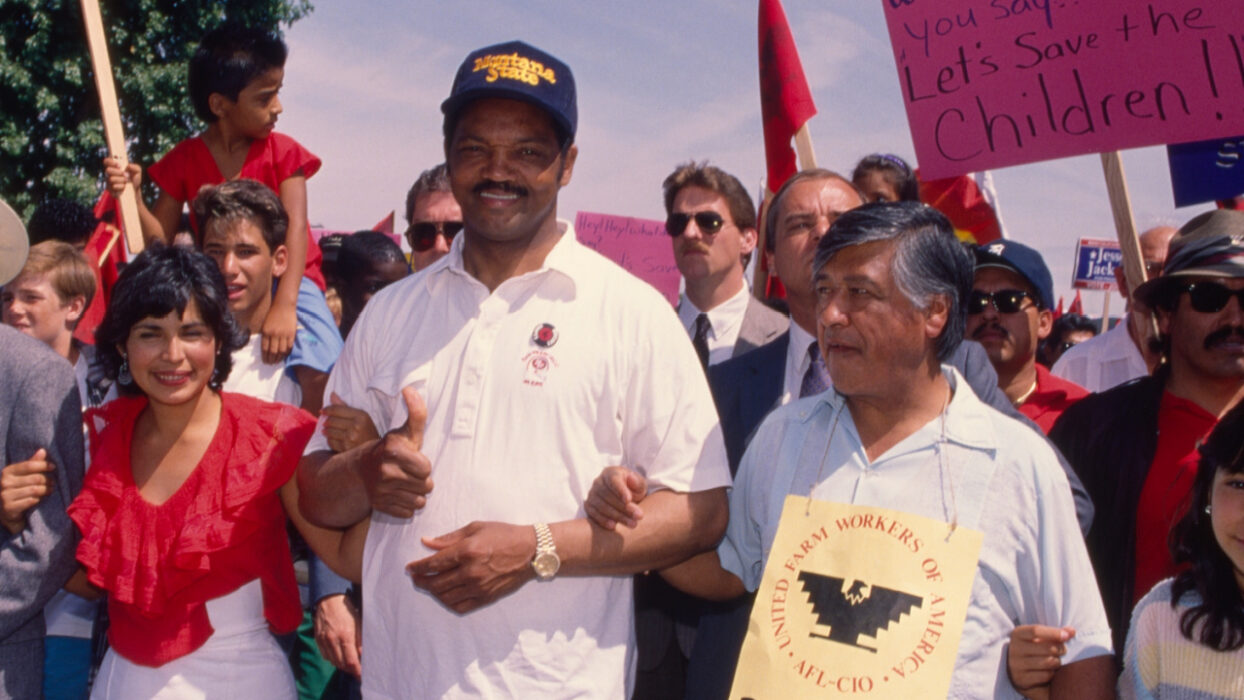
He was also involved in the fight for workers’ rights and against environmental injustices faced by the Latino community. The reverend maintained a long-standing relationship with civil rights icon César Chávez. In 1988, Rev. Jesse Jackson joined the fight to help end Chávez’s last hunger strike in Delano, California. The reverend also joined Chávez on a march to bring attention to cancer clusters in farming communities caused by pesticides.
His advocacy for Latino workers extended past the farms and focused on labor rights. He helped lead boycotts against grocery store chains like Safeway and Ralph’s. The reverend led intensified boycotts alongside Chávez against these corporations to demand, and won, better workers’ rights.
Rest in power, Rev. Jackson
The fight for equality is far from over. What Rev. Jesse Jackson stood for should be a beacon of hope and guidance during this time. As marginalized communities across the country face an onslaught of attacks from the federal government, we should work to continue the reverend’s work. He understood the power of unity against the oppressors. Rev. Jackson showed that unity across identities is an effective tool for fighting oppression from the top.
Rev. Jackson stood for all marginalized people in an effort to bring true equality to those who are often overlooked and trampled on by the rich and privileged. What better way to honor his memory and legacy than to keep up the fight?