
A UN Expert Says the U.S. Is Turning Mexico Into a “Garbage Sink”
Mexico is officially the United States’ dumping ground, and the situation is critical.
According to The Guardian and Quinto Elemento Lab, Marcos Orellana, the UN special rapporteur on toxics and human rights, said the United States is using Mexico as a “garbage sink.”
Orellana described a toxic crisis shaped by weak environmental standards, poor oversight, cross-border waste flows, and an economic model that allows dangerous contamination to accumulate in communities that were never meant to carry this burden in the first place.
After an 11-day investigative mission in Mexico last month, Orellana concluded that pollutants ranging from hazardous imports to dangerous pesticides are undermining people’s right to live healthy lives. According to The Guardian, he found lax standards and weak enforcement that have allowed contamination to pile up over the years. Furthermore, hazardous waste from the U.S. and weak oversight are contributing to the creation of “sacrifice zones” in Mexico.
This way, the issue is not simply that pollution exists. It is that a country already struggling to regulate industrial contamination is being implicitly and materially asked to absorb part of another country’s waste.
Toxic waste in Mexico and a much bigger indictment
“Where standards are weak, what you get is legalized pollution,” Orellana said. He then pushed the argument further. “US overconsumption and economic activity are using Mexico as a garbage sink.”
The traditional way of discussing contamination often isolates each disaster. One polluted river here. One refinery there. One industrial corridor with bad air. One mining spill that never really got fixed. But Orellana is describing a much wider structure. The UN rapporteur highlighted how the cross-border economic relationship itself helps produce the conditions under which pollution is displaced and even normalized.
Orellana warned that more than 1,000 contaminated sites are officially recorded in Mexico’s National Inventory of Contaminated Sites. Many of them, he said, have become “sacrifice zones,” where cancer and miscarriages become part of ordinary life.
American toxic waste in Mexico has already turned rivers, water, and air into sites of daily harm
One of the strongest parts of Orellana’s warning is its concrete nature.
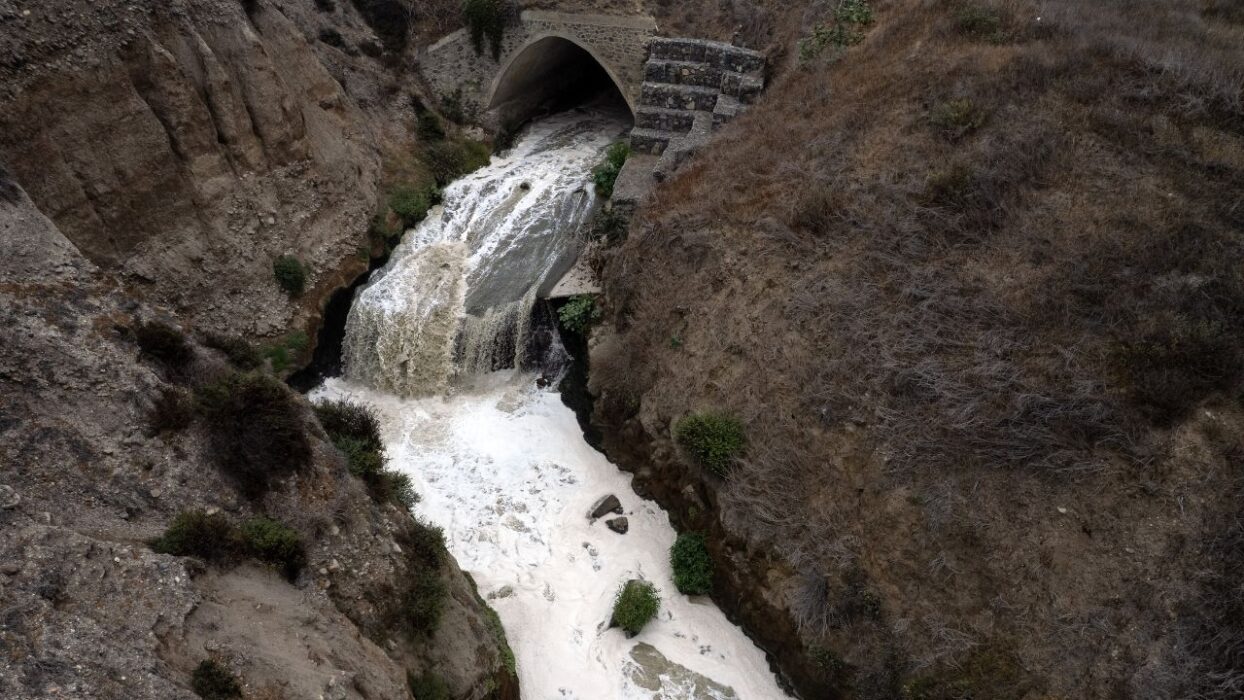
According to The Guardian, his preliminary report pointed to factories releasing hazardous waste into the Atoyac River in Puebla, industrial pig farms contaminating drinking water in the Yucatán Peninsula, and the decade-old mining chemical spill that continues to damage communities along the Sonora River. He also cited the industrial corridor in Tula, Hidalgo, where steel plants, cement factories, and petrochemical facilities operate near a river already contaminated by industrial waste and untreated sewage from Mexico City.
These are not speculative harms. They are ongoing conditions.
“As I heard during one meeting: living in a sacrifice zone means losing the right to die of old age,” Orellana said.
His statement forces the health consequences back into view, especially at a time when the private lobby seems to have pushed environmental activism out of the headlines. Orellana reminded us that pollution is rarely distributed evenly. And, more often than not, it settles into places where people are expected to endure it.
The rapporteur also highlighted the influx of plastic waste from the United States
According to The Guardian, Orellana said that once this waste crosses the border, there is often little clarity about its final destination. He also expressed concern about microplastic particles detected in the Tecate River in Baja California, the Atoyac River in Puebla, and the Jamapa River in Veracruz.
He painted the crisis as a silent threat, not confined to smokestacks or one notorious spill. Instead, it moves through rivers, industrial waste streams, drinking water, and recycling routes that are often presented as environmentally responsible while obscuring who bears the actual risk.
If you want to understand the toxic crisis in Mexico, look at the Atoyac
The Atoyac River is one of the clearest examples of how contamination in Mexico becomes both visible and politically difficult to dismantle.
According to Chemical & Engineering News, the Atoyac basin is surrounded by dense urban and industrial development. And national and international companies in the manufacturing, food, chemical, and textile sectors routinely discharge hazardous waste into the river. The publication describes a region where pollution has deep economic, political, and social roots, and where communities and scientists have spent decades documenting the consequences while authorities moved slowly, inconsistently, or symbolically.
Rodrigo Gutiérrez, a researcher at the Institute for Legal Research at the National Autonomous University of Mexico, told Chemical & Engineering News: “Unfortunately, in Mexico, the law fulfills more of a symbolic role.” He then explained the deeper logic underneath the failure, arguing that the country’s legal infrastructure often prevents institutions from adequately monitoring wrongdoing because “one of the things we sell in the international market for the production of consumer goods is environmental deregulation.”
Therefore, deregulation is not an unfortunate byproduct of development. It is part of the offer
The reporting from Chemical & Engineering News gives that critique a long historical arc. In the 1960s, Tlaxcala and Puebla saw a surge of industrial expansion as transnational automotive, electrical, chemical, and textile firms moved in, attracted by cheap labor, political stability, and access to natural resources.
According to the publication, nearby industries began using the river channels to dispose of toxic waste with little effective oversight. Over the following decades, residents near the Atoyac started reporting headaches, vomiting, sore eyes, renal failure, and rising cancer rates.
Communities in Mexico have been doing the state’s work for years
According to Chemical & Engineering News, residents and activists around the Atoyac began pressing authorities in the early 2000s, only to be dismissed and asked for proof.
In 2003, the organization Coordinator for a Living Atoyac, composed primarily of women and supported by the Fray Julián Garcés Center for Human Rights and Local Development, began inviting researchers to study the basin. Scientists later found elevated levels of arsenic, nickel, lead, copper, and other heavy metals in residents, along with benzene and ethylbenzene in the water.
For Isabel Cano, one of the movement’s central figures, the fight became painfully intimate. According to Chemical & Engineering News, her daughter Zulema was diagnosed with chronic myeloid leukemia after months of symptoms that local doctors dismissed. She later died in 2011. Cano then agreed to make her family’s story the face of a broader legal and human rights complaint.
The tribunals and commissions that later reviewed the basin issued recommendations. According to Chemical & Engineering News, those included ending illegal industrial discharges, carrying out ecological restoration, and establishing annual inspection programs. Yet the publication also makes clear what many people in Mexico already know well: recommendations on paper rarely guarantee enforcement in practice.
Why the toxic crisis in Mexico persists
According to The Guardian, officials in Claudia Sheinbaum’s administration have already acknowledged that key regulatory standards, including pollution limits for factories, are outdated and have announced plans to strengthen them.
Mariana Boy Tamborrell, Mexico’s federal attorney for environmental protection, told the paper her agency had reached a regulatory “turning point” and would begin requiring industries to remediate environmental damage. She also said a new air monitoring system is being rolled out in an industrial corridor in Monterrey. “Then there will be no room for ‘it wasn’t me,’” she said. “We will be able to clearly identify the source.”
However, according to Chemical & Engineering News, the federal institutions tasked with enforcing the law are badly understaffed. In 2022, Conagua had 163 inspectors overseeing more than 523,000 water exploitation permits nationwide. By that same year, Profepa had only 432 inspectors to monitor compliance with environmental regulations nationwide.
Even if staffing improved tomorrow, some experts argue the law itself still falls far short. Omar Arellano Aguilar, professor at the National School of Earth Sciences at the National Autonomous University of Mexico, told Chemical & Engineering News that, out of more than 100 toxic pollutants found in the Atoyac basin, only 22 are regulated by NOM 001 of the National Autonomous University of Mexico and the Federal Law of Rights. Microplastics, pharmaceuticals, and hydrocarbons are not included. He also warned that permit fees tied to water quality can perversely reward rivers that are already polluted. “As a company in your industrial corridor, it is convenient that the water body is polluted because you will not pay so much in your permit fee,” he said.
Monterrey is showing what happens when we normalize these situations
According to The Guardian, Monterrey has become one of North America’s most polluted urban zones while also functioning as a major manufacturing hub tied to U.S. demand. María Enríquez, who co-founded the environmental group Comité Ecológico Integral, told the paper that poor air quality has become part of daily life and that residents constantly deal with rhinitis, eye irritation, and asthma. “We have learned to live sick, especially with respiratory illnesses,” she said.
Guadalupe Rodríguez, who directs a network of childcare centers in Monterrey, offered an equally chilling description. “Families consider it normal for children to have constant coughing,” she said.
The crisis, then, is not only that contamination exists. It is that people are being forced to absorb it so continuously that illness begins to look ordinary.
The fight over toxic waste in Mexico is turning into a test for trade policy too
Finally, Orellana said Mexico could restrict imports of hazardous waste as one way to address part of the crisis. He noted that other countries have chosen to ban such imports without withdrawing from global trade.
Mexican senator Waldo Fernández has already introduced legislation to regulate imported waste more strictly, including a provision that would bar waste imports when they create greater environmental harm in Mexico than would be allowed in the country of origin. Fernández put it plainly: Mexico “must not become a dumping ground for toxic waste or a recipient of pollution under commercial pressures.”
The rapporteur also said, according to The Guardian, that the upcoming review of the free trade agreement between Mexico, the United States, and Canada offers an opportunity to strengthen environmental standards and enforcement. If that chance is missed, he warned, “economic pressure will worsen the toxic crisis.”