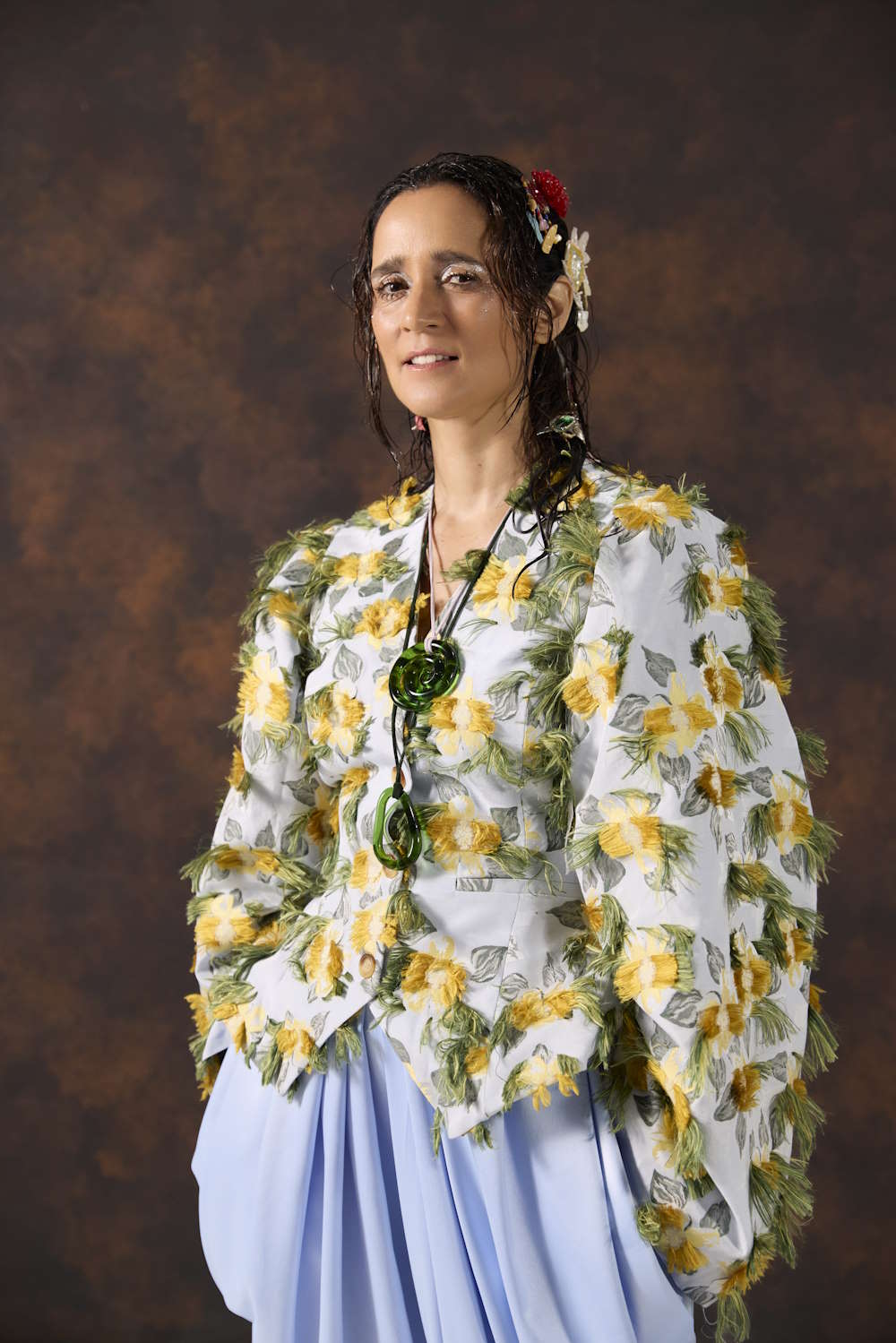
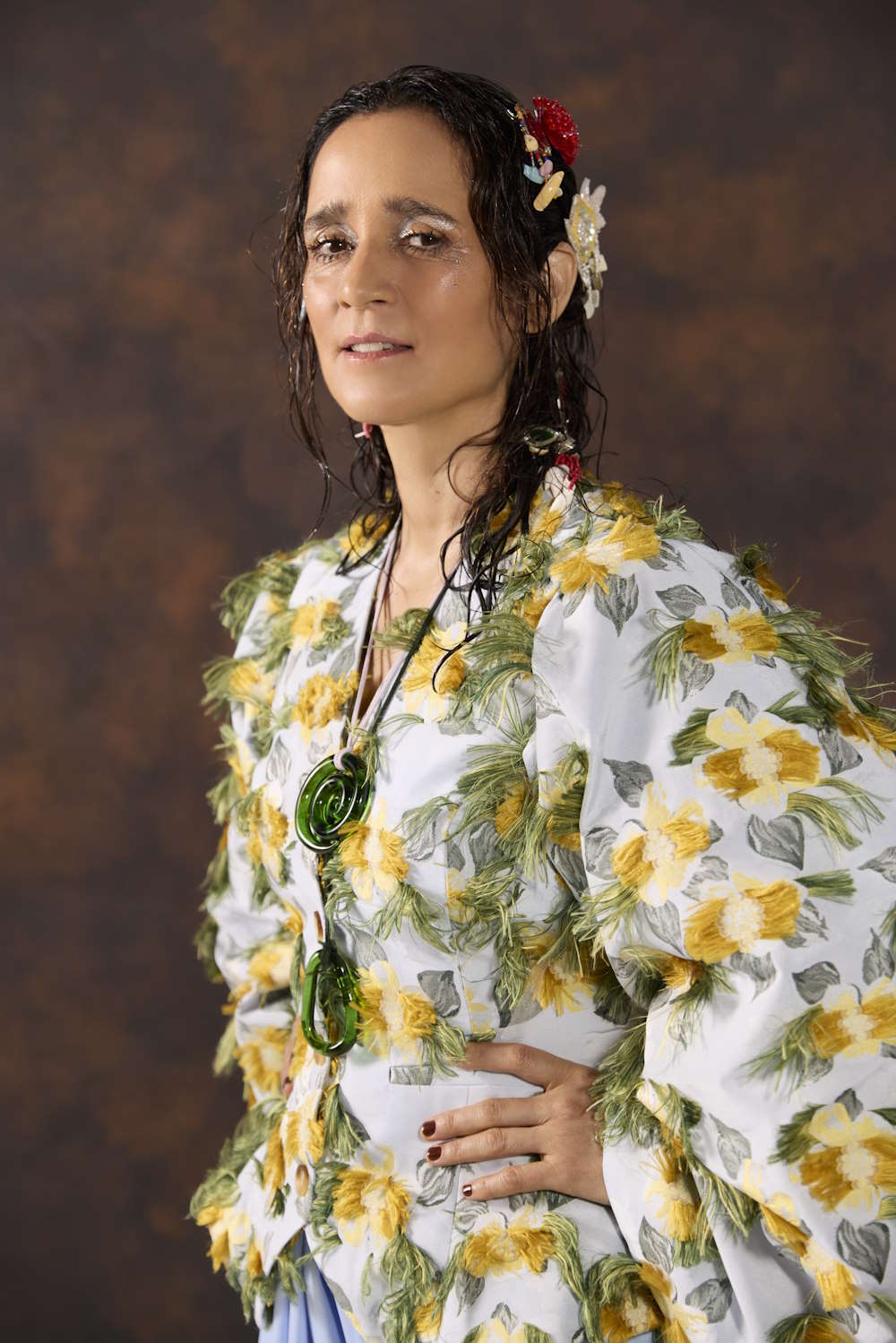
Julieta Venegas speaks about her new album as if she had spent years circling a feeling she could not quite name, until it finally revealed itself as memory, geography, and longing all at once.
Norteña could easily be misunderstood from a distance. Believe me, I did, assuming it was about a music genre rather than an identity rooted in a region. But then, speaking with Julieta, I saw how the Mexican songwriter, whose catalog has moved so fluidly through pop, rock, piano balladry, and heartbreak anthems, is coming back to herself in a whole different way.
When Venegas began shaping what would become Norteña, she did not immediately understand that she was building a memory project.
“It all started as something where I missed my family a lot,” she says. From there, she began assembling two parallel works at once: an album and a book. The book moves through her childhood and adolescence, culminating in the moment she began recording her first album. The record, meanwhile, draws from some of those same emotional currents, though it does not narrate them directly. The two projects are not identical, but they speak to each other.
“I put myself to reading obsessively about Baja California, about Tijuana, for several years,” she says. Out of that reading came an imagined world, one populated by borderlands, distance, migration, yearning, family, and the emotional weight of leaving and returning. “Several themes keep touching each other,” she explains. “The theme of longing comes up many times, of migrating, of missing your family, your country.”
That longing took time to reveal its full meaning. At first, she says, she did not understand that she was making “a project to return to Mexico.” It took years for that truth to clarify itself. She had spent eight years living in Buenos Aires, where she built a life, raised her daughter, and found forms of intimacy and friendship that changed her. But beneath that, life was another current.
“I missed Mexico. I missed my family,” she says. “This whole project helped me realize that I wanted to come back.”
Venegas is careful when she talks about Argentina. She did move there for love, she says, but to leave the story there would be a disservice to what the country came to mean in her life.
After all, she speaks about Argentina as a place that reshaped her.
“I found a lot of myself in Argentina,” she says. “It changed me a lot in many ways.” She was not there working constantly, not there in the same hyper-professional rhythm that defined other parts of her life. Instead, Buenos Aires became, in her telling, a city of friendship, conversation, art, bookstores, theater, and a public hunger for culture that fed her at a deep level.
When romantic love failed, something else held. “When love failed, I found that there was something much more valuable waiting for me in that place,” she says. “My friends rebuilt me.”
Once the foundations were healed, something else happened. Her daughter, who had been very young when they left Mexico, began saying she wanted to go back. That desire helped Venegas understand that the time had come.
Still, she resists the easy idea that Mexico simply “won” and Argentina simply “ended.” Her daughter now understands herself as someone with two countries, and Venegas seems to honor that complexity. Argentina gave her something enormous. Mexico called her back anyway.
That beautiful tension sits at the heart of Norteña.
One of the smartest things Venegas says about the album is that she refuses the trap of false orthodoxy.
“In reality, my record is not traditional,” she says plainly. “It is a record inspired by the north,” she explains, with a very unique ethnographic accuracy. She is making something autobiographical, emotionally exact, and rooted in the sounds that formed her.
“I called it Norteña because I am norteña,” she says.
That is the key to the whole project.
The album does draw on recognizable textures: polka, cumbia, accordion, winds, low-end grooves, and the tonal world of popular music from northern Mexico and Baja California. But Venegas is not interested in following some formal rulebook. She is instead following memory as a guiding tempo.
“There is a lot of wind in it,” she says, laughing a little at the specificity of her own instincts. She talks about the tuba with real delight. She talks about Los Tigres del Norte, the electric bass, the accordion, and the different northern lineages that coexisted in her ears as she grew up. She talks about wanting guitarist Gaby Romero in the project because Romero’s sound felt like the north to her, even if that feeling did not fit neatly into a strict genre map.
That is why the record sounds like an internal landscape. It is inspired by Baja California as much as by any single musical form. The desert, the Pacific, the road trips, the visual memory of Tijuana, and the peninsula saturate the album’s atmosphere.
The slow-cooked nature of this project becomes clearest when she talks about the first song that cracked it open.
About five years ago, during the pandemic, Venegas started writing a song while imagining Lupe Esparza from Bronco singing it with her. The song was about two people wanting to find each other again. She wrote it before she had fully committed to making this album, and it did not fit the pop record she eventually made instead. So it stayed behind, unresolved, waiting.
Most songs, she says, do not torment her for long. If she cannot solve one in a few days, she usually moves on. This one would not let her.
“It followed me,” she says with a laugh. “There was one part I could not resolve, and it woke me up at night and drilled into me.”
Then fate, or the strange machinery of music, intervened. She crossed paths with Bronco at a festival and told Lupe she had a song she had imagined with him for years. He told her to send it. That was the push she needed. She finished it, sent it, and he liked it.
“When he told me, ‘It’s tasty,’ I said, ‘ Good,” she recalls, smiling through the memory.
If Norteña embodies memory and finding yourself, it also talks about separation.
Venegas lights up when she talks about “Mala Línea,” the song she released with Yseult. She describes it as a song about people divided by a border or by any circumstance beyond their ability to solve. Maybe someone has been deported. Maybe distance has done the separating. Maybe the structures that govern migration, labor, and nationhood have rearranged a family from above.
Either way, the wound is the same.
She is careful not to claim a pain that is not hers. “I can say that I have never lived something like that,” she says. “I am fortunate.” She knows her own movement through countries has been shaped by choice, privilege, and access. But she also knows what it means to live as a foreigner, to build a life somewhere else, to understand longing from inside.
And that lets her reach for something careful and morally serious in the song. Not false equivalence, not melodrama, but an attempt to open a little bit of emotional space.
“It is a way of opening some hope,” she says. “It is a ‘don’t give up’ more than an ‘I am going to solve the issue.’”
At a moment when migration is treated in public discourse either as an abstraction or a threat, Venegas keeps bringing it back to the concrete story.
One of the most fascinating moments in conversation comes when Venegas says something that, at first, sounds almost contradictory.
“I do not consider myself at all nostalgic,” she says.
Coming from an artist whose songs have soundtracked breakups, late-night confessions, long drives, and a thousand forms of emotional retrospection across Latin America, that admission almost startles. Then she explains it, and it makes total sense.
She is not interested in nostalgia as paralysis. She is interested in remembrance as inquiry. In telling stories. In understanding what formed you. In passing that knowledge forward.
“The memory is something that I have discovered I like,” she says. “I like remembering.”
That subtle yet meaningful distinction has grown sharper now that she has a daughter. She talks about wanting to tell her who she was before motherhood, before fame calcified into public image, before the adult narrative settled over the younger self. Her daughter, she says, found that beautiful. “I like it more this way,” she told her mother. “I like discovering my mom before I existed.”
That is one of the loveliest things anyone could say to an artist working through autobiography. It also clarifies the emotional architecture of Norteña.
Toward the end of the conversation, Venegas says something deceptively simple about what she hopes listeners will take from the album.
“I hope they feel reflected,” she says.
That is the whole ambition, really. She is not trying to turn her life into a shrine. She wants the songs to exceed her, to move past autobiography and into recognition. A listener from Tijuana may hear something concrete and local. Someone far from the border may discover a world they did not know. Someone living abroad may hear their own ache in the album’s migratory pulse. Someone listening casually may suddenly remember their own family gatherings, their own road trips, their own inherited sound.
“We all have a story to tell,” she says.
While that could border on the cliché in someone else’s mouth, here it does not. Julieta Venegas has spent too many years writing songs that people fold into their own lives for her to mean it lightly.
That is why Norteña feels like such a compelling next chapter. A woman who left for love was rebuilt by friendship and came back with a deeper understanding of what home actually sounds like.