Feel Like You’re Working More and Earning Less? A New Study Says You’re Not Imagining It
There is a particular kind of economic gaslighting that defines modern work. You keep hearing that jobs are up, that growth is steady, that if you work hard, get your degree, stay flexible, and keep pushing, things will eventually click into place. Then you check your paycheck, your rent, your grocery bill, your medical costs, and your level of exhaustion, and start questioning your sanity.
A new UCLA study suggests that a lot of Latino workers in California are living inside exactly that contradiction.
According to the UCLA Latino Policy and Politics Institute’s new State of Latinos in California, 2026 report, Latinos are deeply central to California’s labor force, highly active in the workforce, and essential to industries that keep the state running. And yet they are still paid less, pushed into lower-wage sectors, shut out of higher-paying ones, and left with thinner access to the protections that make work feel sustainable rather than extractive.
So no, if you feel like you are working more and earning less, you are not imagining it.
Latino workers are carrying California. The pay still does not reflect that
The first thing the UCLA report makes painfully clear is scale.
Latinos now make up 39% of California’s workforce, or about 7.8 million workers. From 2000 to 2023, the Latino workforce in the state grew by 77%, compared with just 7% growth among non-Latino workers. According to the report, that is not a temporary shift. It is a structural reality that will shape California for decades.
Latino workers are also participating in the labor force at very high rates. Nearly 74% of Latino men participate in the labor force, compared with 66% of non-Latino men. Latina women also participate at slightly higher rates than non-Latina women, 60% versus 57%.
That should be enough to puncture one of the laziest myths in American public life. The one that keeps casting Latinos, especially immigrants, as economically marginal or peripheral. The data (and our experience) says the opposite. Latino labor is not some side note in California’s economy, or in any economy, for that matter.
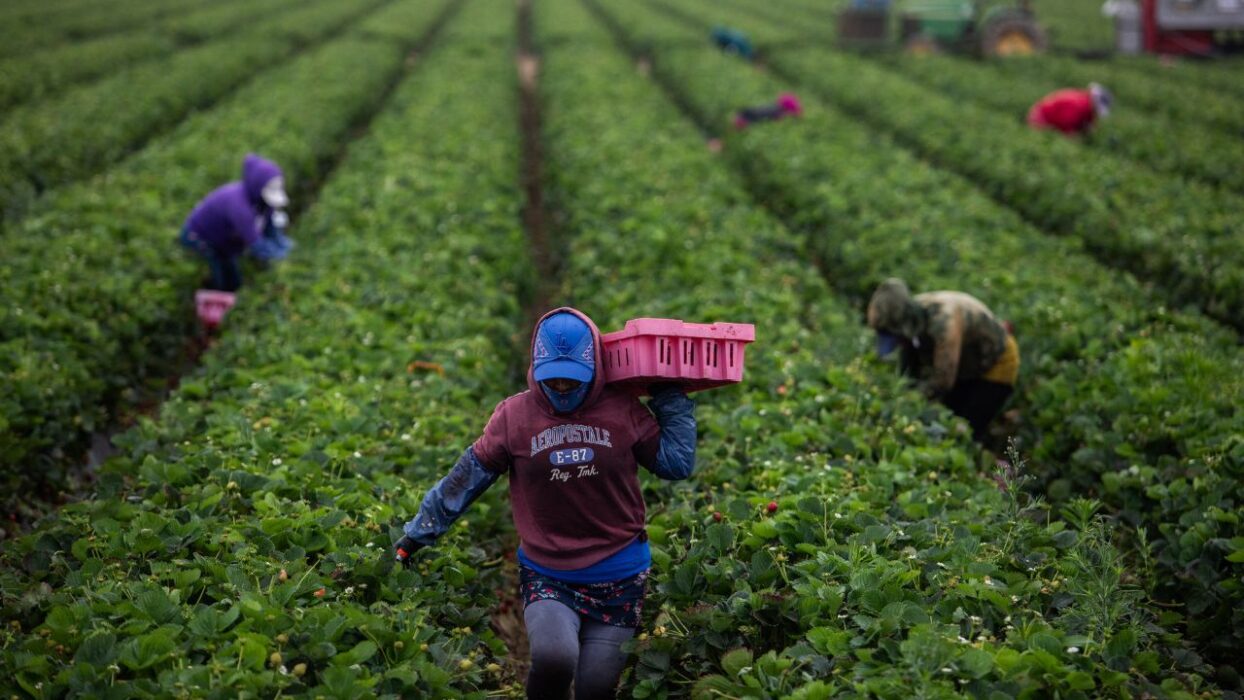
And still, according to the study, Latino workers remain concentrated in lower-wage, labor-intensive sectors like construction, agriculture, retail, and hospitality, while remaining underrepresented in higher-paying sectors such as professional and scientific services, finance, insurance, and real estate.
The wage gap is not just real. It follows Latinos everywhere
To be honest, the report leaves little room for euphemism.
Latinas earn a median hourly wage of $18, compared with $29 for non-Latinas. Latino men earn $20, compared with $35 for non-Latino men. According to UCLA, wage disparities persist even among workers with college degrees and across every major industry.
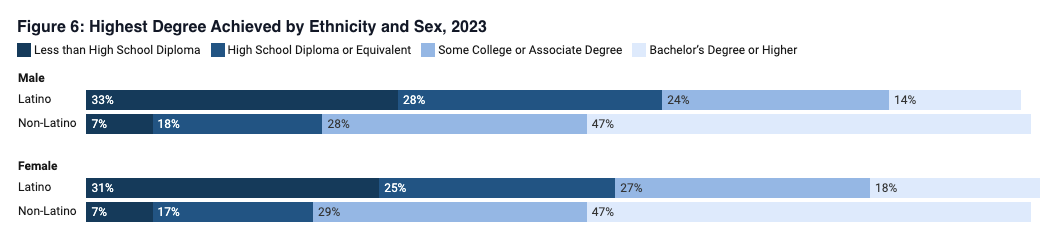
Once again, hard data blows up another comforting fiction. We are constantly told that education is the clean fix, the ladder, the great equalizer. But UCLA found that even college-educated Latinas earn a median of $31 an hour, which is $21 less than college-educated non-Latino men. College-educated Latino men earn $36 an hour, still well below their non-Latino peers.
In other words, the penalty does not disappear when Latino workers do what the system asks.
The UCLA report also found that across every major industry, Latino workers still earn less than comparable non-Latino workers, with some of the widest disparities showing up in the state’s highest-paying sectors. In professional and scientific services, for example, non-Latino men earn $50 an hour compared with $22 for Latino men. Non-Latina women earn $40 an hour compared with $20 for Latinas.
Noncitizen Latinos are doing some of the hardest work for the lowest pay
According to UCLA, noncitizen Latinos participate in the workforce at a higher rate than Latino citizens, non-Latino citizens, and non-Latino noncitizens. Their labor force participation rate stands at 69%. They are especially concentrated in construction and agriculture, sectors that are physically demanding, economically essential, and often lacking in strong protections.
And yet noncitizen Latino workers earn a median hourly wage of just $17. That is $3 less than that of Latino citizens. It is also roughly half the hourly wage of non-Latino citizens and non-Latino noncitizens, who each earn around $32 to $33 an hour, according to the report.
So the workers doing some of the most grueling labor in California’s economy are not simply underpaid in a general sense but structurally discounted.
And because so many Latino households are mixed-status households, the consequences spill far beyond one worker’s paycheck. UCLA notes that about 2.2 million Latinos in California were undocumented in 2023, and another 2.7 million U.S. citizen or lawful resident Latinos lived with undocumented family members. That reality affects access to benefits, trust in public systems, mobility, and long-term stability.
This is what economic dependence on immigrant labor often looks like in practice. Depend on the worker, discount and threaten the worker, then act surprised when the system starts cracking under its own cruelty.
Work is not just underpaid. It is often underprotected
The UCLA report also points out something often missed in wage coverage: not all jobs are built the same, even before the paycheck hits the bank account.
Many of the sectors where Latinos are overrepresented are less likely to be unionized and less likely to offer benefits or stable career paths. According to the report, in 2024, only 8% of retail workers and 18% of construction workers in California were represented by a union, compared with 52% in public administration.
For context, union jobs are more likely to come with health insurance, retirement plans, structured wage increases, and better protection against unemployment. UCLA notes that Latinos in union jobs are more likely to have health insurance and retirement plans and to earn higher incomes than Latinos in nonunion jobs.
So when people talk about work, they should not only ask who has a job. They should ask what kind of job it is, what it pays, what it protects, and whether it lets a worker build an actual life.
Right now, a lot of Latino workers are being asked to carry the state through jobs that do not give enough back.
The squeeze does not end at work
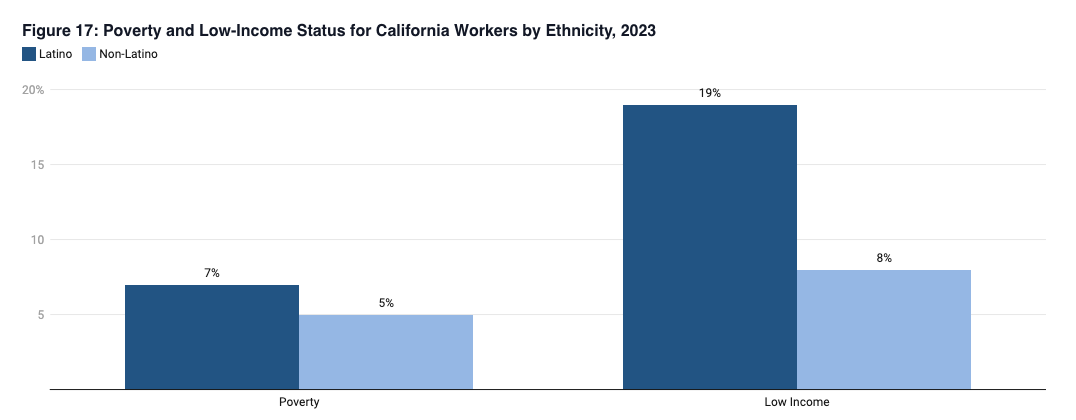
According to UCLA, Latino workers are more than twice as likely as non-Latino workers to live in low-income households, 19% compared with 8%. Seven percent of Latino workers are in poverty, compared with 5% of non-Latino workers. Poverty among noncitizen Latino workers is even higher.
Those disparities ripple outward into health care and housing. The report found that Latinos are uninsured at three times the rate of non-Latinos, 12% compared with 4%. Nearly one-third of Latino noncitizens are uninsured. Latino households are also less likely to own homes than non-Latino households, and when they do, their homes are typically worth significantly less, which limits wealth-building over time.
Meanwhile, 58% of Latino renter households are housing-cost burdened. Among Latino renter households headed by noncitizens, that number rises to 62%.
Honestly? This is where the whole “just work harder” script fully collapses. People are working. They are working a lot. The problem is that too much of that work is structurally barred from producing stability.
The conclusion? California keeps benefiting from Latino labor while rationing Latino opportunity
California depends on Latino communities for labor force growth, entrepreneurship, care work, construction, agriculture, retail, and the renewal of its schools and public systems. The report says plainly that California’s long-term prosperity depends on the strength and well-being of its Latino communities.
And yet the systems that organize work, wages, health coverage, housing, and advancement still produce predictable inequality.
And this injustice goes beyond our community. It is economically stupid. A state cannot keep relying on a population for growth while underinvesting in its ability to live securely, move upward, and stay healthy. At some point, the contradiction grows tentacles you cannot control.
That is why so many people feel exhausted, overused, and stuck. Not because they misunderstood the economy. Because the economy is asking more of them than it is willing to reward.