The 1917 Bath Riots: When a Teen Latina Said ‘Absolutely Not’ to Forced Border Baths for Mexican Workers
Crossing into the United States from Mexico was once a laborious task. For Mexican nationals, the process included a de-lousing process that both humiliated and victimized people. People coming across the border were forced to strip down for officials for years. The demoralizing practice was just one way that the US inflicted its superiority on Mexicans in the early 20th century, but one teenager’s fight provided a small change. This protest is known as the 1917 Bath riots, another important part of our history.
The US government adopted a de-lousing procedure for Mexicans in the early 20th century
Mexico was in the grips of the Mexican Revolution when the United States began to implement a new requirement for Mexicans crossing the border. Between 1914 and 1915, typhus (later known as typhoid fever) started to spread across Mexico. In response, newly elected El Paso Mayor Thomas Calloway Lea Jr. asked senators to implement a quarantine procedure for Mexicans.
Dr. B. J. Lloyd, the Public Health Service Office for El Paso, opposed the quarantine. Dr. Lloyd admitted that there was little concern about the illness as it was located primarily in Mexico City and municipalities in Veracruz and Jalisco. He did, however, suggest opening a de-lousing facility to help sanitize Mexicans before they entered the country.
The US government was quick to pounce on the idea of de-lousing Mexican nationals. The first de-lousing plant opened at the El Paso-Juarez border crossing. It quickly spread to the Laredo-Nuevo Laredo crossing before being implemented across the full border.
The de-lousing procedure was invasive and dehumanizing
Men were separated from the women and children in order to be de-loused. Everyone was stripped down and separated from their clothing while officials would examine the naked bodies of people for lice. Officials also checked the hair of people.
Men who were found to have lice would have their hair shaved close to the scalp. For women, their hair was covered in a solution of vinegar and kerosene. They would then wrap a towel around their hair and wait 30 minutes. After that time elapsed, their hair was reexamined. If there were still live lice, the women would do it again and again until the lice were dead.
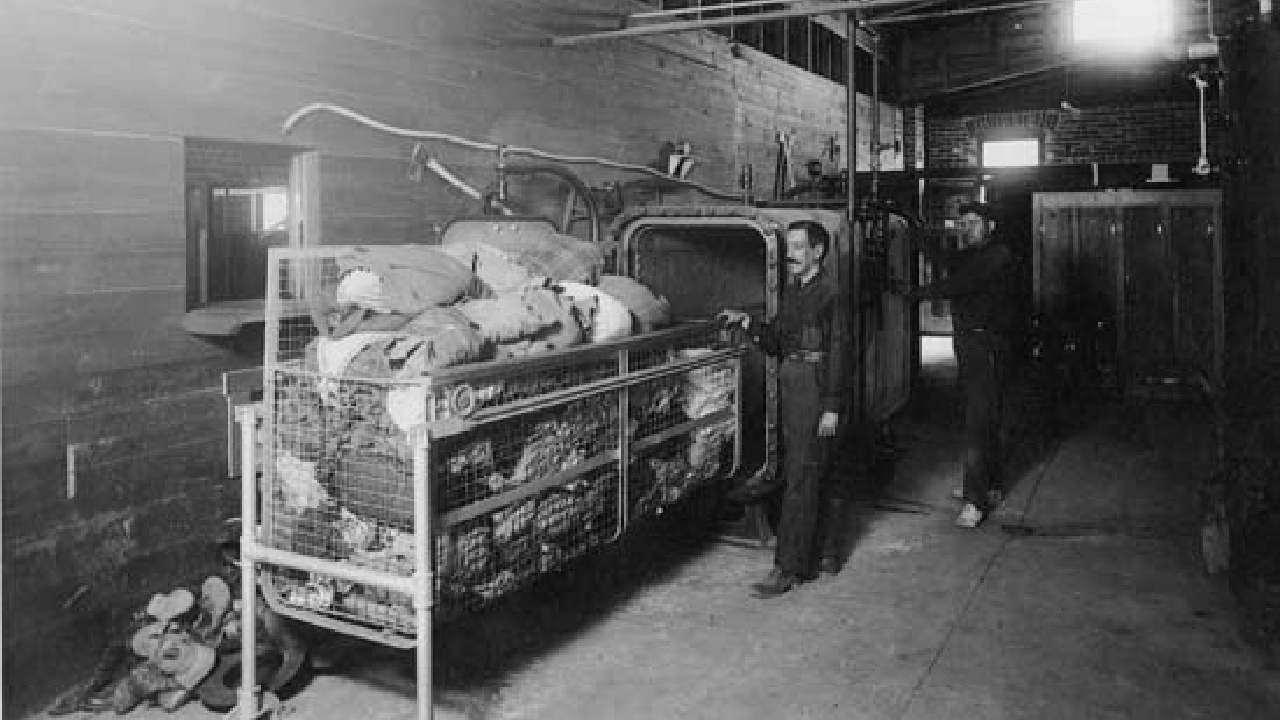
The clothing and accessories were treated separately with various chemicals. There are reports that clothing was treated with Zyklon B at the Santa Fe Bridge crossing. Zyklon B is the chemical agent later used by the Nazis to exterminate Jews in the Holocaust.
The forgotten 1917 Bath riots is an early moment of Mexicans asserting their dignity
The de-lousing and compulsory vaccinations to enter the US caused strife for many. The showers included kerosene, so there was a concern that the showers could catch fire. This is something at the forefront for people. In 1916, a fire broke out in the El Paso Jail in the gas showers after a cigarette was lit. The El Paso Jail fire killed 28 people, and concerns grew that the same would happen to people crossing the border.
On Jan. 28, 1917, Carmelta Torres was in a trolley getting ready to cross the border for work. She, like many domestic workers at the time, would cross the border daily to work. There were stories of officials taking photos of the naked women as they were being de-loused. That day, Torres refused to be stripped and cleaned before she entered the US.
She was refused a refund on her ticket on the trolley to the border, and her frustration boiled over. She began to protest the de-lousing and convinced others to join her in her cause. What started as a small group of women throwing rocks at health and immigration officials ballooned to thousands standing up. They even seized some trolleys that had departed for Juarez and held them until mid-afternoon.
On the second day of the 1917 Bath Riots, several men joined. However, it is believed that the men were less interested in protesting the de-lousing of domestic workers. Instead, it is thought that the men largely joined the protest as a way to signal their dissatisfaction with the new Venustiano Carranza regime.
The riots didn’t change much but there was a small victory
After three days of protesting, the crowds dispersed, and life started to move on as normal. However, one small change had occurred. In response to the unrest, signs appeared at the El Paso-Juarez border crossing stating the officials would accept health certificates issued by Mexican health inspectors.
The de-lousing of Mexican nationals continued into the 1950s. As the US always does, the continued practice soon included pesticides and other chemicals that are harmful to humans. Additionally, days after the riots, the US passed new requirements for Mexicans entering the country. For the first time, Mexicans were forced to pay a head tax, pass a literacy test, and were barred from taking contract work.
So, while Torres’s fight didn’t completely change the system, it is a lesson that even small voices can create change. Small change, in time, leads to bigger change. The 1917 Bath Riots exposed the inhumane and discriminatory practice of forced showers.