
Brazil Reelects Lula in a Historic Win. What Comes Next for the Country and Latin America?
Brazil just gave the world a lesson in democracy, and everyone is paying attention.
In the first round of the 2026 Brazilian presidential election on October 4, Luiz Inácio Lula da Silva finished behind Flávio Bolsonaro by 2,224,965 votes. Because neither candidate secured a majority (51%), they advanced to a runoff.
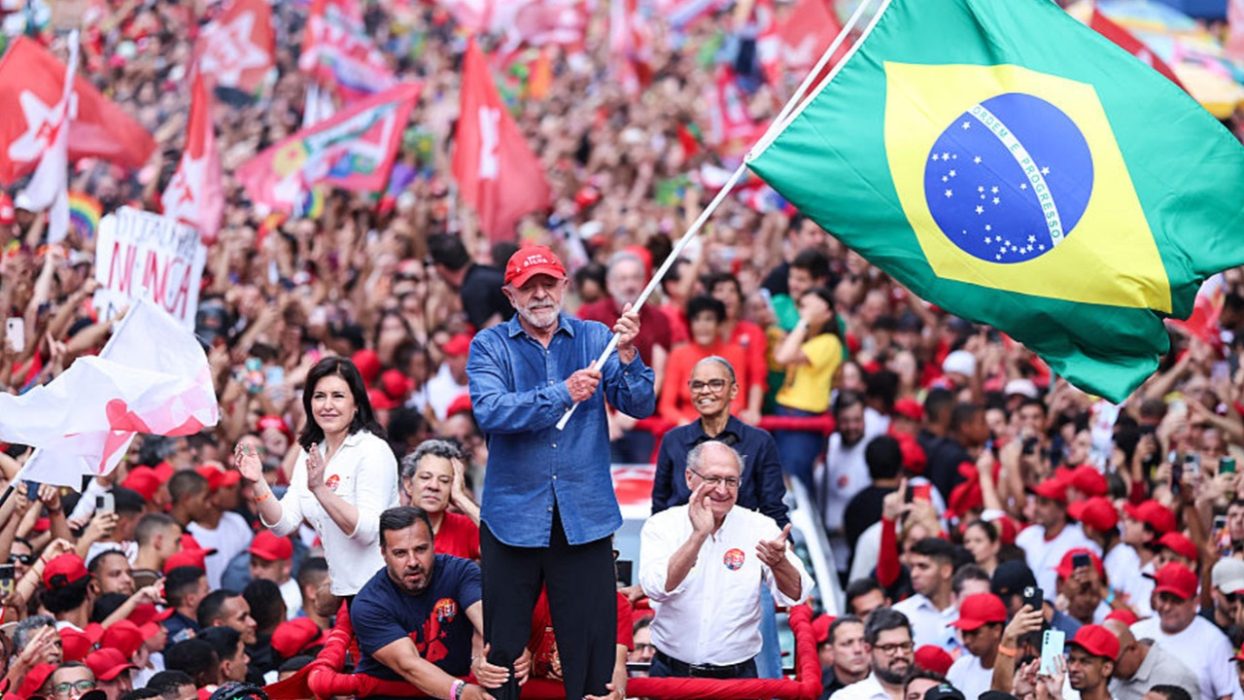
Last night, Lula beat Flávio by 4,430,191 votes, breaking his all-time voting record and getting reelected for a historic fourth term as president.
Lula’s victory is a major win for the South American resistance to conservative politics, for environmentalists concerned about the Amazon forest, and for Big Tech investigations into alleged election interference being taken seriously.
However, Lula’s fourth and final mandate as President of Brazil is poised to be his most challenging yet.
The wall of opposition against Lula
The conservative movement in Brazil may have lost the presidency, but that is the only branch of government it lost. Far-right politicians won a Senate majority this year, and conservatives have won more local victories than any other party since Brazil’s redemocratization in 1989. Specifically, Flávio Bolsonaro’s Liberal Party (PL) emerged as the biggest winner, reaching 28 senators (one-third of the house) for 2027. In other words, Lula will be surrounded by political opponents while trying to govern the country.
What’s more, the chaotic opposition against Lula’s victory has already started.
Flávio, for one, said that “it is impossible to recognize the election results given the circumstances under which things unfolded.” Much like Jair did in 2022—which led to his imprisonment for attempting to stage a coup—Flávio called on his supporters to stand with him as he challenges the results.
The “circumstances” Flávio referenced were requests to extend voting hours in specific areas where voters couldn’t reach polling stations. The details of this thread are far-reaching, but ultimately irrelevant. Why, you ask? Well, because no matter who authorized the extension, and how (little) it affected the election results, Flávio also made the same requests as Lula to extend the voting hours.
To be clear, as journalists explain in the video below, Flávio’s election-fraud argument is based on a request his campaign also made. A request that was eventually authorized because both campaigns requested it.
Beyond the head-scratching accusation, if Flávio Bolsonaro still chooses to challenge Brazil’s entire electoral system over his individual loss, he is calling into question every conservative win across the country.
There are cracks in that wall
Politics can be a lot like show business. Gossip is just gossip, unless it is true. When information leaks, it’s often from within. Fresh coats of paint can hide cracks in a wall until someone realizes it’s cracked.
Jair Bolsonaro was an undeniable conservative choice to run for president in 2018. He was a stoic, militaristic, machista candidate who blamed all Brazilian corruption on the left and ruthlessly vowed to end it. But Jair’s anti-corruption narrative against Lula never really translated into a national movement for the other Bolsonaros.
Jair’s third son, Eduardo Bolsonaro, has an active arrest warrant if he travels back to Brazil as of this writing. Flávio Bolsonaro, who ran against Lula, has also been accused of involvement in serious corruption cases, which is why Brazilian conservatives were skeptical about consolidating behind him in the first place.
Before the presidential race officially began, many studies showed that Flávio was not the strongest conservative choice to run against Lula. Even Michelle Bolsonaro, Jair’s wife and former First Lady of Brazil, openly criticized Flávio, her son-in-law, for most of 2026. Once Flávio became the candidate, silence dawned on the right wing.
But now that Flávio lost, Jair is still barred from running for public office until 2060. The Bolsonaros have only a handful of mandates as senators, so remaining a Bolsonaro loyalist offers little political benefit, especially if you’re a conservative politician who just won an election while Flávio calls the entire electoral system into question.
The truth lies somewhere in the middle
Because Brazil has more than two parties, a conservative majority doesn’t mean that everyone’s on the same team. This political scenario does give Lula’s opponents much stronger footing to pressure his government, shape budgets, and challenge policies. But Congress remains fragmented, with centrist, conservative, and far-right parties still having to negotiate alliances on each issue.
Lula proposed raising the minimum wage above inflation, an idea that will face heavy scrutiny. Fights will erupt over environmental protections and how to handle public security. Millions of people who voted against Lula will also navigate their obvious discontent with the results.
In his victory speech, Lula said he wouldn’t promise national unity because sentiment didn’t always match Brazil’s realities. He argued that he preferred civility, instead. The four-time president then pointed out something that felt misplaced in such an otherwise triumphant speech, but that maybe proves why he’s been trusted so many times to preside over the country: “I didn’t choose Congress, the people did. And it is with them that I will work.”
World leaders react
Political leaders were quick to share their own messages in response to Lula’s win.
Right-wing presidents José Antonio Kast (Chile), Keiko Fujimori (Peru), Rodrigo Paz Pereira (Bolivia), Santiago Peña (Paraguay), and Daniel Noboa (Ecuador) — all name-checked in my previous story for mitú — wrote X posts congratulating Lula.
Other Latin American leaders, like Mexican President Claudia Sheinbaum Pardo and Panamanian President José Raúl Mulino, also congratulated Lula and even hailed his victory as a victory for democracy.
There’s support from U.S. politicians, too. “The people united will never be defeated!” wrote New York City Mayor Zohran Mamdani. “Lula has stood up for Brazilian workers & democracy — and will continue to do so in the next four years,” wrote Vermont Senator Bernie Sanders. “A worldwide win,” wrote Minnesota Governor and former vice-presidential candidate Tim Walz.
Canadian Prime Minister Mark Carney shared a pointedly enthusiastic message about Lula’s victory. “Relations between Canada and Brazil have advanced thanks to our partnership. Let us seize this opportunity to strengthen them further, together,” he wrote.
Former Colombian president Gustavo Petro, who lost his 2026 presidential run to conservative lawyer Abelardo de la Espriella, declared that “Brazil has halted Latin American fascism.”
“Social justice is saved in Brazil, and the foreign attempt to seize its natural resources has been thwarted,” Petro wrote. “Well done, Lula. This is a triumph for humanity, and a strategic defeat for the forces of darkness.”