
This Is Not a Drill: Brazil’s Runoff Could Decide the Amazon’s Future and Reshape South America for Decades
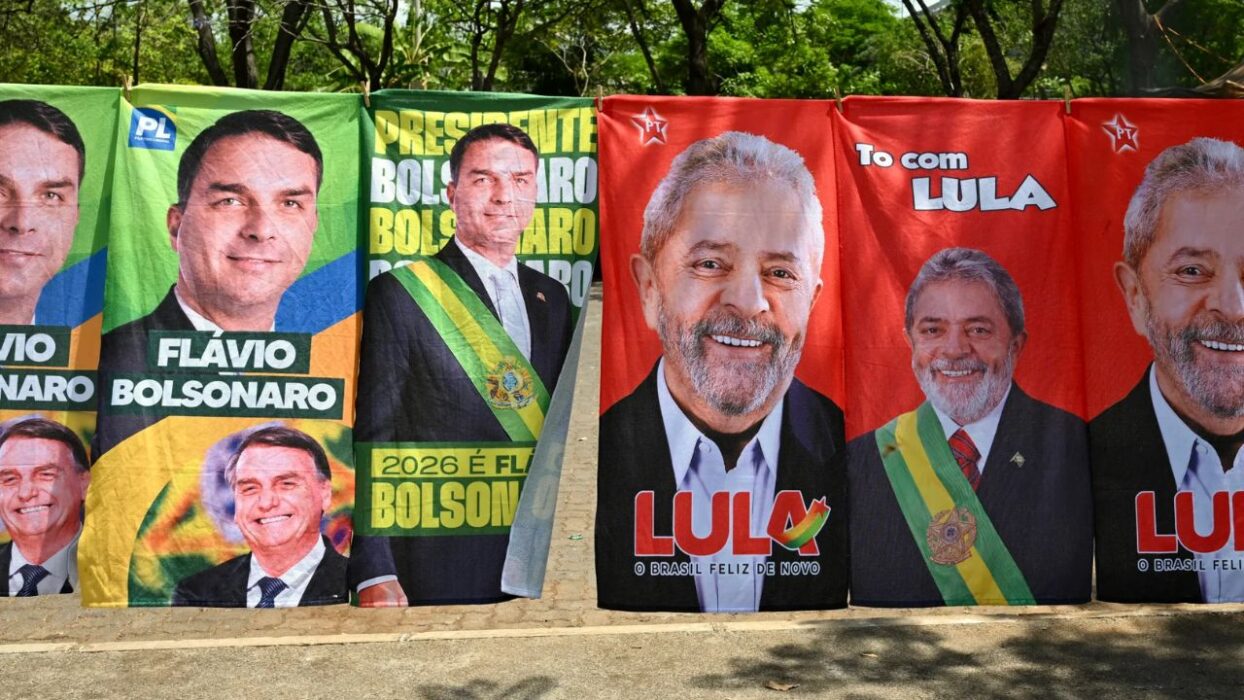
Brazil didn’t reach a consensus on the 2026 presidential election last Sunday. The two most-voted candidates, incumbent president Luiz Inácio Lula da Silva and Rio de Janeiro senator Flávio Bolsonaro, now face off in a three-week runoff that determines what the largest country in South America is willing to fight for. Is Brazil willing to stand by its left-wing leader campaigning for a fourth presidential term, or will it follow all other nations in South America (whether by choice or not) with a sharp turn toward the far-right?
While it can be frustrating to hear that every election is the most consequential electoral race in history these days, it’s hard to describe Brazil’s 2026 presidential election as anything but. Lula and Flávio Bolsonaro are polar opposites: one is a left-wing veteran with a decades-long reputation that makes him a beloved or despised figure, sometimes by association alone; the other is a new conservative challenger known mainly for his association with a father figure named Jair Bolsonaro.
One of those men will run a country that covers half of South America, contains 60% of the Amazon, has one of the world’s largest economies (now a larger total GDP than Canada), and remains the last country in the region with democratically elected left-wing leadership.
Bolsonaro’s shadow.
Incumbent President Lula received 45.16% of the votes in the first round of the 2026 presidential election. His conservative challenger, Flávio Bolsonaro, received 47.03% of the vote and took the lead — a massive surprise for political pundits worldwide.
It stands to reason that you know Jair Bolsonaro, the 71-year-old man who had an active career in politics for 37 years, became president in 2018, and lost to Lula in 2022 while seeking reelection. Jair was subsequently found guilty of plotting a military coup, sentenced to 27 years and three months in prison, and barred from running for public office until 2060.
Jair’s son, Flávio, is the Bolsonaro running for office in 2026 against Lula. And it is Flávio who’s done what no other conservative challenger has been able to do since 2002, Lula’s first time being elected president: defeating the PT figurehead in the popular vote of a presidential election (any round).
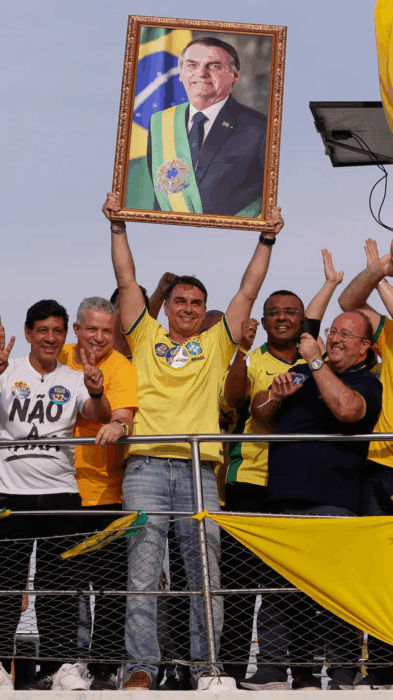
Flávio isn’t a political superstar, but the Bolsonaro last name lifted unimaginable weights in this 2026 election. Besides Flávio’s runoff campaign for president, four Bolsonaro family members were elected on Sunday.
Meet the Bolsonaros.
Jair Bolsonaro’s wife, former First Lady Michelle Bolsonaro, made her electoral debut in 2026 and won a Federal Senate seat with 938,496 votes. Jair’s second son, Carlos Bolsonaro, who had served for two decades as a city councilman in Rio de Janeiro, now captured a Federal Senate seat with just over 2 million votes.
Jair Sr.’s youngest son, 25-year-old Jair Renan Bolsonaro, received over 131,000 votes and secured a seat in the Chamber of Deputies. Last but not least, Jair Sr.’s younger brother, 62-year-old Renato Bolsonaro, won a seat as a federal deputy with over 379,000 votes.
Even the Liberal Party (PL), previously a small party in Brazil’s political landscape, was propelled by the Bolsonaro candidatures and expanded its representation to 121 seats in the Chamber of Deputies. In fact, it is now the largest single party bloc since Brazil’s redemocratization in 1985.
South America’s right turn.
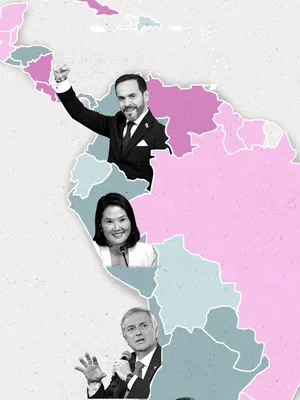
A conservative trend has swept several South America countries in recent years, as mapped by reporters tracking the phenomenon.
Argentina has been governed by Javier Milei’s libertarian administration since December 2023. Over the years, he’s established himself as a fierce Trump ally and the face of the far-right movement in South America.
Chile’s far-right president, José Antonio Kast, took office in March 2026 and gave the country a full reset from Gabriel Boric’s progressive agenda — advocating for strict border controls and strong security enforcement.
Colombia’s June 2026 runoff elected right-wing lawyer Abelardo de la Espriella, which also signaled a clear reversal of policies enacted by former left-wing leader Gustavo Petro.
Peru elected Keiko Fujimori as its ninth president in a decade. Upon taking office, the 51-year-old conservative promptly re-established Fujimorism market liberalism and vowed to fight crime by deporting undocumented individuals.
Bolivia was run by the Movement Toward Socialism (MAS) party for almost two decades. That ended in 2025, when Rodrigo Paz Pereira, who promised “capitalism for all, not just a few,” was elected president. Phew!
Both Ecuador and Paraguay are governed by center-right to conservative leaders: Daniel Noboa and Santiago Peña, respectively. Since taking office, both have pushed anti-crime policies and strengthened ties with the U.S.
Venezuela is still struggling to secure deals or even schedule a formal election date, which Reuters reports as indicative of “how deep U.S. control over [President Delcy] Rodriguez’s government is.”
So, yeah, Brazil is the only country in the region with a different political ideology as of 2026. To be clear: Brazil is a democratic, capitalist country with a left-center president — despite Lula facing accusations throughout his entire career that he has ulterior motives and secret plans. In reality, Lula has now been a democratically elected president three times, and he’s campaigning for a fourth term. He also had a successor, Dilma, elected and reelected. Five mandates later between the two of them, Lula remains passionately pro-democracy.
The Amazon menace.
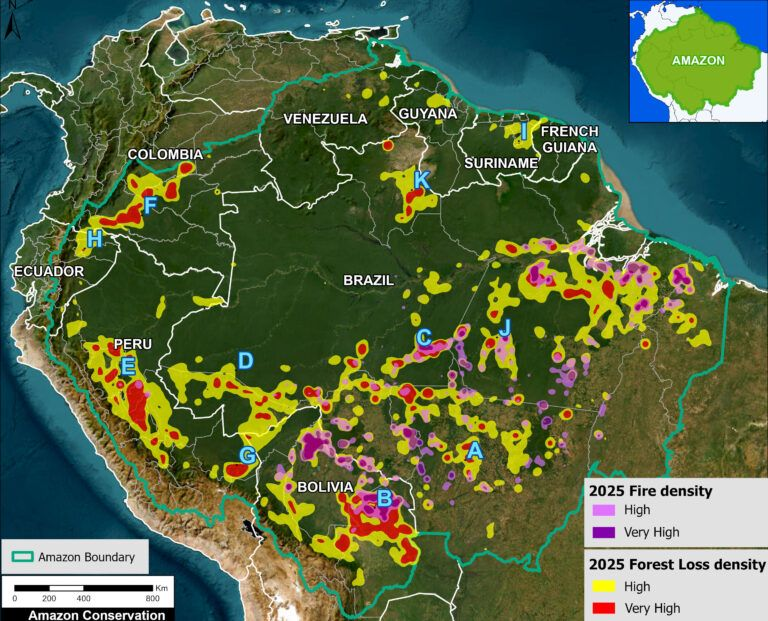
Bolsonaro’s presidential term, from 2018 to 2022, was marked by historically high rates of Amazon deforestation.
In November 2021, Greenpeace reported a 21.97% increase in deforestation compared to the previous year (2020), underscored as “the highest rate of forest destruction since 2006.”
Those numbers rose even higher in June 2022, with the Washington Post reporting an area “five times the size of New York City” cleared in just six months as a result of Amazon deforestation practices under the Bolsonaro presidency.
This writer was born in Manaus, Amazonas, in the heart of Brazil’s Amazon forest. As someone who grew up surrounded by this amazing natural ecosystem, allow me to throw some fun facts at you:
First, no, the Amazon is not the “world’s lungs,” contrary to the popular saying. That doesn’t even make sense, but it is an inaccurate generalization echoed for decades nonetheless.
Even under the logic of capitalism and survival at all costs, protecting the Amazon is essential, as it stores more than a third of all carbon in tropical forests worldwide, reports show. Studies also show that the Amazon absorbs 104 million tons of avoided CO2 emissions, which is a massive contribution to the fight against climate change.
And last but not least, the Amazon also generates rainfall across South America, is home to more than 10% of the world’s known wildlife species, and is home to over 400 tribes.
By July 2023, only a few months after Lula defeated Bolsonaro in 2022, deforestation in the Amazon dropped a whopping 34%, which was reported worldwide as a sign that Lula’s role in advocating for sustainable practices not only worked, but also acted fast.
Just a few months ago, in August, Flávio Bolsonaro stated that he doesn’t believe climate change is real.
Following the first-round results of the Brazilian election, the Associated Press published a story issuing a clear warning: “Future of Amazon rainforest policies at stake in Brazilian presidential election.”
The Brazilian left strikes back.
Yes, Brazil and its stunningly chaotic soul did just elect four Bolsonaros and Flávio to get more votes than Lula in the first round of the presidential race. But guess what? Brazil also just elected a record-breaking 35 out LGBTQ+ politicians into office, including several trans women. Among them is Erika Hilton, who received a whopping 1.5 million votes for her reelection, thus becoming the most-voted congresswoman in the history of Brazil.
Another milestone victory came from Ana Elisa, of Divinópolis, Minas Gerais, who made history at age 21 as the youngest Brazilian woman to be elected to the Chamber of Deputies since 1994. Throughout her mostly online campaign, Ana Elisa’s fundraising efforts eclipsed her opponents’, proving that the Brazilian left is alive and well on the internet — if only Lula and Brazil’s left-wing establishment can focus on communicating with its electorate where they are, abandoning all traditional ideas about political marketing in the pre-internet era.
Social media is Lula’s path to victory.
Through her own successful campaign and several viral videos discussing politics on social media, Ana Elisa has also become the Brazilian left’s poster child for running a modern online campaign that speaks to a new generation and delivers actual votes.
“The fact that I am the youngest woman elected to the Chamber of Deputies carries great symbolic weight,” Ana Elisa tells mitú in an interview. “Not only because of my age, but also because I am the first Black woman elected at the age of 21.”
She adds, “This means a great deal. In the Chamber’s 200-year history, we never had a Black woman elected at 21.”
What were the biggest contributing factors, in Ana Elisa’s view, that led to her historic victory at such a young age?
“I owe this electoral result to my own effort and persistence — despite so many obstacles, and even people within my own political spectrum who tried to undermine me. I remained active and persevered,” she tells mitú. “I also owe a lot to the presence I built on social media. For much of the time I was building my online network, I was working, too, as an intern. It was a deeply meaningful process for me. I built a network of hardworking people. People who were truly driven. That experience was a real game-changer in my life.”
Ana Elisa concludes with a “message to the voters of Minas Gerais: Thank you for believing in me. This stands as proof to everyone that money cannot buy everything.”
(As of this writing, Ana Elisa has reached 2.6 million followers on Instagram, and her latest Instagram Reel has surpassed 7.6 million views in its first 24 hours.)
Ana Elisa’s final point not only rings true for her campaign, but also serves as a wake-up call for the political establishment to listen to up-and-coming politicians who succeed with digital campaigns and actually want to make a difference in their party.
Not long ago, Alexandria Ocasio-Cortez didn’t have a voice among Democrats. Even Zohran Mamdani, at the start of his campaign, faced an uphill battle against the political establishment. In the 2008 presidential primaries, Barack Obama had that experience, too. Ana Elisa’s journey in Brazil feels reminiscent of those success stories in U.S. politics: similar challenges, similar lessons.
Two men, three weeks.
Flávio Bolsonaro and Lula have 19 days (about three weeks) until the runoff election date on October 25. While it’s true that competitive democracies are all about debating different ideas and respecting a majority’s vote, it’s quite something to see the current frontrunner of this race being the child of a man imprisoned for not accepting his loss in 2022, and how the opposing ideas of this conservative agenda aren’t just different, but are actually quite extreme.
The vote difference between Lula and Flávio Bolsonaro is the smallest first-round margin between top-two finishers since 1989. This is great news for Lula. On the other hand, candidates who enter a runoff as the most-voted candidates in the first round tend to win the whole election. That historical data point favors Flávio Bolsonaro.
The Brazilian population also needs to face the statistic that 21% of eligible voters did not cast a ballot in this first round—an unusually high number of voters who chose to sit out the election. If they show up on October 25, these results could change dramatically. Only time will tell.