
Are You Washing That Jersey? These Latino Soccer Superstitions Are Wild
In half the Latino households watching the World Cup this summer, there’s one rule nobody needs to say out loud. Don’t touch the jersey. Don’t move from the couch. And don’t even think about saying the word “campeón” before the referee blows the final whistle.
The 2026 tournament is unfolding across the United States, Mexico, and Canada. And with it, the same cábalas that Latino families have repeated for generations are back in full force. While none of these rituals has ever been proven to change a scoreline, that has never stopped anyone from following them anyway.
The Jersey That Never Gets Washed: Latino Soccer Superstitions Start With the Shirt
Probably the most widespread cábala in Latino fandom is also the simplest. If the team wins while you’re wearing a particular jersey, that jersey gets worn again for the next match. Some fans take it further and refuse to wash it for the entire tournament out of fear of breaking the winning streak. This habit is especially common among Argentine, Mexican, Colombian, and Brazilian fans.
The tradition has its own folklore. There’s a widely told anecdote about Pelé going through a scoring slump after giving away one of his jerseys, a slump that ended only when Santos tracked down and returned the shirt to him. It later turned out the jersey wasn’t even the original. That detail didn’t matter. The magic worked anyway.
The Seat Nobody’s Allowed to Leave, Another Classic Latino Soccer Superstition
Fans treat changing seats after a win as an open invitation to bad luck. Fans plant themselves on the same couch cushion, the same kitchen chair, or the same corner of the bar for every match. Some families can take it even further, requiring everyone in the room to sit exactly where they were sitting when the team started scoring. If someone shifted position right before a goal against, they already know who gets the blame.
Painted Faces and Borrowed Flags: The Loudest Latino Soccer Superstitions
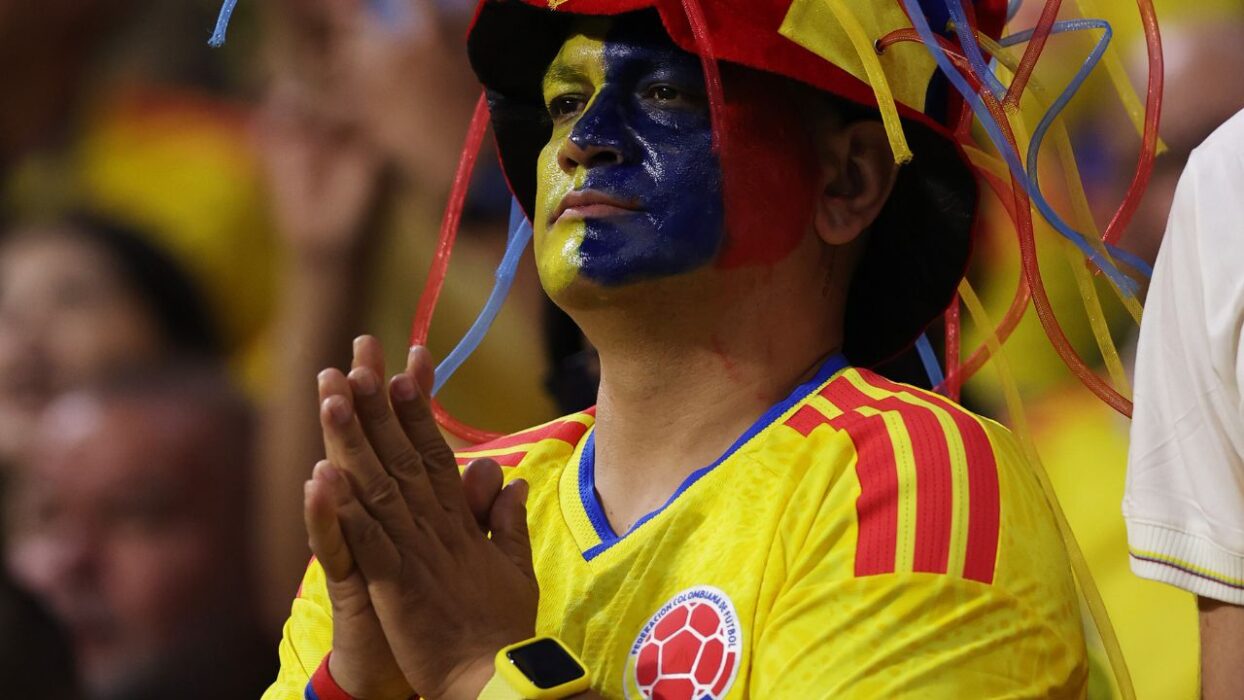
Not every ritual is about avoiding disaster. Painting your face, wearing wigs, hats, and flags in the national colors is as much an emotional gesture as a superstition. Cities with large Latino populations, including Miami, Los Angeles, Houston, and New York, are places where this kind of display is part of the standard World Cup atmosphere.
The Friend Who Isn’t Allowed to Watch and the Group That Can’t Change
Some families treat the guest list like part of the strategy. If the team won while watching alongside certain relatives or friends, that exact group gets reassembled for every subsequent match. Fans might even rearrange travel plans and work schedules just to keep the formula intact.
Then there’s the opposite problem. There’s always one person who, by unanimous family decision, is banned from watching the game because the team always seems to lose when they’re in the room. Argentines call this person “mufa.” In Mexico, the word is “salado.” Sometimes that person accepts their fate. Other times, they sneak off to watch the match alone on their phone in another room so nobody finds out.
The Halftime Rituals That Decide the Second Half
Halftime isn’t just a break for snacks. For many fans, it’s the moment to reset the energy entirely. Some families might turn the jersey inside out if the team is losing, flip the channel, and back again to “restart” the energy, light a veladora, especially common in Mexico, pray outright for a goal, or deliberately change seats if the first half went badly, while staying frozen in place if it went well. Whatever the specific combination, the rule is the same in every household.
The Menu and the Mate That Never Change
Food carries its own cábala. Some families prepare the exact same meal every time their team plays, an asado in Argentina, tacos in Mexico, a parrillada in Uruguay. Colombian fans do the same with bandeja paisa and often dress the whole household in yellow, down to the socks, while Argentine fans treat mate with particular care. If the team won while the mate was bitter, nobody is allowed to add sugar the next time around.
Faith shows up at the table too. Fans across Mexico, Argentina, and Brazil pray, visit churches, light candles, or carry religious cards into decisive matches. Some go further still. Some fans promise pilgrimages, tattoos, or personal sacrifices if their team advances.
Even World Cup Legends Follow Their Own Superstitions
Players are not immune. Ronaldo Nazário shaved his head into the famous “casquito” before Brazil’s 2002 final, explaining that the cut was meant to pull press attention away from an injury he was managing under pressure. Brazil won that final. Fernando Torres reportedly ate the same plate of pasta with tuna before every match, always at the same time.
Gianluigi Buffon wore the same thermal undershirt beneath his uniform throughout every major tournament until Italy was eliminated. Gennaro Gattuso packed his suitcase before a match against the Czech Republic in case Italy lost and went home. Italy won, so he packed his bags before every match for the rest of that tournament.
Mexico, Argentina, Colombia, and Brazil Each Play by Different Rules
Every country layers its own specific customs on top of the universal ones. In Mexico, fans light candles to the Virgin of Guadalupe, visit shrines before matches, and enter the stadium through the same gate every time, stepping in with their right foot first. A losing jersey gets put away until its bad energy passes.
In Argentina, where devotion to Diego Maradona is serious enough to have its own Church of Maradonismo, mate gets prepared the exact same way on match day, with no exceptions to how it’s brewed. For their part, Colombian fans repeat whatever dish brought a win, often bandeja paisa, and dress the household in yellow.
And in Brazil, entire neighborhoods decorate their streets in the national colors before the tournament starts. There’s also a belief that sweeping the house on match day sweeps the good luck out along with the dust.
Saying “Campeón” Too Soon Is the Fastest Way to Jinx It
A handful of rules cross every border. Fans avoid saying the team will win before the match even starts, and refuse to celebrate a goal until the referee confirms it, sometimes holding back the shout entirely. There’s also the phrase “anulo mufa,” used across Latin America to cancel out bad luck the moment someone gets ahead of themselves and mentions a possible victory out loud.
Other rules pile on: keep the same goal celebration every time, since changing it might affect the outcome; turn off the television if the team is losing late so the comeback has room to happen unseen; and never say the score out loud, especially when it’s good.
What Anthropologists Say About Latino Soccer Superstitions
Miguel Lisbona Guillén, a researcher at UNAM’s Center for Research in Multidisciplinary Humanities and Social Sciences, told Infobae that human beings rely on symbols and rituals to organize experience and make sense of the world around them, and that soccer offers one of the clearest modern stages for that instinct.
The parallels with religion run further than most fans realize.
Infobae cited the case of Ángel María Villar, former president of Spain’s soccer federation, who has described asking the Virgin of Guadalupe for Spain’s 2010 title and watching players visit her shrine afterward to give thanks. Croatia’s national team attended mass before its 2026 World Cup campaign, according to Infobae. Lisbona Guillén and Miguel A. Rivera explored the same overlap in their article “El Niño Dios va al fútbol,” which examines a religious figure dressed in the Mexican national team’s colors as a symbol of how popular devotion, national identity, and soccer fandom fuse into one.
None of this requires anyone to believe the rituals actually change what happens on the field. However, many psychologists see real value in the habits anyway, since they help fans manage their nerves and feel some control over a result they can’t actually influence. They also do something less measurable but just as real. They turn watching a game alone into something that belongs to a whole family, repeated the same way, year after year, tournament after tournament, whether the team wins or not.