
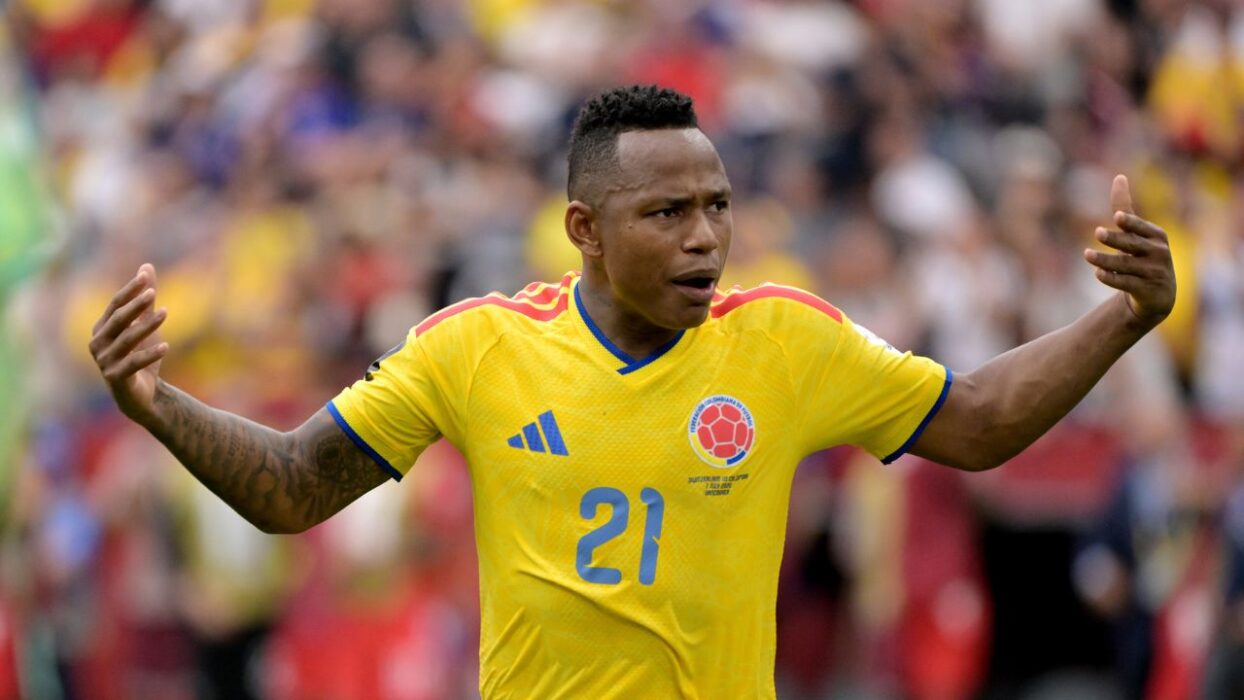
Colombian Midfielder Jáminton Campaz Is in Hiding After Death Threats. For His Country, This Feels Like Déjà Vu
Swiss captain Granit Xhaka played a backward pass directly to the wrong man in the 115th minute of extra time. Jáminton Campaz intercepted it, went clear through on goal, and attempted to curl a first-time finish past goalkeeper Gregor Kobel. He got too much under the ball and sent it over the crossbar.
The match at BC Place in Vancouver ended scoreless. Switzerland beat Colombia 4-3 on penalties. Campaz stepped up and converted his own spot-kick during the shootout.
Since then, the 26-year-old midfielder has received a wave of death threats on social media, declined to board the team’s return flight to Bogotá, and gone into hiding. His whereabouts remain unknown.
In Case You Missed It, Here’s What Happened
Colombia and Switzerland met in the round of 16 on July 8 at BC Place in Vancouver. Neither team scored in 90 minutes, and the match went into extra time.
Then, in the 115th minute, Xhaka made a rare error: a backward pass that Campaz collected in open space and carried into a one-on-one with Kobel. The shot did not find the net. The match went to penalties. Campaz scored his kick. Colombia still fell 4-3, ending their World Cup campaign in the round of 16.
The Threats, and Jáminton Campaz’s Decision Not to Go Home
After the match, hostile comments and death threats flooded Campaz’s social media accounts, per ESPN. He limited comments on his accounts as a precaution.
When the Colombian squad boarded their return flight from Vancouver to Bogotá, Campaz was not on the plane. He had been scheduled to fly alongside teammates Davinson Sánchez, James Rodríguez, and Juan Fernando Quintero. He never boarded. As of this weekend, it is unclear whether he remained in the United States or traveled to Argentina, where he plays for Rosario Central.
In His Own Words
On Thursday, Campaz posted a statement to Instagram alongside a photo of himself with his face covered.
“Football is also made up of difficult moments,” he wrote. “My Colombia, please let us never lose sight of respect. We may think differently or feel frustration and sadness, but no passion justifies hatred or living in fear.”
In a longer statement, Campaz reflected on what representing Colombia had meant to him. “Since I was a child, I dreamed of defending Colombia’s colors, hearing the anthem, representing millions of people, and scoring a goal in a World Cup,” he wrote. “Today, I can only thank God for allowing me to fulfill that dream. These are memories I will carry with me forever.”
He also thanked the fans who stayed with the team and his family. “I want to sincerely thank everyone who stood by us during this World Cup, those who believed in us, cheered us on until the very last minute, and never lost faith. Thanks also to my family, who have been my strength at every step.”
On the result: “To the entire country, I can only say that I share the pain of this elimination. We, too, dreamed of advancing further, and I know the sadness we feel today as Colombians. I deeply regret not being able to bring you the joy we all hoped for, but I want you to know that there was never a lack of dedication, commitment, or love for this jersey. I gave everything I had on the pitch, and I would do it a thousand times over for my country.”
Colombia’s Federation Demands Criminal Prosecution
On July 10, the Colombian Football Federation (FCF) issued a formal statement condemning the threats and calling on the country’s attorney general to expedite a criminal investigation.
“No athlete, nor any member of their inner circle, should be subjected to intimidation for representing their country in a sporting arena,” the federation said.
The federation called on fans to ensure sporting disappointments never translate into real-world aggression. “Football must be a space for unity, respect, and hope,” the federation said.
“The executive committee of the Colombian Football Federation expresses its full solidarity with and support for Jaminton Campaz, his family, all the players in the Colombia national team, and the delegation as a whole,” they added.
The Shadow of 1994
In 1994, Colombian defender Andrés Escobar scored an own goal in a 2-1 group stage loss to the United States, a mistake that contributed to the team’s early World Cup elimination.
Days after the team was eliminated and returned home, Escobar was murdered in Medellín.
As we reported earlier, Escobar returned home despite warnings from his family. After leaving the El Indio nightclub in Medellín, he was confronted by brothers Juan Santiago and Pedro David Gallón Henao, drug traffickers linked to paramilitary groups, and their bodyguard, Humberto Muñoz Castro. Muñoz Castro shot Escobar six times. Escobar died 45 minutes after arriving at the hospital.
Muñoz Castro was sentenced to 43 years in prison and served eleven. He has been free since 2005, per mitú. The Gallón Henao brothers served fifteen months of house arrest for concealing the crime. Juan Santiago Gallón Henao, who later resurfaced in investigations linking him to drug trafficking and paramilitary financing, was shot and killed as he entered a restaurant in Mexico in February 2026.