
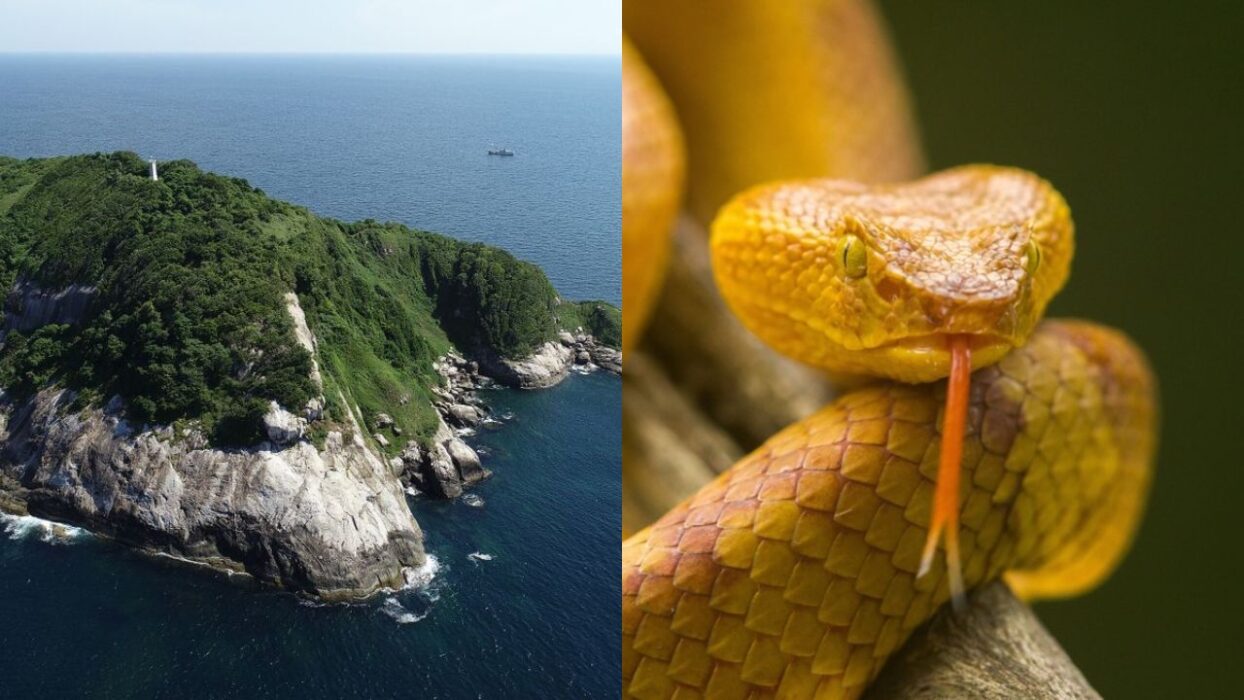
Humans Literally Can’t Go Here: Inside the Island That’s Too Dangerous to Visit
There’s a place on Earth where it’s illegal for humans to visit. Not because of a war or a natural disaster. It’s an island off the coast of São Paulo, roughly 21 miles offshore in the Atlantic Ocean, where the danger comes entirely from the ground beneath your feet. Snakes. Thousands of them. So many and so venomous that one bite can kill an adult human in less than an hour.
We are talking about Ilha da Queimada Grande. The English name is Snake Island, though that barely captures what it actually is. It’s a small, rocky island about 106 acres—smaller than most city parks—yet it’s home to one of the highest concentrations of snakes anywhere on the planet. And they’re not just any snakes. They’re a species you can’t find anywhere else. A golden lancehead viper, endemic to this one island, with venom so lethal it has earned the nickname “the most dangerous snake in the world.”
The Brazilian government banned human visitors in 1985. The only people allowed on the island now are research scientists with special permits, and even they go in protective gear. For most people, Queimada Grande exists only in stories, in documentaries, in the kind of place you read about and think: I’m grateful I don’t have to go there.
Why This Island Became a Snake Reservoir
Around 12,000 years ago, rising sea levels cut Queimada Grande off from mainland Brazil. When that happened, the snakes—particularly the golden lancehead vipers—became trapped. With no competition from other predators or snakes for food, and with an isolated population of a few hundred to a few thousand snakes, the species began to evolve in a direction shaped entirely by the island’s unique conditions.
The snakes slowly specialized. According to Smithsonian Magazine’s research on the island’s evolution, the golden lancehead developed venom roughly five times as potent as that of its mainland relatives. For scientists, this is the result of thousands of years of evolution responding to the island’s specific pressures. On the mainland, a lancehead viper hunts rodents, birds, and smaller prey. Its venom is powerful, but it doesn’t need to be devastating. On Queimada Grande, where prey is limited and every meal matters, the snakes evolved venom that acts faster and kills more efficiently.
The result is a viper with venom so powerful that it can dissolve the skin and muscle of its prey before the animal can even escape. A human bitten by a golden lancehead might experience severe tissue damage, kidney failure, and in some cases, brain hemorrhaging. Death can come within an hour if left untreated, though treatment requires access to antivenin that’s rare and difficult to produce.
The Human History That Led to Isolation
The island wasn’t always forbidden. For centuries, it was virtually unknown, just another rocky outcropping in the Atlantic. The island consists partly of barren rock, a result of deforestation. In fact, that is where its name comes from. Queimada means “burned” in Portuguese. The island was transformed by locals’ attempts to clear land for banana plantations by burning. In the early 20th century, a lighthouse was built to keep ships away from the island. When the lighthouse was automated, the last human resident left.
Researchers then began studying its unusual snake population. Scientists recognized that Queimada Grande represented an exceptional evolutionary story frozen in time, a place where a single species had undergone dramatic adaptation in complete isolation.The danger became apparent quickly. Between the 1960s and 1980s, a handful of people visited the island—mostly researchers, fishermen, and daredevils. Several died. According to documented accounts by travel researchers, a lighthouse keeper who lived on the island in the 1920s was one of the few to survive extended periods there, likely because he was extremely cautious and lucky. By the time the Brazilian government recognized the threat, it became clear that the island needed protection not just for the snakes, but for human safety.
In 1985, Brazil officially banned public access to Queimada Grande Grande. No visitors were allowed without explicit government permission.
The Island Becomes a Conservation Question
What makes Queimada Grande complicated isn’t just the danger of the snakes. It’s that the snakes themselves are dying. The golden lancehead viper is critically endangered, with its population steadily declining over the past few decades. According to conservation research, the population has declined due to a range of factors: the loss of bird species that the snakes depend on for food, the changing climate affecting the island’s ecosystem, and the introduction of invasive species that have disrupted the island’s delicate balance.
For scientists, this creates a paradox. The island needed to be protected from humans to prevent deaths. But the snakes on the island are disappearing, and the only way to study the problem—the only way to potentially save the species—requires researchers to go to the island and risk their lives.
The Brazilian government has responded by allowing a small number of qualified herpetologists to visit, subject to strict protocols. They wear protective equipment, move carefully, and document everything they find. The research has become one of the only ways to understand what’s happening to the population and what might be done to save it.
What Happens When Humans Respect Nature
Queimada Grande exists in our imagination as a kind of boundary. It’s a place where nature makes it clear: you are not welcome here. Not because the island is hostile in some metaphorical way, but because the basic act of being on the ground—the moment your foot touches the earth—can kill you.
That clarity is rare. Most dangerous places in the world are dangerous because humans have made them that way, or because they’re unpredictable. But Queimada Grande is dangerous in the simplest, most honest way possible: there are snakes here that will kill you if you step on them, and there are so many of them that stepping on one is almost inevitable.
In a world where humans have carved up and modified almost every landscape on Earth, Queimada Grande stands as a place we’ve agreed to leave alone.