
As Tourists Pack Mexico’s Día de Muertos, Families Ask for Room to Grieve
A few years ago, Martha Nashieli went to the cemetery in San Andrés Mixquic, a village at the edge of Mexico City, to lay flowers on her father’s grave and was told to wait outside. “They wouldn’t let me in,” she told CNN’s Rocio Muñoz Ledo. “I was frustrated because he’s my dad, I’m from here, and they weren’t letting me enter because there were seas of people.”
Mexico City’s government counted about 100,000 visitors at the Mixquic cemetery over three days last year, from Oct. 31 to Nov. 2, close to seven times as many people as live in the village, CNN reported. This year, Día de Muertos again filled Mexico City with parades, giant Catrinas, and international visitors. Simultaneously, researchers at the National Autonomous University of Mexico (UNAM) warned that the crowds and the money are changing how, and for whom, the holiday is celebrated.
In San Andrés Mixquic, the Cemetery Has Run Out of Space for Mourners and Visitors
On Nov. 1 and 2, families across Mexico gather at the graves of their loved ones with marigolds, copal incense, candles, songs, and offerings. In Mixquic, they now do it surrounded by tourists, who walk among the headstones with cameras and flashes as families keep vigil. Nashieli, 40, has seen visitors among the graves since childhood and isn’t asking them to stay away, but she said the space can no longer hold everyone.
“Suddenly, something intimate becomes — I wouldn’t want to put it this way — but it becomes a spectacle, doesn’t it?” Nashieli said. “And this is something intimate, something very private. At each grave, there’s a sense of communion.”
Authorities once built a bridge above the cemetery, letting visitors view the graves from overhead and leaving the ground to the families, said Driselda Sánchez-Aguirre, a UNAM professor whose work has examined mass tourism in Mixquic. It left some residents feeling watched “like little animals in a zoo,” and the bridge was used only once, she told CNN. For now, Mexico City’s official tourism guide recommends that visitors ask families before photographing them and keep their flash off. Mayor Clara Brugada has said the cemetery is running short of burial space and promised to address it, though her plan doesn’t deal directly with the crowds.
“When the cemetery exceeds its physical capacity, individual responsibility gets lost in the crowd,” Sánchez-Aguirre said, arguing that simply asking tourists for respect is not enough. Visitors who see others using flash or stepping on graves may conclude that “this is what everyone does,” she said. She proposed briefing visitors at the entrance and telling them, “You are entering a sacred space where families keep vigil over their loved ones.”
“So, we invite them to come respectfully – to come live our tradition, to get to know it, to preserve it, to take it back to their own homes,” Nashieli told CNN during last year’s celebrations.
Mexico City’s Día de Muertos Parade Began as a Scene in a James Bond Movie
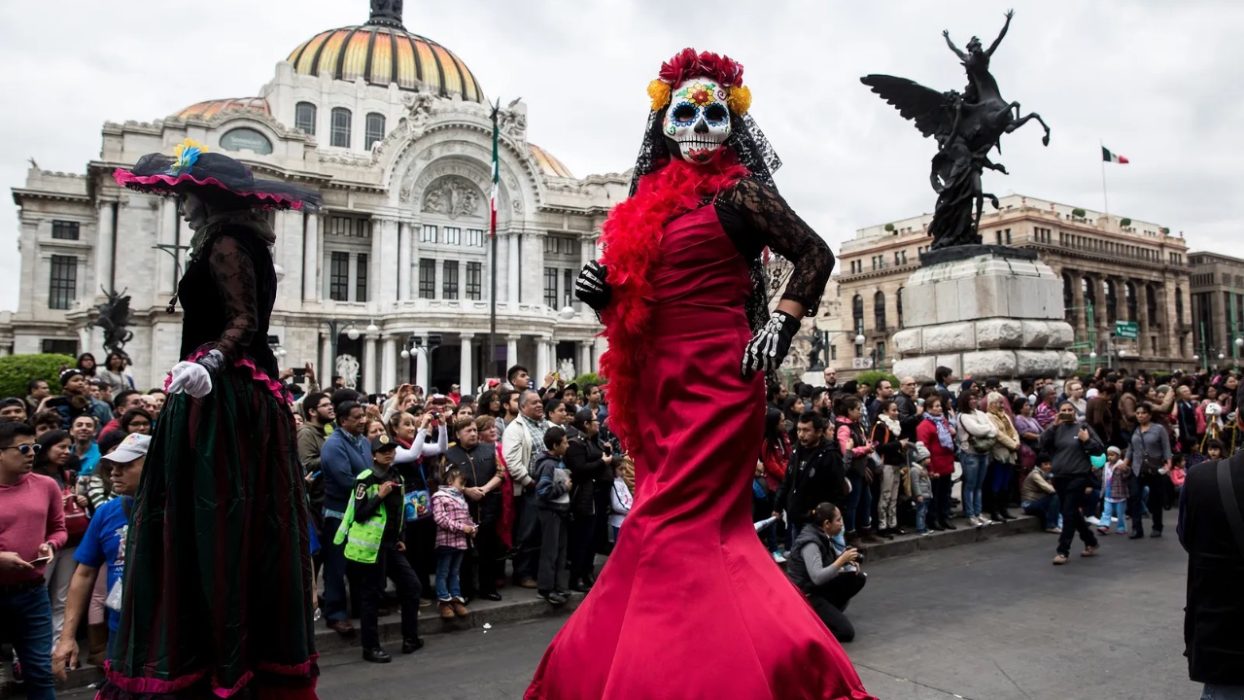
In the capital, the celebration has grown into a month of events. The Gran Desfile de Día de Muertos, held on Saturday, Oct. 31, for the 10th time, drew 1.6 million Mexicans and tourists and brought together 4,000 artists, according to the Spanish news agency EFE. The parade ran along Paseo de la Reforma to the Zócalo, where the city installed a monumental Catrina more than 33 meters tall that Guinness World Records certified as the tallest in the world.
The parade was created after the 2015 James Bond film “Spectre” imagined a massive Día de Muertos procession through Mexico City, a scene the government liked enough to turn into a real event, El País reported. The film’s opening sequence inspired the first parade in 2016, according to UNAM Global, the university’s news outlet. The Mega Procesión de Catrinas, which drew 20,000 people from the Ángel de la Independencia to the Zócalo on Oct. 25 for its 13th edition, was created by a collective of makeup artists together with the city government and describes itself as a project born “with the purpose of strengthening and preserving the Día de Muertos tradition at a time when Halloween was beginning to gain a greater presence in Mexico,” El País reported.
“Our traditions shouldn’t be overtaken by commercialization or the idea that this parade is something (like) ‘Disneyland.’ Our culture is incredibly rich and has other concepts and cultural values,” Luz María, 57, told EFE at the parade. She also drew a line between death that comes naturally, which Mexicans celebrate, and the more than 133,000 people who have disappeared in a country where thousands of families across many states build altars for the disappeared and for those killed amid rising violence.
Mexico City hosted about 5,000 Día de Muertos activities this year, generating up to 12 billion pesos for the city. And the celebrations nationwide are expected to generate 53 billion pesos, about $2.9 billion, a 7% increase over 2025. This year, the holiday also overlapped with the Formula 1 Grand Prix weekend in the capital, which El País reported can bring up to 21 billion pesos into the local economy.
For Many Visitors, Día de Muertos Now Comes as a Package
A Día de Muertos weekend in Mexico City can cost a foreign visitor up to 10,000 pesos, El País reported. For that price, the Journey Mexico “Day of the Dead Experience” package includes a private after-hours tour of the National Museum of Anthropology, visits to altars in Coyoacán and San Ángel, the celebrations in the Zócalo, and a candlelit cemetery visit in Mixquic. An Airbnb experience baking pan de muerto with a local baker costs 1,000 pesos, and a trajinera ride through the canals of Xochimilco on the night of Nov. 1 costs twice that.
Most holiday hotel guests, though, are Mexican. Mexico’s Tourism Secretariat projected that 1.69 million tourists would stay in hotels during the festivities, including 1.25 million domestic travelers and 450,000 international visitors, according to Tourism Secretary Josefina Rodríguez Zamora. “Día de Muertos is a display of the identity that connects us with our roots, that celebrates our history, and that blooms in each region in a different way,” Rodríguez Zamora said.
María Angélica Galicia Gordillo, an anthropologist at UNAM’s Institute of Anthropological Research, told El País that in big cities the holiday has turned into a show. “It’s for the tourists, not for devotion. As long as you folklorize an element so traditional and so deeply rooted, it’s going to be commercialized,” she said. Of mass tourism’s benefits, she added, “You make the rich richer, that’s all. Not the community.”
Tourism revenue tends to flow to travel agencies, intermediaries, and companies based outside the communities. At the same time, residents take on the organizing, cleaning, cooking, and hosting.
In Michoacán, “Coco” and the Crowds Have Changed What Visitors Expect to Find
“I think the point is to distinguish between what it is to celebrate the tradition and what it is to show it. They are two things,” Cristina Oehmichen, an anthropologist at UNAM’s Institute of Anthropological Research, told UNAM Global.
When tourism gains weight, rituals can start to be scheduled around tour itineraries, and the most colorful, photogenic elements get priority. At the same time, everyday community practices drop out of the picture. On the island of Janitzio, in Michoacán, research documented visitors posing in front of families at prayer and even stepping on graves. The university also warned of cultural homogenization, in which regional traditions, such as the altars of Michoacán’s Purépecha communities, give way to a single, uniform image of what Mexican looks like.
Pixar’s “Coco” has also shaped what visitors look for. A study involving Ilia Alvarado Sizzo, a geographer at UNAM’s Institute of Geography, documented visitors arriving in Santa Fe de la Laguna, in the Lake Pátzcuaro region, searching for “Mamá Coco.” In Paracho, guitar makers began producing more white guitars inspired by the one in the film, though many were traditionally made in natural wood tones. In December 2025, Rodríguez Zamora said the film had boosted Japanese tourism to Mexico by sparking interest in the holiday.
Galicia Gordillo, for her part, criticized the foreign romanticization of the holiday in media products like “Coco,” but credited the Catrina boom that followed “Spectre” with pushing back against Halloween. “The kids stopped dressing up as witches or gringo monsters, and now they’d rather dress up as Catrines and Catrinas,” she told El País.
Día de Muertos Has Been Changing for Five Centuries
The Nov. 1 and 2 observances arrived in Mexico in the 16th century, shortly after the Spanish conquest, and today’s celebration reflects a blend of Spanish and Indigenous cultures. Franciscan churches in Texcoco, Tlaxcala, and Mexico City were the first to mark the days with offerings that included corn, bread, chickens, and even cacao, according to Mexico’s National Institute of Anthropology and History. Similarly, the Mexican state has also reshaped it over the centuries, according to Veka Duncan, author of a new book on the history of Día de Muertos, “Entre Flores nos reciben y entre ellas nos despiden.” The creation of civil cemeteries in the 19th century changed how Mexicans honored their dead, revolutionary nationalism later framed the holiday as Mexican, Indigenous, and secular, and tourism programs such as Pueblos Mágicos have helped spread it more recently, Duncan told El País.
“In reality, almost everything we might think of as a tradition is a much more recent invention than we’d like to think […] Traditions never stay static,” Duncan said.
“A tradition that doesn’t change dies […] What’s important is not to forget that celebrating death in Mexico is about remembering the connection with our ancestors,” Galicia Gordillo told El País.