
Americans Turned Tulum Into a Gold Rush. Now They’re Leaving, and Locals Are Left to Pick Up the Pieces
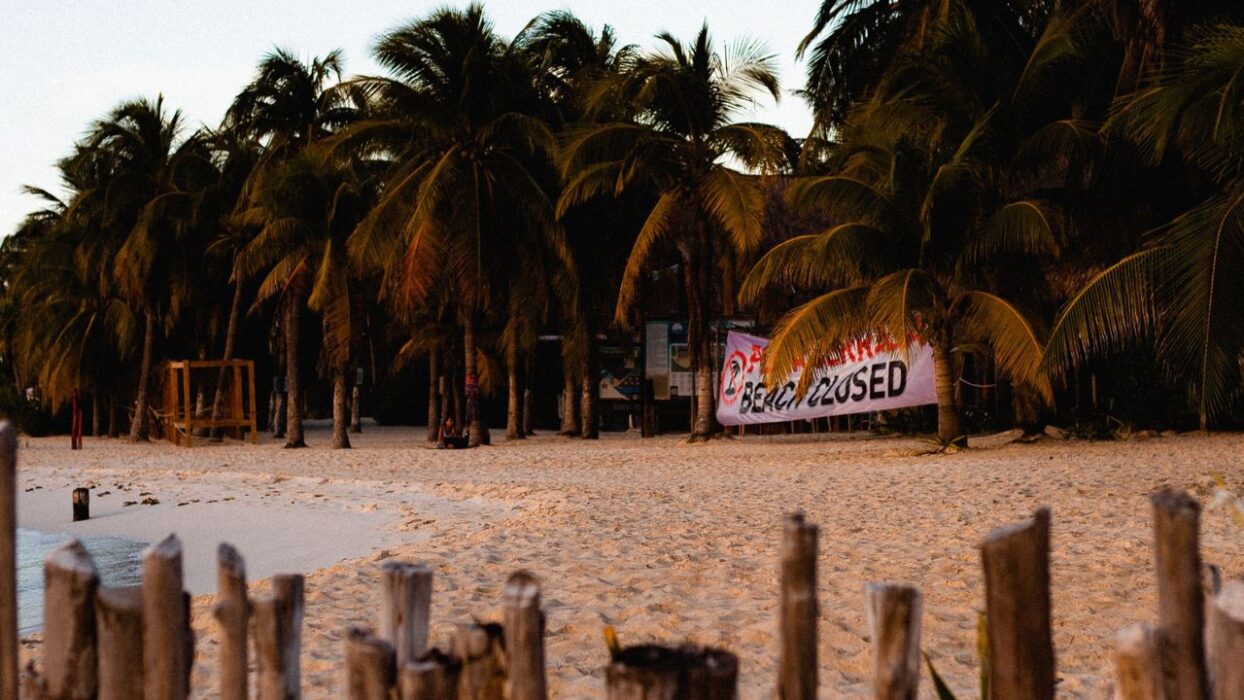
Many of those who found a new home in Tulum are now setting roots elsewhere. Up until a couple of years ago, it was considered “the gem of Mexico.” Today, it is a ghost town, where nearly half the shops now sit closed, according to journalist Helen Jennifer.
However, Tulum did not fall apart on its own. It is another example of how human mobility across borders shifts. Tulum built up fast, sold hard, and was picked over by the same people who once couldn’t stop posting about it, Americans included. And now that the town is buckling under the weight of that attention, the people who profited from the boom are simply leaving. Meanwhile, the Mexican workers who built it are the ones left to absorb the collapse.
Tulum: A Dream Built for Export
Tulum’s appeal was never really about, well, Tulum. It was about what it represented: that the version of the American dream people couldn’t afford at home was suddenly available for a fraction of the price a couple of hours south of Cancún.
“We’ve always known Tulum was the exception,” Matteo Luthi, COO of Journey Mexico, told Travel Weekly last November. “You’d spend a lot of money, but the return was huge. People loved it because you’d arrive, kick off your shoes, forget your watch and relax. There were beautiful beaches, great restaurants and a relaxed, mellow vibe.”
Locals and foreign investors raced to build and support that fantasy: restaurants, hotels, beach clubs, condos, Jennifer reported. It was, in words of locals, a “gold rush.”
But Then, It Turned Ugly
Gold rushes are precisely that: rushes. As demand outpaced supply, Tulum’s charm curdled into aggressive perversion. “They have thought of every scam under the sun,” said a former resident quoted by Jennifer. She recounted a night out with friends that ended with a bar handing them a bill for a bottle of liquor they never ordered. The bill came out to roughly $700, and some in the group were able to talk it down from there.
Luthi argues plain overconfidence. “They went too far,” he told Travel Weekly. “Prices kept rising, and there was less loyalty to the tourism industry, to the agencies and tour operators that helped drive customers. The attitude [of hotels and businesses] became arrogant. Businesses knew they were the hot ticket. And if you didn’t like what they were selling, that was fine, because they were still making money. They stopped going the extra mile.” He described a town that lost its sense of scale entirely. “We’re talking about four kilometers of beachfront with just one road in and out. People kept building hotels, restaurants and nightclubs, and greed took over. What used to be an ecological beach town of small, 20- or 30-room hotels turned into five-story developments. It changed the demographic completely.”
That overbuilding strained everything underneath it. Tulum’s roads, power grid, cell service, and Wi-Fi were never designed for the volume of people now passing through them. And Luthi said the traffic alone could add half an hour or more to a trip across a town that’s only a few miles wide.
The Ocean Turned on Tulum Too
Even nature stopped cooperating. Roughly 15 years ago, per Jennifer’s video, a seaweed called sargassum began washing ashore in quantities no one had seen before. According to Mexican outlet ArgosLatino, scientists identified a new source of the algae in 2011, the “Great Atlantic Sargassum Belt.” That is, a mass stretching from West Africa to the Gulf of Mexico and the Caribbean. It grows for three main reasons, ArgosLatino reported. These include fertilizer and wastewater runoff pouring into major rivers like the Amazon, the Orinoco, and the Mississippi. Warming ocean temperatures, in which sargassum thrives. And iron- and phosphorus-rich dust blown across the Atlantic from the Sahara. Ocean currents and trade winds carry the algae north from the equatorial Atlantic. And the shape of the Yucatán Peninsula funnels it straight into Quintana Roo’s coastline.
By June 2025, Tulum workers were clearing sargassum off the beaches by hand, with shovels and wheelbarrows. The municipality had already collected 1,900 tons of it by that point in the year, more than the 1,300 tons collected in all of 2024. And hotel officials and business owners told CNN it was the worst year for sargassum since 2018.
“It’s a Caribbean-wide issue,” Luthi said, “but it hits Tulum harder because it’s a protected area. You can’t bring in machinery to clear it. Sometimes there are two or three yards of it before you reach the water.” ArgosLatino reported the smell of the decomposing algae has been enough on its own to push many travelers toward Acapulco or Los Cabos instead.
Paradise, But Only if You Can Afford the Toll
By Mexican law, Tulum’s beaches are supposed to be free and open to the public. In practice, according to Jennifer’s report, hotels and clubs routinely block the path.
The flashpoint has been Parque del Jaguar, a park built around Tulum’s archaeological zone and beaches, now managed in part by Mexico’s Secretariat of National Defense (SEDENA). According to ArgosLatino, foreign visitors pay $25 to enter, hours are capped between 8 a.m. and 5 p.m., and transportation inside the park is frequently mandatory and costly. Hotels have privatized most of the best beaches, leaving residents and domestic tourists with the rocky, sargassum-choked stretches instead. And the closure of the once-popular Playa Paraíso under the park’s new boundaries left that beach deserted. Archaeological site visits dropped 33% in the first half of 2026 compared to the year before.
Getting to Tulum in the first place hasn’t been easy either.
The Felipe Carrillo Puerto Airport, which opened in late 2023, has struggled to hold onto carriers. “They built an airport, but it’s so complicated,” Luthi told Travel Weekly. “Flights have been canceled because demand isn’t there. The airport is 40 minutes from town, and depending on traffic, it can take an hour to reach your hotel. Then there’s the pickup fee from taxis, which ranges from $60 to $100, some of the highest in the country. It just doesn’t make sense.”
Small business owners have described a parallel squeeze from local government. According to ArgosLatino, garbage collection fees jumped from a few hundred dollars to over $10,000 without explanation. And some business owners compare municipal inspectors to organized crime, showing up looking for any reason to fine a business or collect a bribe, sometimes demanding payment in cash only.
For its part, the Mexican government has tried to respond.
Last November, Secretary of Tourism Josefina Rodríguez Zamora announced new agreements guaranteeing free public beach access in Tulum and simplifying entry to Jaguar Park, the first actions from a Strategic Actions Coordination Committee for Tulum created under President Claudia Sheinbaum Pardo, according to Travel Weekly.
Two new public access points opened in the hotel zone, at Playas Conchita and Del Pueblo, along with a southern entrance inside Jaguar Park itself. Similarly, a unified pricing structure was introduced for the park, the archaeological zone, and the protected natural area, with Tulum residents guaranteed free, year-round access to their own beaches.
Whether that’s enough to undo years of privatization is still an open question.
When Paradise Turns Dangerous
As demand for drugs grew alongside the party scene, rival cartels moved in to fight over the market. And violence followed. “My first two months living in Tulum, there was almost a shooting in Tulum every week,” one immigrant told Jennifer. “I’m talking about in main tourist spots in Tulum.”
That fear became official in March 2025, when Tulum’s municipal Secretary of Security, José Roberto Rodríguez Bautista, was assassinated in an armed attack, according to Quintana Roo’s Attorney General’s Office, cited by CNN en Español. Quintana Roo Governor Mara Lezama condemned the killing publicly. As of last fall, the U.S. State Department was still listing all of Quintana Roo at Level 2 on its 4-level travel advisory scale, urging Americans to exercise increased caution, stick to well-traveled tourist areas, and be especially careful after dark.
The Workers Tulum’s Boom Left Behind
For every foreigner posting a farewell video, there’s a Mexican family who never had the option to leave when things got good, and now has no choice but to leave now that they’ve gotten bad. TV Azteca told the story of a worker known as El Chuchuy and his family, who arrived in Tulum from Veracruz hoping to build a better life through honest work. For years, they were part of the machinery that ran the hotels, clubs, and shops behind what the world saw as a Caribbean jewel. That stability didn’t last. By November 2025, amid what TV Azteca described as a perceived tourism crisis, the family was living in precarious conditions on the edges of town, in an informal settlement of dirt roads and makeshift housing built for the workers who service Tulum’s tourism industry but were never meant to be seen by it.
As key spaces closed and violence increased in the region, TV Azteca reported, more families made the same calculation: leave Tulum and return to where they came from, or move on to another town in the Yucatán interior. El Chuchuy’s family eventually reunited in one of those pueblos, where daily life is uncertain in a different way than tourist-zone precarity. Some days, there isn’t enough food. Decades of physical labor in the tourism industry have taken a visible toll on El Chuchuy himself, who can no longer walk normally, according to TV Azteca. His story has become, in the outlet’s words, a symbol of how fragile an economic model can be when it goes from boom to uncertainty within a matter of years.
Was This a Blip, or a Reckoning?
Not everyone believes Tulum’s decline is permanent, and the data is genuinely mixed depending on when you look. Quintana Roo tourism figures showed hotel occupancy in Tulum’s coastal zone falling to around 30% last summer, with the town center dipping as low as 15%, according to Travel Weekly. For their part, United and JetBlue cut flights, and Air Canada canceled its seasonal route outright. But by the fall, the numbers had started climbing again: from 53.3% occupancy in mid-August 2025 down to 48.1% in early September, then back up to 59.8% in late October, 63.6% the following week, and 69.1% by the first week of November, according to Quintana Roo’s Tourism Secretariat, cited by CNN en Español.
David Ortiz Mena, president of the Tulum Hotel Association, told CNN the numbers were running about four points below 2024 levels, but pushed back on the idea that Tulum was in crisis, arguing that summer is naturally the slow season and pointing to signs of “a clear recovery” heading into winter. He blamed most of the summer slump on economic anxiety back in the United States, which supplies around 60% of Tulum’s tourists: inflation, interest rate changes, and a 43-day federal government shutdown that left many federal employees without pay, all of which made Americans cut back on travel. “Tulum is still a great destination,” Ortiz Mena said. “It has a lot to offer. Unfortunately, the bad gets highlighted so much, and then it’s hard to get the good news across.”
Tulum council member Eliazar Mas Kinil agreed the U.S. economy has an outsized effect on the town.
“The United States is our neighbor,” he told CNN. “So everything that happens there impacts us. In the end, I think the American consumer holds onto their money and says, ‘I’m not going to move until I know what’s coming.’” He predicted a much stronger season by December and January, and both officials pointed to the 2026 World Cup, which Mexico co-hosted with the U.S. and Canada, as a potential boost.
However, Hazael Cerón, who studies tourism competitiveness at Universidad Anáhuac, offered a more sober read. He told CNN that Tulum’s real problem is the absence of strategic planning behind the boom that followed the pandemic and public projects like the Tren Maya and the new airport. Room rates have held roughly steady, he noted, but taxi fares run high, and some vendors charge as much as 200 pesos, about $10.50, for a single coconut. “Suddenly we see the basket of golden eggs,” Cerón said, “and we want to squeeze it dry, and that’s what happened.” He called Tulum “a warning sign” for other Mexican destinations chasing the same kind of rapid growth. “It happened because of the boom that was generated, the Tren Maya boom, the airport boom,” he said. “But we need to heed that warning so we can apply it to other destinations and have planned tourism instead of reactive tourism.”
Whatever recovery officials were forecasting for the winter of 2025 into 2026 doesn’t square with what Jennifer, TV Azteca, and ArgosLatino all found once they went looking this summer: empty shops, an emptied-out hotel zone, and Mexican families packing up and leaving town for good.
What Americans Are Learning, the Hard Way
Americans got a small, brief taste of what it feels like when a place stops working for you. The rent gets too high, infrastructure can’t keep up, and even the people who run things treat you like anything but a neighbor. For a lot of the immigrants in Jennifer’s video, that experience was enough to end the relationship entirely and go home.
But that’s exactly where the conversation around migration becomes raw and uncomfortable. The Americans leaving Tulum have passports that get them almost anywhere, savings accounts, and homes to return to. For his part, El Chuchuy doesn’t have another Tulum waiting for him. He has a body worn down by decades of labor that made other people’s paradise possible, and a family trying to figure out where the next meal is coming from in a pueblo far from the coastline he helped build up.
Cerón’s warning about Tulum becoming “an experiment” for other overheating destinations like Acapulco or Mazatlán isn’t really a warning about tourism boards or hotel occupancy rates. It’s a warning about what happens to the people who actually live somewhere when outsiders forget that an “expat” is just a fancy word for “immigrant.”