
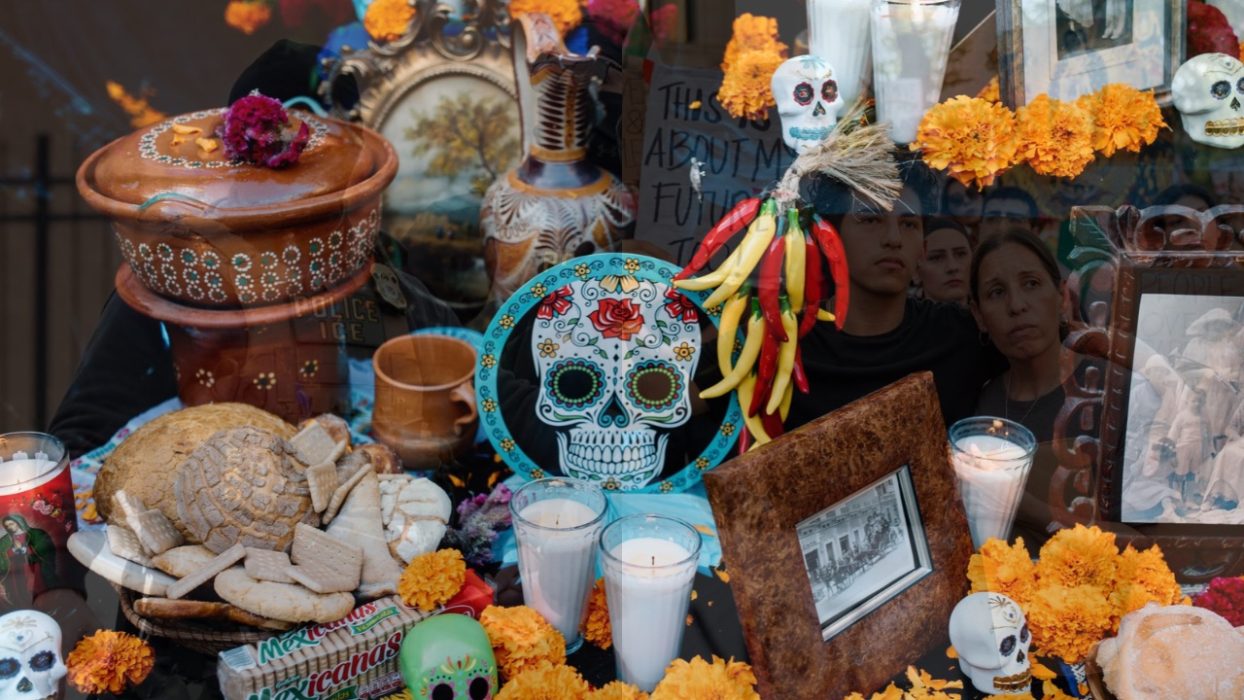
Op-Ed: This Día de los Muertos, the Holiday’s Real Meaning Matters More Than Ever
I used to think Día de los Muertos was a creepy holiday. Why would I want to celebrate the dead? I didn’t realize the answer to that question until some of my favorite people died.
My grandmother, our family matriarch, was one of them. It was a regular Tuesday this past August. From one day to the next, she went from being in the hospital for something that didn’t seem life-threatening, our family believing she would be okay, to passing that next morning.
I now find so much comfort in Día de los Muertos, as it allows my family and me to keep my grandmother alive through our memories, love, and remembrance.
And I am reminded that I am not alone in this grief, especially this year.
There is a collective grief our Latino comunidad is facing this Día de Muertos.
We remember the over 6,500 deaths in Venezuela from back-to-back, twin earthquakes that devastated the country this past summer. Several scientific estimates suggest the number could be higher than 10,000.
We remember the thousands either missing, killed, or injured by the 7.4 magnitude earthquake in Colombia.
We remember Jocelynn Rojo Carranza, an 11-year-old girl who died by suicide after being bullied at school for her family’s immigration status, according to her family.
We remember Lorenzo Salgado Araujo, a Mexican construction business owner living in the U.S. for 35 years with no criminal record, a father of three, who ICE fatally shot.
We remember those who have died in ICE custody or in contact with ICE officers, which includes a recorded 62 people in the last two years, not including the 9 who have been killed in at least 30 shootings involving ICE or CBP agents.
We remember the 980,000 migrants who were deported in President Trump’s second term under the administration’s historic deportation initiative. 80% of these migrants had no criminal record. Additionally, about 71% of long-term U.S. migrants have no criminal convictions, as do around 70% of people in ICE detention. And we acknowledge the fear reported by students while ICE raids continue to happen right outside of school property.
But also this year, Latino culture continued to blossom.
With Latino food and music becoming increasingly global, historical performances and wins from Latino favorites like Bad Bunny, Karol G, and Cardi B, and record-breaking economic output and population growth among Latinos, there was much joy to be had.
Many of Día de los Muertos traditions are rooted in Latin America’s original ancestors: The Aztecs, Mayans, Toltecs, etc. Our indigenous ancestors celebrated death because, to them, it was not a sad ending. Instead, it reflects the natural cycle of life, where our connection with the spiritual realm grows stronger, since our loved ones remain alive in memories, the values they leave us, and their favorite things, signified by the pan dulce, marigolds, and other items left on the ofrendas.
We’ve learned to hold celebration and sorrow at once. Because through death, we carry forward the lessons and values the deceased teach us, earthside, for generations to come.
I couldn’t understand why Latinos loved celebrating death so much that they have a holiday for it. But now I see why. Because love and heartbreak, life and death, joy and sadness, wins and losses, often coexist.
Death teaches us so much about living. This Día de Muertos, we unite in grief and remembrance of the lost to celebrate life and acknowledge that much work remains.