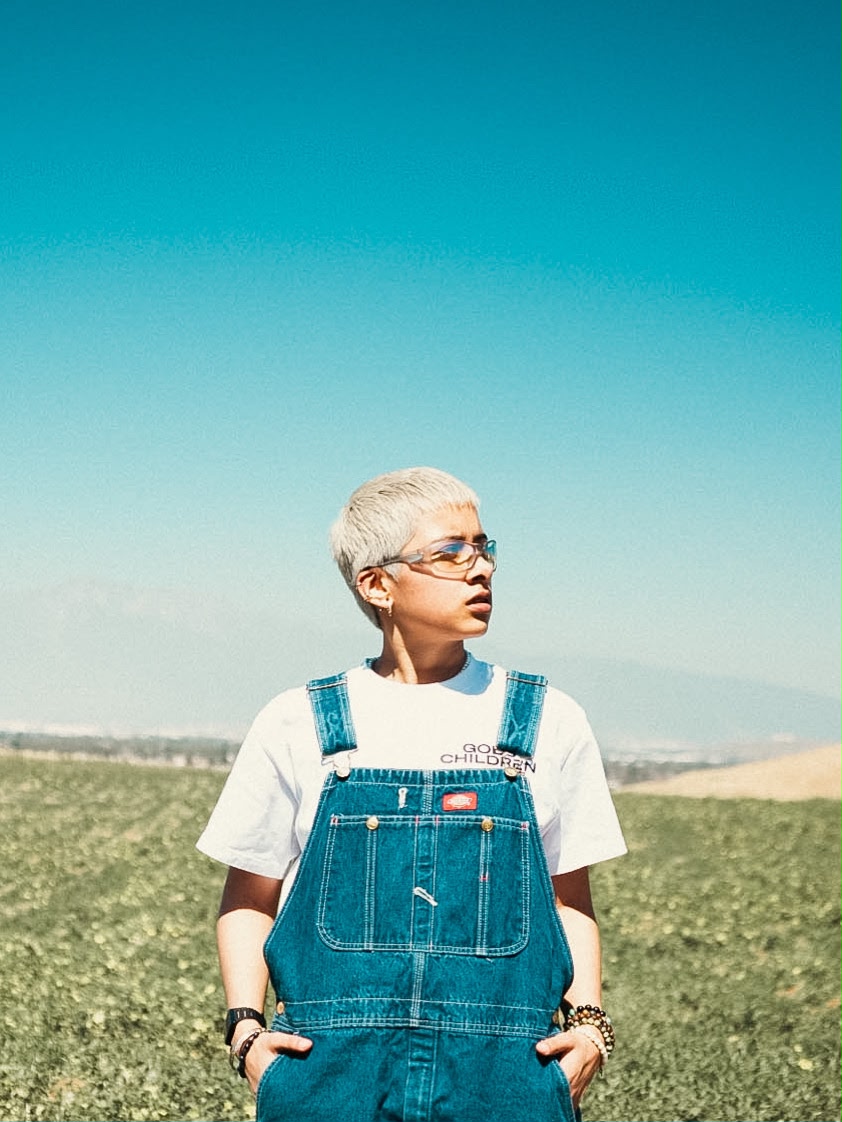
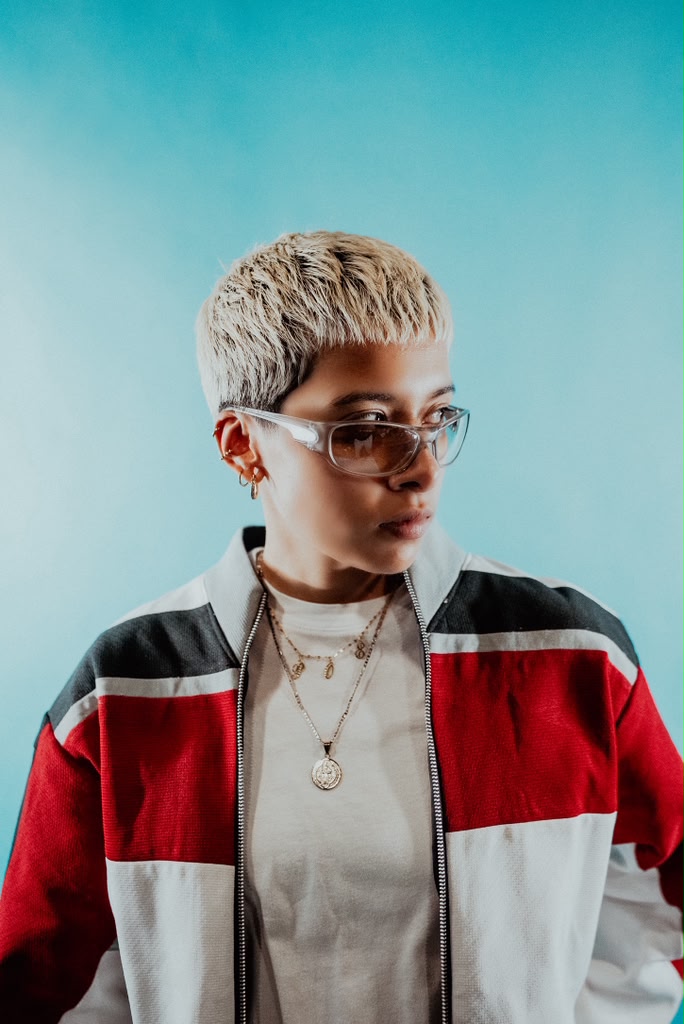
At fifteen, Poe Leos asked her mother for a birthday gift that would change the trajectory of her entire life.
“When I turn fifteen, can I cut all my hair off?” she told her mother. For a Mexican girl from Chihuahua, this was not a naive request. In Latino culture, our hair is a lineage, passed down through generations—mothers braiding daughters, long strands stretching down to the hip bone, a visible declaration of femininity and belonging. To cut it off was to cut yourself off from something almost sacred.
“I told myself I was never going back,” Poe said, sitting in the almost perfectly controlled setting of a virtual interview. “That’s how real it is for me.”
What she was announcing at fifteen—what took her years to fully articulate—was that she would not hide. That the version of herself that existed before the scissors would not be the version the world would see.
Poe Leos was born in Chihuahua in 1999. She was raised in Rockford, Illinois, which meant she was raised in the space between two worlds—Mexican and American, ranchera and R&B, her mother’s mariachi kitchen and the MTV music videos her cousins showed her behind her mother’s back. She was then raised to be an emotional singer. Her mother had her singing heartbreak songs at three years old, those songs of despecho that seem almost hilarious in a child’s voice.
But she was also raised in Illinois in the early 2000s, which meant she was absorbing Beyoncé, Missy Elliott, Pharrell, and the entire landscape of R&B and hip hop. She was learning that emotions could be rhythmic, vulnerability could be cool, and a woman was now a bit freer to choose between being soft and being powerful. She was learning that there was a different way to exist in the world.
“I always heard everybody from Alicia Keys to Pussycat Dolls to Beyoncé,” she said. “And at the same time, my mom was giving me respect for mariachi.”
What Poe did not do was try to be both. She had the unconscious realization that there was no need for a neat division between her Mexican and American identities. Instead, she let them collide. And from that came something entirely her own—a sound she would spend her twenties figuring out how to articulate.
“I’ve moved to a lot of different places my whole life,” she explained. “I was born in Mexico, but every summer they sent me to Mexico for two or three months. I was around so many different cultures—Honduran, Nicaraguan, Black American, the American lifestyle, Mexicans in America, which is a completely different type of Mexican culture. And then you compare that to ranch life in Satevo, Chihuahua, to the life of a Mexican in Los Angeles. It’s mind-boggling how cool it is.”
The music industry is well-versed in mansplaining. It has a way of asking women questions, then interrupting to answer them for them. What’s more, it’s a categorization machine: Is she sexy? Is she maternal? Is she the girl next door or the untouchable star? Is she straight or gay? And if she is gay, is she the kind of gay that can be marketed—the kind that doesn’t threaten the straight men who might buy her music—or is she the kind that has to hide?
When Poe arrived in the industry, the industry asked its questions. And Poe, in her own way, refused to answer them.
“I’m very aware of the fact that I am going against the mold based on my haircut, my everyday dress,” she said. “I knew since day one it was gonna be 10 times harder for me to enter into a place where I wasn’t expected, versus being the girl that everybody expects. I could’ve left my hair long. I could’ve worn a skirt. But something in me, my whole life has led me to be so unique.”
However, for Poe Leos, this was not a stage for protest in the traditional sense. It was a gentler way to fight through literacy. She was ready to teach the industry the chords for her own harmony.
For someone from Chihuahua, queerness is a readable language. After all, it’s the home of Juan Gabriel, El Divo de Juárez, whom Poe Leos calls her King.
“He’s a Chihuahua treasure,” Poe said. “He was my king of pop, my king of mariachi, my king of songwriting. But there’s obviously a difference when you’re a man.”
Against all odds, Juan Gabriel could wear sequins and introduce his genius through ambiguity. A woman with short hair, or a woman who refuses to perform femininity, is asking for a completely different kind of trouble. The rules are not the same.
And yet, Poe understood the assignment. After all, the real and honest strategy is making something so good, so true, so authentically yours that by the time the industry realizes what you’re doing, you’ve already won.
“I believe that although I’m choosing to ignore the problem people may have with my way of being, I think there’s also very much a struggle that I can’t ignore,” she said. “I think I can somewhat agree that I’m not going to fight it because I don’t need to. But I do think there’s a difference when you’re a man.”
When asked about her strategy—how she moves through an industry designed to contain women—Poe talked about “pushing past boundaries.”
“My fight is a fight that pushes past the boundaries and kind of sneaks by past the eye of the person that doesn’t like it. The range of motion that I’m in is a sphere, and there’s nowhere else you can hide.”
The metaphor of a space without corners or edges isn’t lost on a world defined by screens and frames. It implies Poe Leos moves in all directions at once. She makes ranchera that sounds like R&B, conscious hip hop that sounds like heartbreak, and music about love that refuses to specify gender.
“She is just a regular girly,” she said, speaking about herself in the third person. “She might be in a hard shell, but she’s a regular girl, and this is a type of girl that exists. And I’m representing a type of Mexican American and young adult. And you can’t stop it because the range of motion that I’m in is a sphere, and there’s nowhere else you can hide.”
Poe has had conversations with her label about her appearance. She has made it clear from the beginning: “Listen, this is how I am. I may or may not be wearing oversized, baggy shorts in the video. And we’re gonna love it, and it’s gonna look great.”
And she is right. It does look great. Moreover, it looks authentic, and that’s not common currency in today’s music industry.
This is what it looks like for a new generation to fight homophobia and sexism in Latin music. While speeches and activism are as urgent as ever, Poe Leos chooses the simple insistence on existing as yourself in a space that has no room for you.