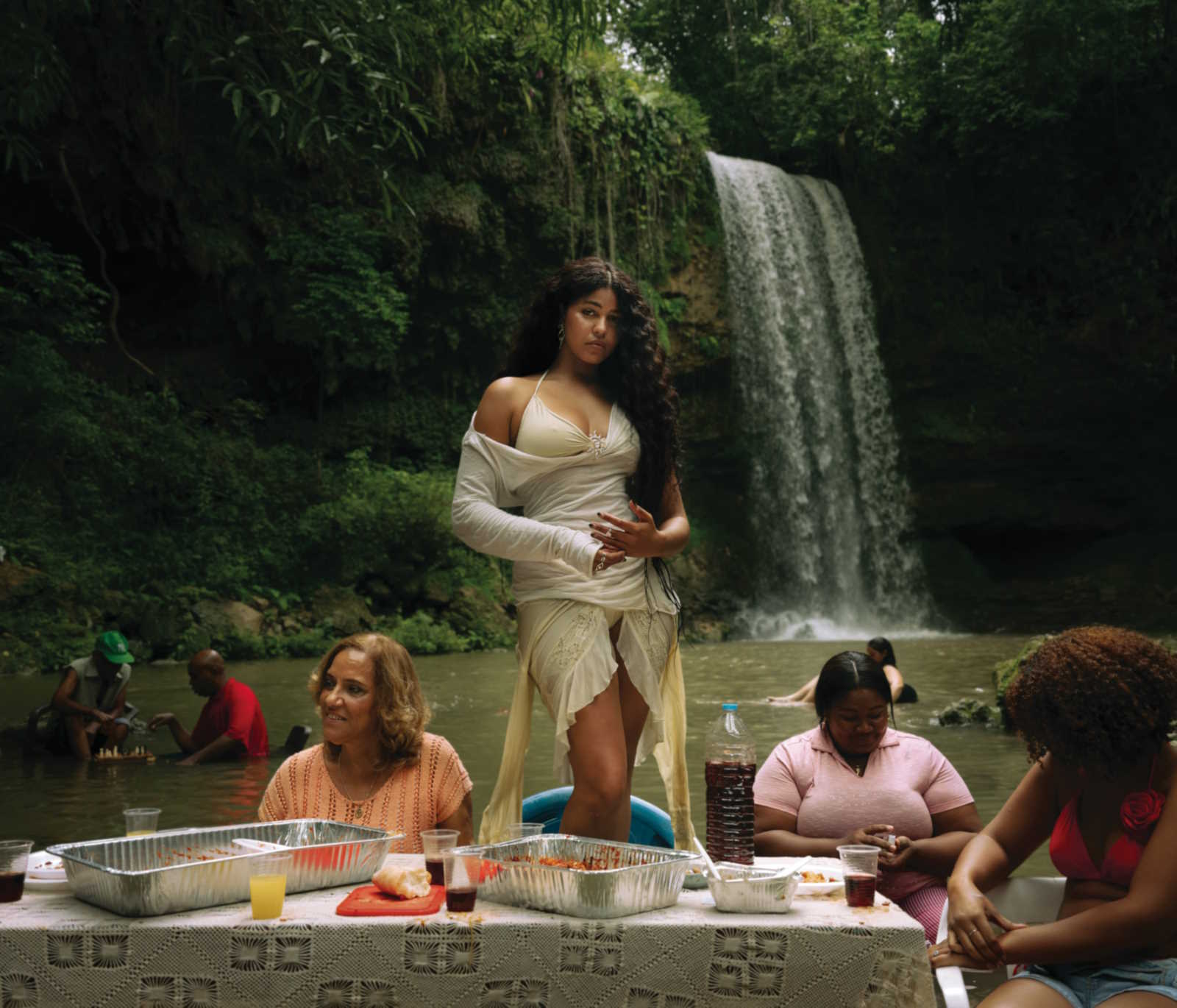
When I noticed the records on the wall behind YEИDRY during our video call, she showed me her favorite. Then she held up another, a Björk record her boyfriend had just bought her, which she counts among her favorites too. A minute earlier, she had told me where her ear began. On her mother’s side, there was La India, Selena, Juan Luis Guerra and the bachateros. On her Italian father’s side, there were the Bee Gees, Whitney Houston, and Barbra Streisand, on the vinyl he kept in the garage and played on weekends. “Both of them, my mom and my dad, introduced me to music like that, with [giants], you know?” she says. “Like Whitney Houston.”
Looking at her records, I understood what she meant by something she had told me earlier. “I feel like I’ve always had a very specific instinct and taste in music,” she says. “And I have very high standards. That’s a mega problem.”
YEИDRY, the Dominican-Italian singer born in Santo Domingo and raised in Turin, has just released her debut album, Como agua, and taped a Tiny Desk Concert for NPR. Her team describes the album as a journey through “migration, healing and self-discovery.” I had read almost everything written about her before our conversation, and I came with an angle already in mind. I offered it to her: YEИDRY is where perfectionism meets sabor.
She was singing long before she was writing, and she first tried putting lyrics and sounds together around 20. “I’m 33 now,” she says, and the years in between taught her that having instinct and following it are two different skills.
“I’ve always had my instinct and my taste, but many times I didn’t follow it because I didn’t trust my ideas,” she says. In the studio, especially at the beginning, she found herself in rooms with people who had far more experience than she did, and she deferred to them. “I always thought, ‘Well, they must know better than me what they’re doing,'” she says. “In this industry there are always a lot of men around.” That has changed. “Not anymore,” she adds, “because now I have my team of powerhouse women.”
Her early releases, she says, carry the evidence. “I put out songs that I didn’t feel at all, and I was like, ‘Oh, I wanted this to be a salsa, and it’s not,’ or, ‘I wanted this to look different,'” she says. On Como agua, she refused to let that happen again. “With this album I fought a lot with everyone, because at the beginning not everyone sees the vision and what the song can end up being,” she says. She still hears small things she would change, like a track with “a lot of reverb” that she would have liked “drier.” But when she sits down and listens to it today, her verdict holds: “Okay, most of the things I wanted to do are in it.”
YEИDRY moved to Italy with her mother when she was four. Until she was 18, her taste was the sum of her parents and the radio: bachata, merengue and salsa from her mother’s side; the Bee Gees and the great pop voices of Whitney Houston and Barbra Streisand from her father’s; and plenty of Timbaland and Rihanna. She also heard a great deal of Neapolitan music, which she says explains a comparison she gets often. Listeners hear flamenco in her voice, and she corrects them. “I don’t know anything about flamenco, but I listened to a lot of Neapolitan music, and it’s the same scales.”
At 18, she began spending hours searching for music on YouTube, and she came out the other side with Frank Ocean, James Blake, Björk, Massive Attack and Radiohead. “I switched my musical taste,” she says. The alternative records she found then are still the ones she plays today, alongside everything that came before; her playlist can run from Burial to Juan Luis Guerra to Dylan.
image credit: Karla Read
The decisions she does make carefully are about who plays each part. Her bachata “Herrera” began in London with a local musician who bought a guitar specifically to play bachata. When it came time to record, she looked for Dominican guitarist Yasser Tejeda. For palo percussion, she asked Edgar Molina, because, she says, it wouldn’t have sounded the same otherwise. “If I’m going to play a genre like merengue, then you have to find percussion that’s legit,” she says. “You can fuse it, but for me it’s very important that the roots are there.”
The lyrics are where she is hardest on herself. “As a writer I’m still not at my potential,” she says. “I feel like I’m at 10 percent, because I want to write so much more.”
She describes the issue as one of channeling. “I can’t sit down and say, ‘Okay, I’m going to write a song,'” she says. “I do it, but it’s different from when I hear a melody and say, ‘Wow,’ and the whole song comes out of me from there.” That’s how “Espejo” came to her, and “Me quedo acá” came to her on an ordinary walk. “I had the whole melody of the song,” she says. “I went for a walk, and I wrote it, randomly.” She writes every day, by hand, in small notebooks, but she doesn’t finish songs daily the way some artists her age, she suspects, do in the studio. Discovering that about herself while making the album shook her. “At first I felt less than,” she says. “I felt like, ‘Okay, maybe I’m not good enough at this.’ But I feel like everything is an exercise.”
I recognized something of myself in her standards. As a Syrian-Venezuelan, I carry the Mediterranean and Latin America too, and I’ve always believed that everything the Mediterranean touches shares a particular intensity. I told her I’d noticed how often she said something could be better, and I asked whether something had set that off. “It’s always been like that,” she says. “Since I was a girl.”
As a child, she took up volleyball and quit when she realized she wasn’t that good. Her mother, a Latina mother in every sense, never pretended otherwise. “‘Yes, my daughter, well, she’s not the best volleyball player,'” YEИDRY remembers her saying. “Always like that.” She’s careful not to blame her, though. It isn’t her mother, she says. She’s simply very much like that herself, and her curiosity feeds it. “I want to read all the books in the world, I want to know everything,” she says, until at some point, “it’s too much, and I had to step back.”
When I offered her my perfectionism headline later in the conversation, she dug deeper. “Growing up in Italy has been very strange for me,” she says, “because I’ve studied more than my friends because I had to, like, prove that I was worthy of being there.” Her Italian, she says, is “so fine” because she wanted to be the best speaker in any room, in case anyone doubted she belonged. “So growing up, I was like, ‘I have to speak perfect Italian better than these motherfuckers so nobody can tell me shit,'” she says. “And that is, like, an attitude that I brought with me.” It also meant a lifetime of explaining herself. “I had to constantly over-explain, like, why I look like this, but I speak Italian perfectly,” she says. “My whole life.”
Her mother lived the same thing from another angle. She left Santo Domingo at 28 and set out to learn Italian well enough to handle everything a new life required, from paperwork on up, and lost much of her Spanish along the way. “She was like, ‘If I move to this country and I’m trying to build a life for my kids, I have to learn Italian,'” YEИDRY says.
The world outside her own head didn’t make finishing easier. She says she felt saturated by music in general while making the album, with so much of it coming out constantly and so heavily processed that “you can’t hear how human the voices are.” “I had to force myself to be like, finish this…” she says.
She finished it, as an artist who spent her early years in the studio assuming the people around her knew better, and her childhood in Turin making sure no one could question her Italian. On Como agua, she put that same relentless preparation into something she had rarely defended before: her own ear, against everyone who couldn’t yet hear what she heard.