
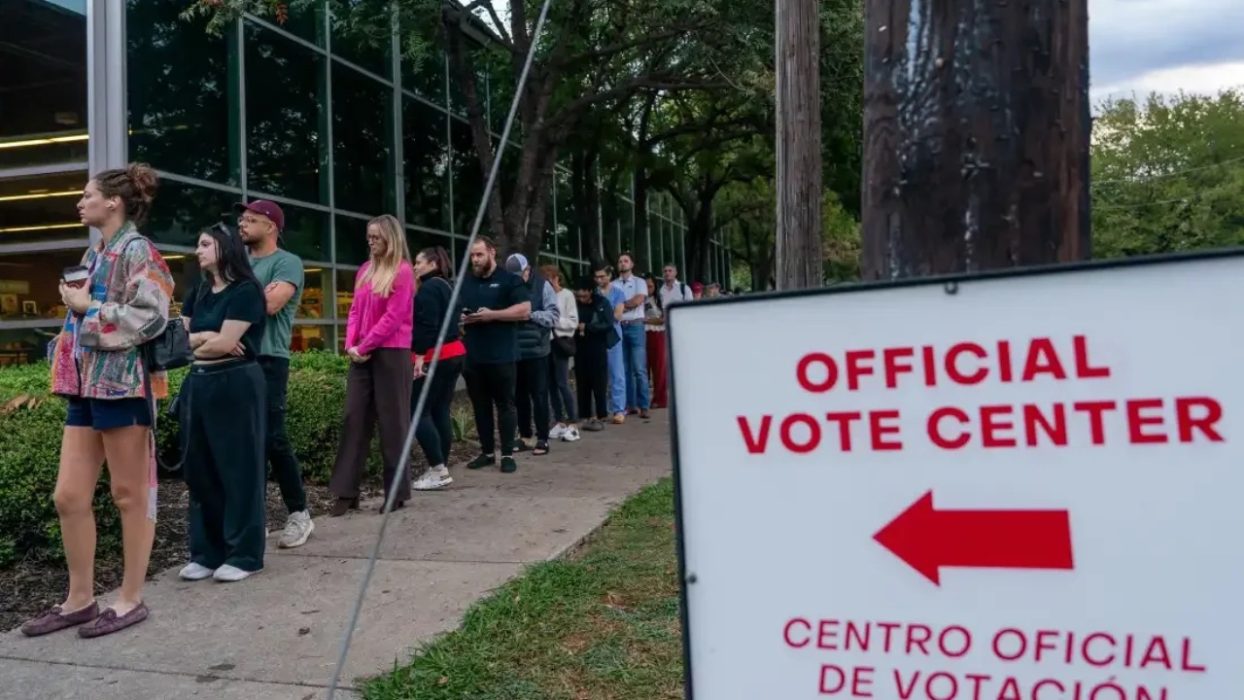
Young Latino Voters Helped Power the Midterms. A Former DACA Recipient Explains Why
For 14 years, Claudia Quiñonez lived on deadlines. One of the first people to apply for Deferred Action for Childhood Arrivals, or DACA, in 2012, she renewed her protection again and again, a process she compared to renewing a subscription with “many, many steps and lots of fine print,” and no promise that the renewal would come through. Missing a deadline, she said, could have meant losing her work permit, her driver’s license, her job and her health insurance. Quiñonez, who was born in Bolivia and moved to Maryland when she was 11, recently became a green card holder. “DACA was a Band-Aid to a broken immigration system,” she told mitú.
Quiñonez is now the organizing director at United We Dream Action, the immigrant youth-led network she joined in 2017. Many of the young people the group organizes cannot vote but still organize their communities, according to United We Dream Action. In the 2026 midterms, young voters helped Democrats take control of both the House and the Senate, according to the Center for Information & Research on Civic Learning and Engagement (CIRCLE) at Tufts University.
Young Voters Matched Their Best Midterm Showing Since 2018
CIRCLE estimates that 27% of Americans ages 18 to 29 voted in the 2026 midterms, the second-highest youth turnout for a midterm in 30 years, behind only the 31% it estimated for 2018. The estimate rests on exit-poll data, carries a margin of error of 2 percentage points either way, and will be updated in the spring of 2027 when voter-file data becomes available, according to CIRCLE. In battleground states, including Texas, Florida, Georgia and Michigan, CIRCLE put youth turnout at 30%.
Those young voters leaned further toward Democrats than any other age group. Nationally, 66% of voters ages 18 to 29 backed a Democratic House candidate, compared with 56% of voters ages 30 to 44, 51% of those 45 to 64 and 53% of those 65 and older, according to CIRCLE’s early analysis, published by Tufts Now on Nov. 9. Of young voters who backed Democrats for the House this year, 33% had not voted in 2024, while 11% had voted for President Donald Trump, according to an analysis of NORC’s Civic Health & Elections Project by CIRCLE researcher Sara Suzuki.
“I think young people are fed up with living in a gerontocracy and really want to see their generation being elected to office,” Suzuki told KPBS.
Young Latino Men Went From Trump to Two-Thirds Democratic
Young Latino men leaned slightly toward Trump in 2024. Still, two-thirds of them backed Democrats for the House this year, according to CIRCLE’s analysis in Tufts Now, which compared 2024 presidential votes with 2026 House votes and cautioned that the two sets of numbers don’t line up exactly. Among young Latino voters overall, 71% backed Democratic House candidates, according to CIRCLE figures cited by United We Dream Action.
Support for Democrats among young voters ranged from 54% among young white men to 86% among young Black women, Alberto Medina, CIRCLE’s communications team lead, said, according to Tufts Now. “So when we’re talking about the youth vote, it’s very important not to treat it as a monolith,” he said.
Fifty-two percent of young voters ranked the economy and jobs among the country’s three biggest problems, with health care next at 42%, according to CIRCLE. Immigration made the list for 26%, and 29% of young voters said they were falling behind economically.
Children of Immigrants Walked Out of School and Into the Polls
Quiñonez, who began organizing in high school at 17 and became a paid organizer at 20, said young people are often told to let adults decide their future. “They say young people are the future, but we’re also part of the present,” she said.
Many young people have been hit by the affordability crisis and by family detention, she said. “Their parents, their moms, their dads, their siblings, their communities have been impacted by the inhumane detentions and deportations that they’ve seen, and they’ve said enough,” Quiñonez said. “They literally led walkouts from their schools to the polls,” she added.
She pointed to Texas, which she described as “one of the very first states that passed in-state tuition” for undocumented students. Young people who benefited from that policy have since become part of Texas’ culture and economy, she said, and many of them “organized and mobilized their families to go out and vote.” Quiñonez compared the moment to the civil rights movement, when young Black students pushed the country toward desegregation. “We’re seeing the children of immigrants say enough is enough to family separation, to the unaffordability crisis,” she said.
In Greensboro, North Carolina, students at N.C. A&T organized marches to an off-campus early-voting site after the Guilford County Board of Elections declined to place one at A&T or at UNC Greensboro, a decision students said energized both campuses, The Greensboro Thread reported. “The irony is that when these barriers pop up, young voters get really activated,” said Caroline Smith, director of programs at the Andrew Goodman Foundation, according to The Greensboro Thread.
Not Everyone Reads the Youth Vote the Same Way
Chris Meadows, chair of the Guilford County Republican Party, called the young voters behind some of the Democratic upsets “malinformed,” according to The Greensboro Thread. “They just don’t understand what they’re voting for,” Meadows said. “They’re voting for handouts which aren’t gonna come.” He also said Republicans have to work harder to win over young voters.
Experts also cautioned Democrats against taking that support for granted. “The youth vote is up for grabs,” said Yael Bromberg, a voting-rights expert and adjunct law professor at American University, according to The Greensboro Thread. “They are not to be presumed.”
“It does not mean that youth decide every race,” said Leela Strong, the Newhouse Director of CIRCLE, according to Tufts Now. “It means they cannot be treated as marginal in a tight one.”
Claudia Quiñonez Wants the New Congress to Remember Its Promises
Young people are sending Congress a loud message, according to Quiñonez. “Congress cannot continue to respond with investigations, statements, moments of silence,” she said. She wants legislation that gives DACA recipients and people with Temporary Protected Status a pathway to citizenship, pointing to the American Dream and Promise Act, which Rep. Sylvia Garcia, a Texas Democrat, introduced in February 2025 with Rep. María Elvira Salazar, a Florida Republican, as a co-lead. “We’re already so embedded in communities. We’re already part of America,” Quiñonez said.
She also wants Congress to take on the cost of living, a worry she said she shares with many of her friends. “We’re probably never going to be able to own a home,” she said.
With new members arriving in Washington in January, Quiñonez said young people need clear demands to make sure lawmakers remember their promises. “The reason why so many people won is that people organized in their districts, people organized their communities,” she said. “I don’t think this is the end, nor should we stay complacent.”
Asked what she would tell young Latinos who still hesitate to get involved, Quiñonez spoke about the families who brought them here. “Our parents did not make the courageous sacrifice, the courageous choices and sacrifice to move across oceans, across lands, for us to be afraid,” she said. “They made the ultimate act of love to give us a better life.”