
What Actually Happens After the Midterm Elections?
Two days after the midterm elections, Democrats are set to run both the House and the Senate. The New York Times’ latest results count showed Democrats with 54 Senate seats to Republicans’ 44, and 240 House seats to 147, with races still being counted. Going into Election Day, Republicans held narrow majorities of 218 to 214 in the House and 53 to 47 in the Senate, Reuters reported.
The results will not change who sits in the White House. They will change how much President Donald Trump can get done in his last two years in office, and they have already set both parties on the road to 2028.
The Count Takes Longer Than You Think, and Trump Says He’ll Accept the Results
As of Wednesday, the Senate races in Alaska and Mississippi and dozens of House contests were still too close to call. For his part, President Trump was “absolutely willing” to accept the results, he told The New York Times in a phone interview Tuesday night. “We’ll, you know, look forward to working with them,” he said of Democrats. “We’ll probably work something out.”
That pledge followed a year in which Trump and his administration raised doubts about the security of the vote, the Times reported. On Election Day, Homeland Security officials warned on social media that noncitizens who voted would be arrested, even though officials had turned up few cases, according to the same report. In the end, the worst fears about interference did not come true, The Guardian reported. “It was essentially too big to rig,” a Trump adviser who was not named told CNN.
The New Congress Won’t Take Over Until January
Winning the House and Senate does not hand Democrats power right away. The newly elected members take their seats in January, Morgan Stanley noted in its post-election analysis, and until then Republicans keep their current majorities. In a pre-election analysis, Reuters wrote that if Democrats won the Senate, Republicans would likely rush to confirm Trump’s nominees before the new members are sworn in.
However, once seated, Democrats will take over the committees in both chambers, along with their subpoena power. That gives them tools for investigation and oversight, leverage over federal spending, and the power to stop Trump’s nominees, including any future Supreme Court pick, wrote Laurel Rapp, who directs the U.S. program at Chatham House, the London-based policy institute. Top aides at the White House are already preparing for those probes, a senior official told Reuters. “Nobody wants to deal with the investigations,” the official said.
Yes, Trump Still Has His Veto and His Executive Power
A Democratic Congress can pass bills, but it cannot make them law on its own. Most bills need 60 votes to get past a filibuster in the Senate. And Democrats will not have enough seats to overcome one, NPR reported. What’s more, Trump can veto whatever reaches his desk. “I have total veto power, so they have to come to us,” he told the Times. “And if they have some good ideas, I’m certainly open to working.” Late on election night, he posted a picture of a red cap printed with the word “VETO.”
For months, the White House has been preparing executive actions on tariffs, immigration, housing, and spending so that Trump can keep pursuing his priorities around Congress, Reuters reported. Analysts expect clashes in 2027 over raising the debt limit and keeping the government funded. And Trump told the Times he thought he and Democrats could work together on it.
The Real Challenge Now Is For Democrats
Once voters had time to celebrate, they immediately began demanding that the Democrats live up to the massive vote of confidence they had just given them. According to Rahm Emanuel, former Obama Chief of Staff and former U.S. Ambassador to Japan, “Republicans will lose today. What we do in 2027 will determine whether we have won.” Emanuel strongly recommended drafting a “major ethics bill” for all three branches.
For him, that would entail a “ban on all stock trading and all participation in prediction markets,” as well as “a mandatory blind trust, term limits,” and what he calls “the Kushner rule,” which would prohibit “any foreign money while you are in government.”
Meanwhile, social media users immediately began urging people to contact House Representatives and Senators to let them know the first thing Democrats must do is remove Schumer and Jeffries from leadership positions. The call comes after Rep. Hakeem Jeffries said following the results—and after launching his bid for House Speaker—that he “isn’t interested in impeaching Trump.”
Similarly, environmental organizations pointed out that “during the 2026 midterm election cycle, climate silence has taken hold across much of the Democratic Party. In fact, the Society of Environmental Journalists and The Guardian examined the campaign websites of Democratic and Republican Senate candidates in eight battleground states. Of all the candidates surveyed, only two explicitly mentioned climate change.”
Planned Medicaid and Food Assistance Cuts Could Be Revisited
The One Big Beautiful Bill Act trims roughly $900 billion from Medicaid and $200 billion from SNAP, the federal food assistance program, over the next 10 years. With Democrats running Congress, some of that money could be restored, or the cuts postponed or scaled back, during upcoming budget talks, according to Ariana Salvatore, who leads public policy research at Morgan Stanley. Democrats will also be better positioned to bring back the expanded Affordable Care Act subsidies, though big health care bills are still unlikely to pass before 2028, the firm noted.
State results matter too. Democrats picked up hundreds of state legislative seats across the country, and nearly every ballot measure calling for a pause on data centers passed, The Guardian reported. In Texas, Gov.-elect Gina Hinojosa ran on pausing approvals for new data centers, which makes project delays in the state more likely. Colorado voters turned down a conservative proposal to require police to work with immigration agents, and voters in Idaho, Missouri, Nevada, and Virginia added or expanded reproductive rights protections.
For Trump, the Lame-Duck Stretch Has Begun
Midterms have long worked as a verdict on the sitting president. The president’s party lost ground in the House in 20 of the 22 midterm elections since 1938, according to the U.S. Vote Foundation, a nonpartisan voter-information group. Michael Genovese, a political scientist at Loyola Marymount University, has described the pattern as a “two-year presidency,” because a president usually has the most allies in Congress only during the first half of a term, the foundation noted.
“We’re very much going into lame duck era for Donald Trump,” Ludovic Hood, a senior fellow at the Hudson Institute, said at a Chatham House panel on Election Day. Some Republicans are already urging the president to shake things up. “He needs to clean house,” the veteran Republican strategist John Feehery said, according to Reuters, after calling the results a “huge disaster” for Trump. Vice President JD Vance, widely seen as Trump’s political heir, pinned the losses on the war in Iran. Trump himself has given few signs that he plans to change course. “I don’t view it as a hit on me,” he told Fox News on Tuesday night, Reuters reported, while the White House posted, “PSA: TRUMP IS STILL YOUR PRESIDENT.”
Latino Voters Showed They Are a True Swing Group
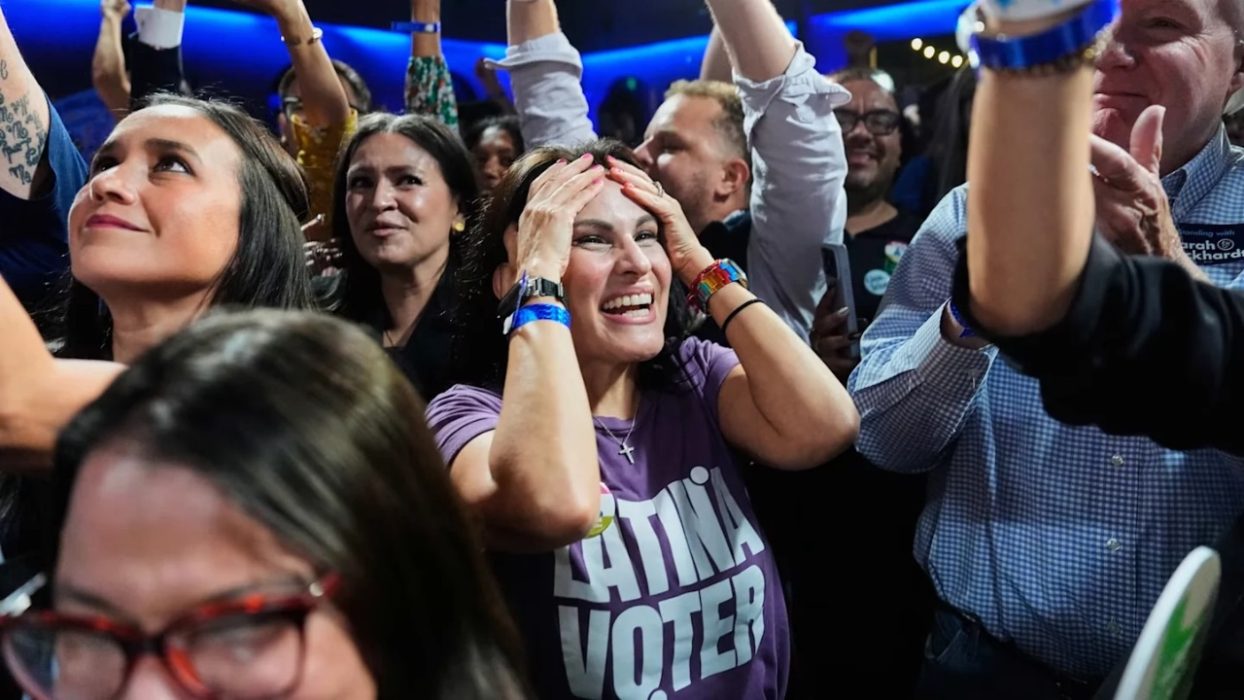
Furthermore, one key finding from Tuesday night is that Latino voters moved sharply away from Republicans this year, two years after Trump lost the group by only 5 points in 2024. Roughly 60% of all voters gave ICE a negative rating. Among Hispanic voters, 68% said they disapproved of the agency’s performance, according to the survey of voters that the major TV networks and The Associated Press commissioned. That shift helped undo Republican redistricting plans in South Texas, NPR’s Domenico Montanaro wrote, and makes Latinos “a true swing group in the country that is underrepresented at the polls and has a lot of power.”
However, the win did not make Democrats broadly popular. In the same survey, 47% of voters viewed them favorably, compared with 41% for Republicans.
The 2028 Race Started the Morning After
A midterm wave does not predict who wins the White House next. In the midterms between 1952 and 2012, when the president’s party lost House seats, that party was about as likely to keep the White House two years later as to lose it, according to the U.S. Vote Foundation.
Today, both parties are already looking ahead. Democrats are heading into their first contested presidential primary in eight years, with possible candidates ranging from Georgia Sen. Jon Ossoff to New York Rep. Alexandria Ocasio-Cortez, Chatham House’s Rapp wrote, and the party remains divided on foreign policy, including the U.S. relationship with Israel. On the Republican side, Vance and Secretary of State Marco Rubio are expected to run, Rapp said, and both remain closely tied to Trump’s unpopular policies.
As the U.S. Vote Foundation put it before Election Day, whatever happened in November, “the 2028 presidential election campaign will begin the very next day, and it will be anyone’s game.”