
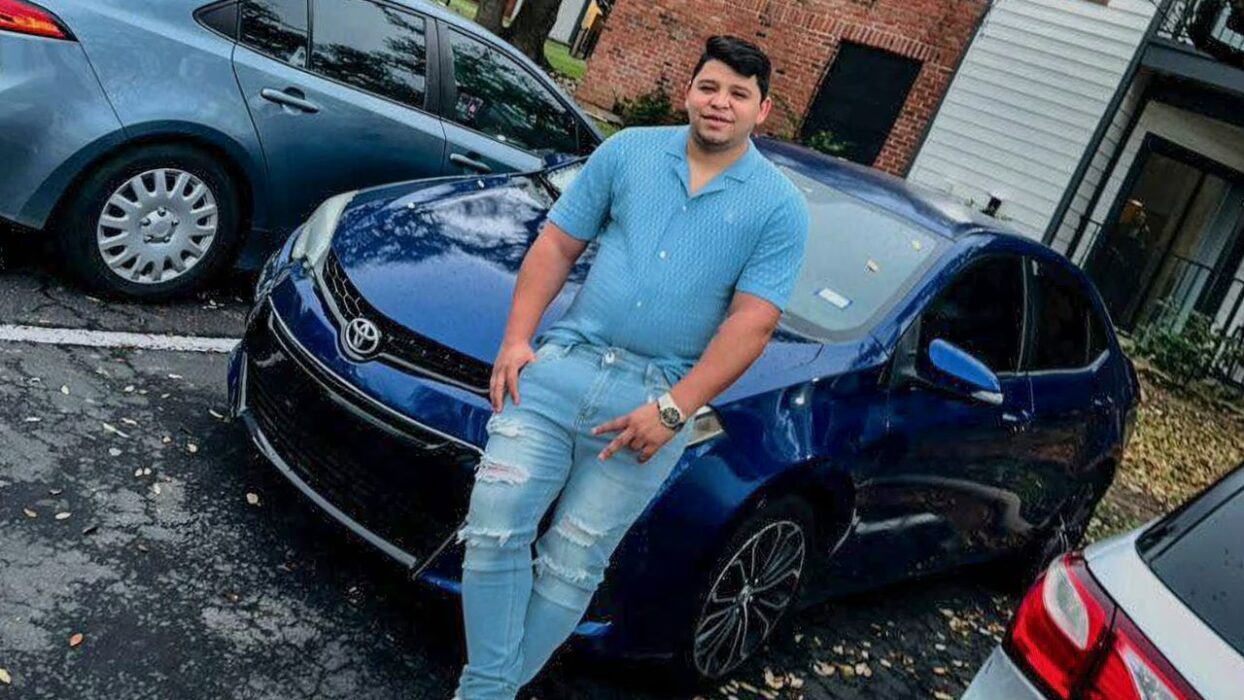
What We Know About the ICE Shooting of a Venezuelan DoorDash Driver in Austin
Wilber Rafael Garcés Pérez called in to a Monday news conference in Austin, Texas. His voice, carried over a reporter’s phone and amplified for the room, described his own gunshot wound for anyone who would listen. “I am not doing well due to the gunshot wound. And I have not received the medical attention that I require,” he said through a translator. His statement came more than 24 hours after an Immigration and Customs Enforcement agent shot him while he was delivering food for DoorDash.
Garcés Pérez, 28, is a Venezuelan immigrant who was shot in North Austin on Sunday afternoon, according to city officials and the immigration attorney representing him, Kate Lincoln-Goldfinch. The shooting happened just before 1 p.m., and it set off protests at the scene that continued into a second night on Monday.
What Happened Sunday Afternoon in North Austin
A bystander named Heidi Clark was livestreaming her drive down Research Boulevard to Facebook when tires screeched behind her. As she neared the intersection with Anderson Square, she turned her camera toward the scene in time to catch a person running from an SUV toward a blue sedan, and then gunfire. Video obtained separately by ABC News shows then Garcés Pérez sitting on the ground, hands cuffed behind him, his shirt cut open to reveal what appeared to be a gunshot wound. Footage from CNN affiliate KVUE shows his blue Toyota Corolla with damage to the front passenger door and at least two apparent bullet holes in the rear window.
A spokesperson for the Texas Department of Public Safety told NBC News the agency had received a request for assistance from ICE for a vehicle pursuit involving that same Toyota Corolla. The Department of Homeland Security said in a statement that Garcés Pérez was in stable condition and in federal custody pending removal, and that Homeland Security Investigations, part of ICE, is leading the inquiry with help from the FBI. Multiple law enforcement sources told CBS News the officer who allegedly opened fire has been placed on administrative leave, which the network noted is standard practice while an investigation is pending. As of Monday, DHS had not said whether the officer involved was wearing a body camera, nor given a detailed public account of what led to the shooting.
The Accounts of What Led to the Shooting Don’t Fully Agree
A source familiar with the incident told CNN that ICE officers were conducting immigration enforcement based on license plate checks Sunday when they identified a vehicle registered to Garcés Pérez, stopped him, and said he fled the scene in his car after a brief exchange with officers. That source said it was unclear whether his car had come to a complete stop during that initial exchange, and that the shooting happened afterward.
Garcés Pérez told the Monday press conference and, separately, El País a different version. He said an unmarked pickup truck cut him off, that the officer who got out identified himself and asked for his documents, and that he did not intend to flee, but only asked to park his car in a lot instead of leaving it in the road. He said the officer refused, and that agents rammed his car as he tried to turn to park it, before he was shot.
Lincoln-Goldfinch, relaying his account separately to NBC News, said an unmarked black truck sideswiped him once while he was making a delivery, that he didn’t know it was ICE, and that after he made a U-turn under a highway, the truck sideswiped him again before agents got out, shot him, and pulled him from the car.
Austin Police Chief Lisa Davis said Sunday there may have been a foot chase involved, but cautioned that the information was preliminary and she had not yet been briefed by federal partners. Lincoln-Goldfinch rejected that account entirely. “There was not a foot chase as they said that there was,” she told CNN. “He didn’t even know he was dealing with ICE until he was shot.”
He Says He’s Still Carrying the Bullet, and Still in Pain
Exactly where the bullet struck him depends on which account you read. Officials described it to CNN simply as a shot to the torso. Lincoln-Goldfinch told NBC News the agents “shot him in the back of the neck.” Garcés Pérez, describing his own injury, was shot near the clavicle, NBC News reported, and he told El País the shot “fractured my collarbone.”
He said doctors told him the bullet was too close to his spine to remove. Furthermore, he gave El País a more detailed and more troubling account of the same decision, saying a doctor told him surgery wouldn’t happen because the hospital was in a hurry to discharge him into ICE custody. “How are they going to leave the bullet in there?” he said.
He was released from the hospital Sunday and, according to his lawyer, transferred to the South Texas ICE Processing Center in Pearsall, more than 100 miles away, a trip CBS News described as roughly a two-hour drive. His family was notified of the transfer around 4:30 p.m. Sunday by a hospital lawyer, though Garcés Pérez said he didn’t actually arrive at the detention center until around 4 a.m. Monday. Lincoln-Goldfinch said he “slept overnight in a processing center without a bed” and went without pain medication. Garcés Pérez told the Monday press conference he received an unknown pill that morning and had been sleeping on the floor of a cold room. He was allegedly given ibuprofen in the early hours and later moved to an infirmary that had no beds available either.
Later Monday, Lincoln-Goldfinch told CNN’s “Erin Burnett OutFront” that Garcés Pérez had lost movement on the “entire left side of his body,” meaning he is “facing paralysis.” That evening, she said in a social media video that a fellow inmate had told her Garcés Pérez was taken to a hospital, though she had no further update at the time. By Tuesday, he had been readmitted to the hospital following pressure from Texas lawmakers and the protests that followed his shooting.
ICE Says He Was Here Illegally. His Lawyer Tells a Different Story.
DHS has said publicly that Garcés Pérez entered the country illegally under the Biden administration and had a final removal order. ICE said in a statement that its investigation centers on “the agent involved in a shooting against an undocumented migrant from Venezuela.” A senior administration official separately told NBC News that Garcés Pérez had no criminal history beyond being in the country illegally.
Lincoln-Goldfinch said Garcés Pérez entered the U.S. in 2024 through CBP One, a Biden-era app that let migrants book appointments to seek asylum at official ports of entry, and that more than 900,000 people used it before the Trump administration ended the program. Garcés Pérez had a work permit and was pursuing his asylum case, his lawyer said, when a notice to appear in immigration court was mailed to an old address after he had already reported a change of address. He missed the hearing without knowing it existed and was ordered deported in absentia, a mistake Lincoln-Goldfinch called common given how the courts handle these notices. For its part, DHS separately terminated the parole status of CBP One arrivals last year and told them to leave “immediately,” and that a federal judge in Boston ordered the administration in April to restore their legal status, though DHS has argued the president has the authority “to determine who remains in this country.”
Juan Proaño, CEO of the League of United Latin American Citizens, argued at Monday’s news conference that the dispute over Garcés Pérez’s legal status misses the more urgent point. “Wilber is a victim of the shooting and the most important witness to it,” he said. “You do not deport the key witness to your own officer’s use of force.”
Austin’s Shooting Is the Latest in a Pattern Playing Out Across the Country
Sunday’s shooting is at least the third involving immigration agents in Texas since the start of Trump’s second term. Two months earlier, an ICE officer fatally shot Lorenzo Salgado Araujo, 52, in Houston during a pursuit while he was driving his construction crew to a job site. His son, Lorenzo Salgado Jr., told CBS News his father had lived in the U.S. for more than three decades. DHS has said Salgado Araujo tried to run over agents, but NBC News reported the agency has not provided evidence supporting that claim.
Similarly, earlier this month, two U.S. citizen teenagers said ICE agents attacked them in Alamo, Texas, after they filmed an immigration stop, with video showing one of them punched repeatedly in the head while pinned to the pavement, CNN reported. And in recent weeks, federal prosecutors charged ICE officer Christian Castro with lying about his own non-fatal shooting of a Venezuelan man in Minnesota. He is free on bond after pleading not guilty.
The pattern extends beyond Texas.
Renee Good and Alex Pretti, two American citizens, were fatally shot by immigration agents in Minneapolis in January. Rep. Casar has pointed to that shooting, saying DHS officials initially described the protesters involved as “domestic terrorists” despite video that appeared to show them moving away when agents opened fire.
Similarly, in July, an ICE officer in Biddeford, Maine, shot and killed Johan Sebastián Durán Guerrero, a 25-year-old Colombian man, during a traffic stop. Independent Sen. Angus King of Maine told CBS News that Homeland Security Secretary Markwayne Mullin confirmed Durán Guerrero was not the operation’s intended target, and NBC News reported neither he nor Salgado Araujo had been. And on the same Sunday, Garcés Pérez was shot. Federal immigration officers in Evanston, Illinois, allegedly tried to arrest a man who turned out to be a U.S. citizen; local police told CBS News he reported injuries to his head, neck, and teeth. On-duty ICE and Customs and Border Protection agents have shot at least 20 people during the second Trump administration, eight of them fatally, prior to Sunday’s shooting in Austin, according to a CNN analysis.
“This is a pattern – it’s a disturbing pattern – and it’s got to stop,” U.S. Rep. Greg Casar, a Democrat who represents part of Austin, told reporters.
Local and National Officials Are Demanding Independent Investigations
Austin Police Chief Lisa Davis said the department’s investigation would be impartial and based on the facts, while acknowledging the frustration the shooting has caused. “It is important that we distinguish between what we know, what we have heard and what the evidence ultimately establishes,” she said in a video statement. The Travis County District Attorney’s office separately requested an independent investigation, saying its office and the Austin Police Department should be “co-equal partners” rather than have the department investigate alone. Austin’s Democratic Mayor Kirk Watson said the city would involve the Texas Rangers as well. “While I’m unhappy and I’m angry about it, I’m not surprised at all,” Watson said. “It’s happened in other cities with the nature of ICE and the way ICE is doing its business these days.”
Casar has called for the release of any body camera footage and accountability for “any ICE officer who broke the law,” and he has demanded Garcés Pérez be released from the Pearsall facility into medical care. A representative from the office of Rep. Joaquin Castro, who visited the Pearsall facility, said ICE told him Garcés Pérez would be taken back to the hospital because he was in “tremendous pain.” LULAC national president Román Palomares called for Congress to create independent oversight of the agency. “To every American, whatever your politics are, call your senators, call your congressmen, tell them that the streets of this country will not be policed without oversight, and that no one is above the law,” he said. Lincoln-Goldfinch has pressed the same point publicly. “The public deserves more than an agency’s account of a shooting or killing. We deserve to see the evidence,” she wrote in a social media post. “ICE traffic stops also need to end.”