
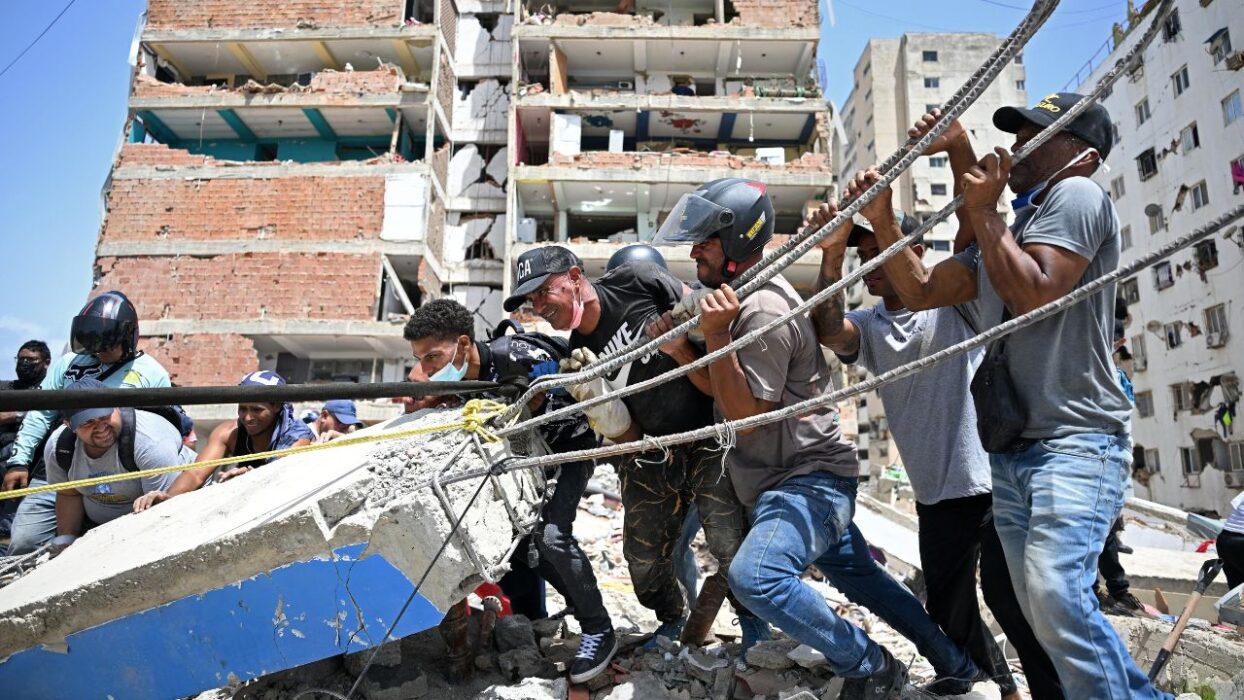
When Venezuela’s Earthquake Hit, the People Showed Up. The Government Did Not
What is the role of a government? So many decades have passed since Venezuela last had a democratic government with even a shred of humanity that what happened in the last 72 hours stands as the latest and most devastating example of the paradox of being Venezuelan.
At least 920 people died, and more than 4,500 were injured after the most powerful earthquake to strike Venezuela since 1900, when a magnitude 7.7 quake hit the country. More than 50,000 people are missing, though the government had not confirmed that figure as of this writing.
Inside the Magnitude 7.5 Earthquake That Hit Venezuela on June 24
Last Wednesday, June 24, at 6 p.m. local time, a magnitude 7.5 earthquake struck Venezuela. It arrived just 39 seconds after a magnitude 7.2 foreshock. The epicenter was in the municipality of Veroes, in the state of Yaracuy, in northern Venezuela.
June 24 is a national holiday in Venezuela, marking the Battle of Carabobo. Many businesses were closed, and thousands of people were on vacation. Dozens of buildings taller than seven stories collapsed completely. And many others were damaged, including the country’s main international airport, where part of the terminal ceiling collapsed and the runway split.

Why Venezuela Sits on Some of the Most Dangerous Fault Lines in the Region
For decades, scientists and presidents knew Venezuela lies near the boundary of two tectonic plates, the Caribbean Plate and the South American Plate. Both plates are constantly trying to slide past one another. Sometimes they lock together, building up energy that eventually has to be released. That movement created a system of fault lines that converge in northern Venezuela. This raises the odds of a large magnitude earthquake.
These are the Boconó Fault, which runs from Táchira to the Caribbean, the El Pilar Fault, which mainly crosses the northeastern state of Sucre, and the San Sebastián Fault, which runs offshore near Venezuela’s Cordillera de la Costa mountain range. Although its entire course is underwater, the San Sebastián Fault runs almost parallel to the country’s central coastline, about 10 kilometers from Caracas, which makes earthquakes a common occurrence in the capital.
That concentration of faults explains the high seismicity of Venezuelan territory, especially in the north. In the Andean region of Mérida, for example, the Venezuelan Foundation for Seismological Research, known as Funvisis, detects dozens of small earthquakes every day. The government-affiliated agency recorded more than 130 significant seismic events between 1530 and 2004. And the true number is likely higher because the monitoring station network was much smaller until the start of this century. Funvisis recorded 1,274 tremors as of June 25, some of them in eastern Colombia.
Venezuela Has Survived Devastating Earthquakes Before
Venezuela has a recorded history of these events. The 1900 earthquake, a magnitude 7.7, remains the most powerful ever recorded in the country. The 1929 earthquake also triggered a tsunami. And historians still dispute its death toll, with some estimates putting it above 1,000. The 1967 earthquake left between 225 and 300 dead and thousands injured.
The Earthquake Venezuela Saw Coming and Never Prepared For
Mexico did not wait for a second warning. After the 1985 Mexico City earthquake killed an estimated 10,000 people, largely because of buildings constructed without enforced seismic standards, the government rewrote its building codes in 1987, then again in 2004 and 2022. It also built SASMEX, the world’s first public earthquake early warning system, specifically so that the next major quake would not catch the country by surprise again. When a comparable earthquake struck Mexico City in September 2017, it killed 369 people. Nearly every building that collapsed that day had been built before 1985 or had been built in violation of the code that followed.
Chile followed the same logic. Its seismic building codes have been enforced since 1972 and tightened repeatedly after major earthquakes. Most recently, following the 2010 Maule earthquake. That code is why a magnitude 8.8 earthquake in Chile, one of the strongest ever recorded, killed around 500 people. Meanwhile, a magnitude 7.0 earthquake in Haiti, with weaker shaking but no comparable codes, killed more than 200,000.
Venezuela did not need a warning. It already had one.
And it even responded to it once. The San Sebastián Fault runs roughly 10 kilometers from Caracas. That’s why the 1967 Caracas earthquake, magnitude 6.6, killed an estimated 225 to 300 people. And exposed the same structural weaknesses that engineers are citing today. The government adopted its first seismic building code that same year, later formalized as the COVENIN 1756 standard in 1982. But enforcement never kept pace with the rules on paper.
Less than 25 percent of construction in Venezuela complies with seismic standards today, according to structural engineer Elena Oliver Saiz. Caracas itself sits on a deep alluvial basin that amplifies shaking, a geological fact known long before June 2026. The Gran Misión Vivienda Venezuela, the government housing program launched under Hugo Chávez in 2011 that claims to have delivered more than a million homes, is now facing scrutiny over the quality of construction of those same units. Mexico and Chile treated a known risk as a mandate to keep building differently. Venezuela treated it as a box checked once and never reopened.
The gap widened again in the response window that matters most.
The first 72 hours after an earthquake are crucial. It’s when survival rates for people trapped under rubble fall from roughly 90 percent at 24 hours to 20 to 30 percent by 72 hours. Mexico and Chile both mobilized the military, civil protection, and trained urban search-and-rescue teams within hours of their respective earthquakes. Venezuela’s emergency alert system did not function during the June 24 earthquakes, according to residents and on-the-ground reporting. Search and rescue operations were hampered by shortages of heavy equipment, spare parts, and diesel fuel needed to run the machinery that existed. Ambulances were scarce, hospitals were quickly overwhelmed, and residents in several neighborhoods reported seeing no government rescue workers at all on the disaster’s first day, leaving civilians to dig through collapsed buildings with their bare hands.
Venezuela’s earthquake struck a country still reeling from what analysts have called the largest peacetime economic collapse recorded between 1970 and 2015, a contraction driven by years of government mismanagement, corruption, and hyperinflation. Mexico and Chile spent decades after their worst earthquakes investing in the systems built to prevent the next disaster from becoming a catastrophe. Venezuela spent those same decades hollowing out the state that was supposed to build them.
How Venezuela’s Earthquake Response Fell Apart in the Golden 72 Hours
During those same 72 hours, also known as the golden hours because they represent the critical window for finding survivors under rubble, officials blocked aid shipments from reaching distribution points and did not arrive in La Guaira until residents had already organized their own response, driven partly by the government’s absence and partly by widespread distrust. Several Venezuelans drew a contrast with how quickly the government typically floods the streets with security forces during political unrest, noting that not a single official appeared in the earthquake zone during the first 24 hours.
A Transition Government Already Accused of Losing Track of Millions in Aid
All of this unfolded nearly six months after a U.S. military operation resulted in the capture of former president Nicolás Maduro and the installation of Delcy Rodríguez as interim president. In the months since, as part of what has been described as a collaboration arrangement between the Venezuelan government and the Trump administration, the country’s track record on accountability has already come under question. In May, the Venezuelan Medical Federation reported that 71 tons of medicines and medical supplies the United States had sent as humanitarian aid earlier in the year had never reached hospitals, according to the federation’s president, Douglas León Natera, who said medical staff in multiple states had not received the shipments despite official announcements that they had been delivered.
That same month, the United States completed the removal of roughly 13.5 kilograms of highly enriched uranium from a Cold War-era research reactor in Venezuela, an operation Venezuela’s own foreign minister said had taken on new urgency after Maduro’s capture. Political rhetoric from both the Venezuelan government and Washington had also promised the release of political prisoners and an end to repression. Neither has happened.
The World Sent Rescue Teams to Venezuela. Its Government Barely Did
Other countries moved quickly to help. El Salvador was among the first to respond, sending 300 rescue workers and paramedics along with 50 tons of medicine and supplies. France deployed a team of 85 search-and-rescue specialists, and Spain sent a plane carrying government search-and-rescue teams. Mexico sent a federal team of military rescuers and medical personnel, according to President Claudia Sheinbaum, with more aid available if needed, and Colombia sent more than 60 rescuers along with 12 tons of humanitarian aid. Argentina offered assistance as well, joining several other Latin American nations in pledging support.
How Venezuelans Showed Up for Each Other When Their Government Didn’t
On the ground, most Venezuelans showed that when their country suffers, unity outlasts the moral, ideological, and structural damage the regime has caused. Some people looted stores and the ruins of collapsed buildings, but most mobilized to help. While government officials demanded payment in dollars to let families view the bodies of relatives at the morgue, ordinary people organized online. They are building websites to help reunite families and relay distress messages from survivors still waiting to be rescued.
Even though experts say the odds of finding more survivors are now very low, people have not stopped trying. To the point that the road connecting Caracas and La Guaira became gridlocked, with no government leadership to help coordinate the effort until it was far too late.
What Comes Next for a Country Whose Regime Has Left It to Rebuild Itself
At this point, the government’s response has amounted to little more than a show staged in coordination with the United States. It proves once again that two things can be true about Venezuela at the same time: a country shattered by a violent and corrupt regime can be brought to its knees, and it can still rise to help its own people and stand up to corrupt authorities, demonstrating the courage that defines its people.
The question that remains is what happens next. A country already torn apart, still in the hands of the same regime, has to find a way to move forward. Who will rebuild it, and whose interests will that rebuilding actually serve?