

New Report Finds U.S. Latinos Are Now the 4th Largest Economy in the World
There is a version of the conversation about U.S. Latinos that has dominated certain political spaces for decades. The rhetoric insists that our community is a burden and/or a threat. However, we’ve always come forth with solid numbers to prove what we actually contribute, documented or not. Now, the 2026 LDC U.S. Latino Economic Impact Report, released in May by the Latino Donor Collaborative and researched by Arizona State University’s W.P. Carey School of Business, brings new and updated data. The community being described as a drain on the country is, by measurable output, the single most powerful growth engine in the American economy.
“What this report represents is not advocacy. It is arithmetic. It is income earned, businesses started, jobs filled, taxes paid, and goods purchased,” report authors write.
Here are the most crucial facts from the report.
The U.S. Latino Economy Outgrew China in 2024
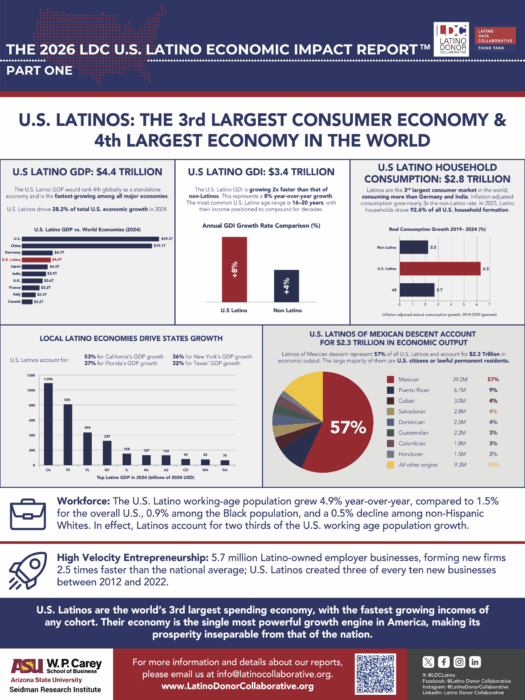
U.S. Latino GDP reached $4.4 trillion in 2024. Considered as a standalone country, this economy would rank fourth in the world, behind the United States, China, and Germany, and ahead of Japan, India, the United Kingdom, France, Italy, and Canada. That position alone is extraordinary. The growth rate is what makes it impossible to look away.
Between 2019 and 2024, U.S. Latino GDP grew at an annualized rate of 5.4%, per the report. In contrast, China grew at 4.9%. The United States grew overall by 2.4%. In other words? No major economy on earth grew faster than the U.S. Latino economy during that period. Now, put it in perspective: Latinos represent roughly 20% of the U.S. population, and still, we accounted for 28.2% of total U.S. economic growth in 2024, the equivalent of $419 billion in additional GDP in a single year, well above their five-year annual average of $270 billion.
The U.S. outperforms its developed peers in part because it has this second engine running inside it, one that operates at the pace of a rising emerging economy, against all odds.
Latinos Are Two-Thirds of the Country’s Entire Workforce Growth
The Latino working-age population grew 4.9% year-over-year between 2023 and 2024, per the report. The overall U.S. rate was 1.5%. The growth rate for the Black population was 0.9%. The non-Hispanic White working-age population declined by 0.5%. In practical terms, Latinos accounted for two-thirds of all U.S. working-age population growth last year. Without this community, the country’s labor supply would be contracting.
The productivity story runs alongside the headcount story. Inflation-adjusted GDP per capita among Latinos is growing at nearly 2.9% annually, compared to 1.7% among non-Latinos and 1.6% for the total U.S., per the LDC report. More workers and rising output per worker are compounding simultaneously, which is why this growth is not a momentary spike. The structural driver is demographic: the most common age range among U.S. Latinos is 16 to 20, compared to 61 to 65 among non-Latinos. The cohort is still entering its peak earning years, and the ASU researchers estimate that aggregate and per-capita income are positioned to compound for decades.
The Latino Spending Power That’s Literally Holding the Housing Market Together
U.S. Latino household consumption reached $2.8 trillion in 2024, exceeding the household consumption of Germany and that of India, a country of 1.4 billion people. After adjusting for inflation, Latino household spending grew at 6.3% annually between 2019 and 2024, nearly three times the 2.2% rate for non-Latino households, per the report. And the community is more than just a large market. It is the third-largest consumer market among the world’s major economies and the fastest-growing.
The housing figures are where the dependence on this community becomes undeniable. According to the 2025 State of Hispanic Homeownership Report by NAHREP, cited in the LDC data, Latino households added a net 441,000 new households in 2025, the largest annual gain by any cohort since the Census Bureau began tracking the figure in 1975. Every other cohort lost households that year. Without Latino household formation, total U.S. household formation in 2025 would have fallen to 125,000. Latino households drove 92.6% of all U.S. household formation. In other words, the country’s housing market cannot survive without our community.
5.7 Million Businesses, Growing at 2.5 Times the National Rate
There are 5.7 million Latino-owned employer businesses in the United States, and they have been forming at a rate 2.5 times that of non-Latino-owned firms, per the report. Between 2012 and 2022, Latino entrepreneurs created three of every ten new businesses in the country. And these are not concentrated in low-margin sectors. The five largest areas of the U.S. Latino economy in 2024 were public administration ($541 billion), manufacturing ($540 billion), real estate ($405 billion), healthcare ($311 billion), and construction ($305 billion), each expanding at annual rates between 7% and 12.3%.
At the state level, the numbers are just as stark. California’s Latino economy reached $1.1 trillion and accounted for 53% of the state’s total economic growth. Texas generated $820 billion, Florida $444 billion, and New York $329 billion, with Latinos contributing between 32% and 37% of each state’s growth, per the report. The LDC describes this not as a regional phenomenon but as a national one: local Latino economies drive state growth across every state in the country.
The LDC has been publishing this data since 2010. The 2026 report calls the prosperity of U.S. Latinos “inseparable from the prosperity of the nation.” That is the careful, institutional phrasing. The plainer version is that the political narrative about this community has never aligned with its economic reality, and the distance between the two keeps widening with every report.