
A New Report Just Explained the Real Gap Inside the Latino Vote, and It’s Not What You Think
In November 2024, we reported that Latino voters had swung the electorate and delivered Trump his re-election victory. What’s more, numbers suggested Latino men in particular found comfort in his message despite a campaign built on rhetoric that demonized and dehumanized the Latino community.
Early exit polling from NBC News showed Trump picking up 45% of Latino voters compared to Harris’ 53%, a massive swing from Biden’s 65% to Trump’s 32% just four years earlier. By all accounts, it seemed Latino men supported Trump over Harris by 10 points. That single number became the headline of the entire election.
The Correction Nobody Really Noticed
Nine days later, we reported the correction. The American Electorate Poll of Hispanic Voters, powered by Unidos US, found the swing wasn’t nearly as precise as the exit polls suggested. Latino men actually voted for Harris at 56%, not the 53% first reported, and voted for Trump at 43%.
Latinas, meanwhile, voted for Harris at 66% and Trump at just 32%. The real story was never “Latino men elected Trump.” It was that a real, persistent gender gap existed inside the Latino vote, just a smaller and more complicated one than the first headlines claimed.
A New Report Finally Explains the Latino Gender Gap
A new brief from the UCLA Latino Policy and Politics Institute and the UC Berkeley Institute of Governmental Studies explains that gap. Using data from the May 2026 Berkeley IGS poll of 1,912 Latino registered voters in California, the second report in an LPPI-Berkeley IGS series ahead of the November 2026 election finds that Latinas are consistently more likely than Latino men to prioritize protecting immigrant communities, fighting the Trump agenda, and defending democracy and voting rights.
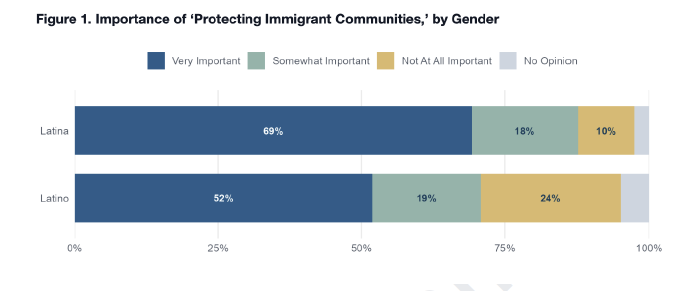
Just months before the midterm elections, these topline numbers are more important than ever. For example, 69% of Latinas say protecting immigrant communities is very important, compared with 52% of Latino men, a 17-point gap. On “fighting the Trump agenda,” 68% of Latinas call it very important, compared with 51% of Latino men, another 17-point gap. On defending democracy and voting rights, both groups rank the issue highest overall: 87% of Latinas call it very important compared with 77% of Latino men, a 10-point gap.
“These findings show why California’s Latino registered voters cannot be understood as a single political constituency,” said G. Cristina Mora, professor of sociology and co-director of the Institute of Governmental Studies at UC Berkeley and the report’s co-author. “Gender tells us part of the story, but the differences become much clearer when we also consider voters’ age and educational attainment. That more complete picture is essential to understanding the priorities of the Latino electorate.”
The Real Divide Is Young Latino Voters
While previous analysis of the Latino vote focused on gender differences, this new report highlights the importance of voters under 30.
Among that age group, 88% of Latinas say protecting immigrant communities is very important, compared with just 60% of Latino men, a 28-point gap. On fighting the Trump agenda, it’s 82% of Latinas versus 52% of Latino men, a 30-point gap, the widest in the entire report. And 92% of young Latinas call defending democracy very important, compared with 74% of young Latino men.
Older voters don’t show anywhere near the same split. Latino men over 60 were actually more concerned about the Trump agenda than Latino men between 30 and 60, and the gap between older Latinas and Latinos narrows considerably compared to their under-30 counterparts.
College Erases Almost All of the Gap
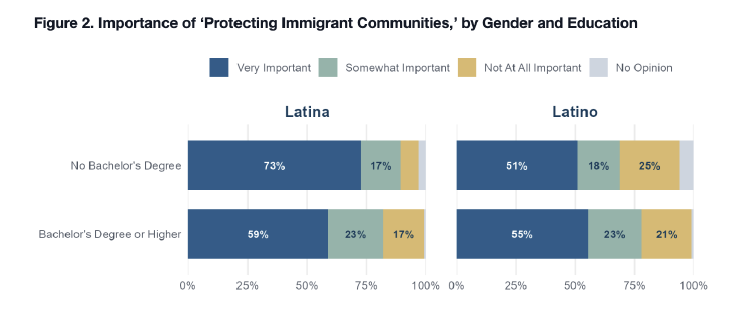
Education tells the same story but from a different angle. Among Latinas and Latino men without a bachelor’s degree, the gaps are eye-opening. 22 points on immigrant protections, 19 points on the Trump agenda, 12 points on democracy. Among college graduates, the gaps nearly disappear: 4 points on immigrant protections, 7 points on the Trump agenda, and 4 points on democracy.
Language follows the same pattern. Among English-dominant voters, Latinas are 20 points more likely than Latino men to prioritize immigrant protections and fighting the Trump agenda. Among Spanish-dominant voters, that gap shrinks to about 2 points on both issues.
Put those three findings together and the nature of the Latino vote in general changes dramatically. In short, the loudest disagreement in the Latino electorate isn’t between men and women broadly. It’s between young, non-college-educated, English-dominant Latino men and everyone else, including the Latinas standing next to them.
So What’s Actually Driving the Gender Gap?
The report’s authors are careful to call this a hypothesis, not a conclusion, but they offer a few theories worth sitting with. Working-class Latinas may be more likely than Latino men to hold jobs in child care, elder care, teaching, and social services that put them in daily contact with undocumented family members, friends, and neighbors. They may also be more active in churches, schools, and community institutions, running a PTA or leading a Spanish-language prayer group that connects them to a wider range of families.
Latino men, the researchers suggest, may be pulled in a different direction. Some in construction may see themselves as competing for jobs with undocumented workers. Others may have ties to the military or law enforcement, professions with more conservative immigration track records. And younger Latino men, the report notes, may simply consume more conservative news than the Latinas around them do.
Why This Latino Gender Gap Isn’t Just a California Story
The poll only surveyed California voters, and party registration plays a real role here too. California Latinas register as Democrats at nearly 54%, compared with 42% of Latino men, and register Republican at 15%, compared with 25% of Latino men. But co-author Nicholas Vargas, associate professor of Chicanx/Latinx Studies in the UC Berkeley Department of Ethnic Studies, says the pattern reaches beyond one state’s registration rolls.
“Although this survey represents California registered voters, the patterns it identifies deserve national attention,” Vargas said. “As both parties compete for Latino voters in races that will determine control of Congress, they should not assume that Latinas and Latino men—or voters of the same age and educational background—are responding to the political environment in the same way.”