
Good News This Week: Mexico Built Its First Electric Car, 250 Women Wove a Sky in Jalisco, and a Dog Named Maverick Made It Home
With the World Cup in the spotlight this week, and so much going on, the news can feel overwhelming. That’s why we look for positive stories that might otherwise go unnoticed.
Here are a few uplifting stories we found.
Firefighters in Oregon recently answered a call about a dog named Maverick who had spent the night trapped on a cliff and was difficult to spot.
Earlier this month, Bend Fire & Rescue in Oregon received an unusual call. Instead of a cat in a tree, it was about Maverick, a dark-colored dog who vanished overnight when his leash broke during a walk. After hours of searching, his owner found him on a narrow ledge about 25 feet above the ground.
“Frightened and unsure, Maverick had tucked himself into a recessed area, making him both difficult to see and challenging to access,” Bend Fire & Rescue wrote in a recent Instagram post. A firefighter used a rope system to reach the ledge, gently coaxed Maverick out, put on a leash, and brought him safely back up.
“We recognize that animals are family, and we treat them as patients with the same care, compassion, and professionalism we provide to all those we serve,” the department wrote. “We’re happy to report Maverick is safe and back home where he belongs.”
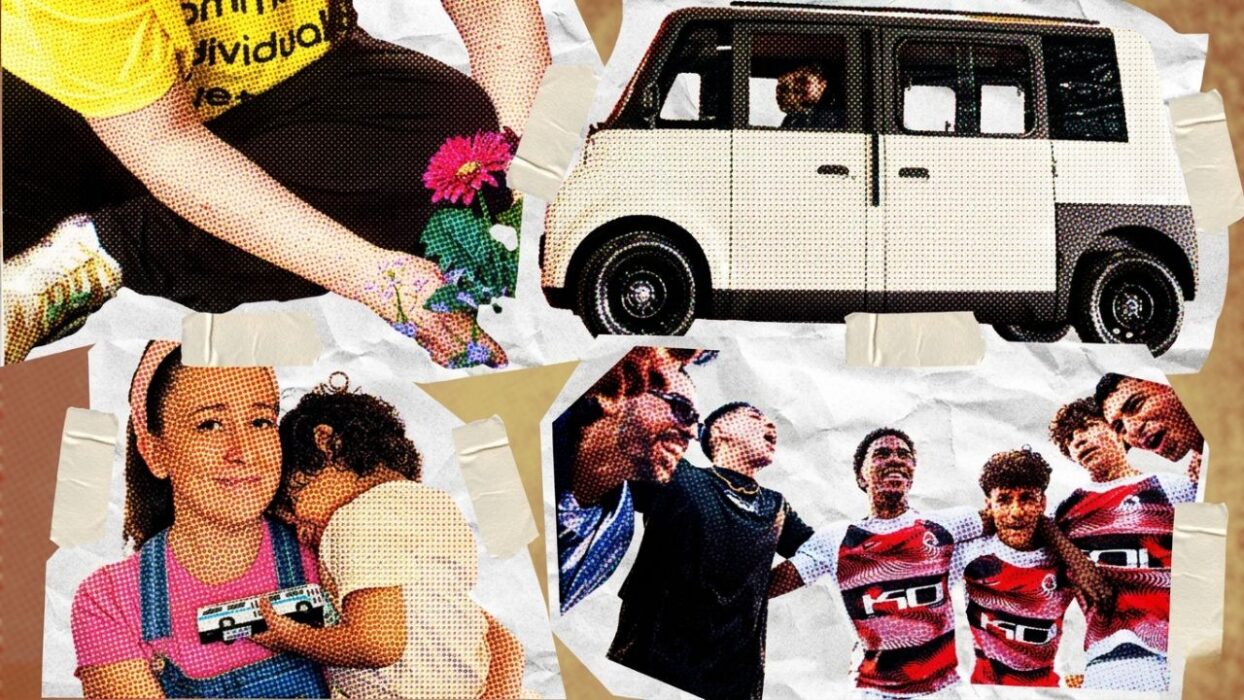
On June 7, Mexico launched its first domestically made electric car. It seats six people, costs under $9,000, and can be charged overnight with a standard wall outlet.
On June 7, President Claudia Sheinbaum drove a prototype electric car onto a stage at a Mexican Air Force hangar near Mexico City. Over two years, more than 80 Mexican researchers, engineers, and students from several institutes worked together to build it. The car is called Olinia Uno, which means mobility in Nahuatl, and costs about 150,000 pesos, or $8,600.
According to The Autopian, the Olinia Uno is a compact, practical urban electric car designed for city life. Its 14.7-kilowatt-hour lithium-iron-phosphate battery provides over 100 kilometers of range. Charging requires no special station. At 110 volts, the standard Mexican household outlet, a full charge takes eight hours. At 220 volts, it takes four. According to Mexico News Daily, the charging mechanism is compatible with the NACS standard, the same charger Tesla uses, meaning the infrastructure is already being built.
The operating costs make the case even clearer. According to official government data, the Olinia Uno costs 49 centavos per kilometer to run. A conventional taxi costs 2.40 pesos per kilometer. A motorcycle costs about 1.18 pesos. President Sheinbaum announced that drivers could save up to 50,000 pesos, approximately $2,900, annually compared with a combustion-engine vehicle. According to Electrive, SECIHTI coordinated the project with a target of 75 percent domestic materials by 2030, up from the current 50 percent. A cargo truck variant, Olinia Cargo, arrives next month.
Meanwhile, in Zapopan, 250 women spent five months weaving an entire sky over the historic center for the World Cup.
Visitors walking through the Andador 20 de Noviembre in Zapopan’s historic center this month find something extraordinary above them: thousands of colorful woven pieces forming a full canopy over the pedestrian corridor that connects the Arcos de Zapopan with the Plaza de las Américas and the Basílica de Zapopan. The project is called Cielo Tejido, Woven Sky, and according to Directo al Paladar, more than 250 women artisans from Etzatlán, Jalisco, created it entirely by hand, working from their homes beginning in January 2026.
The numbers are staggering. According to Directo al Paladar, citing statements from Lorena Ron, founder of Cielo Tejido, the installation covers 1,870 square meters and includes approximately 5,600 hand-made hexagons. Each hexagon required about 250 meters of thread. The total thread exceeds 1,400,000 meters, equivalent to roughly 1,400 kilometers.
“The women weave at home, take the thread, weave at their own pace, and return what they finish,” Ron told ESPN. “In the workshop, each hexagon is sewn by hand to give shape to the snake and the trees.” That snake, woven into the patterns overhead, appears to change its skin throughout the day as light and shadow shift across the fabric. The installation also features the flags of the seven national teams playing in Guadalajara for the World Cup: South Korea, the Czech Republic, Mexico, Colombia, the Democratic Republic of Congo, Uruguay, and Spain.
Nike just gave street soccer a global stage, and it looked exactly like how a generation of us grew up playing the game.
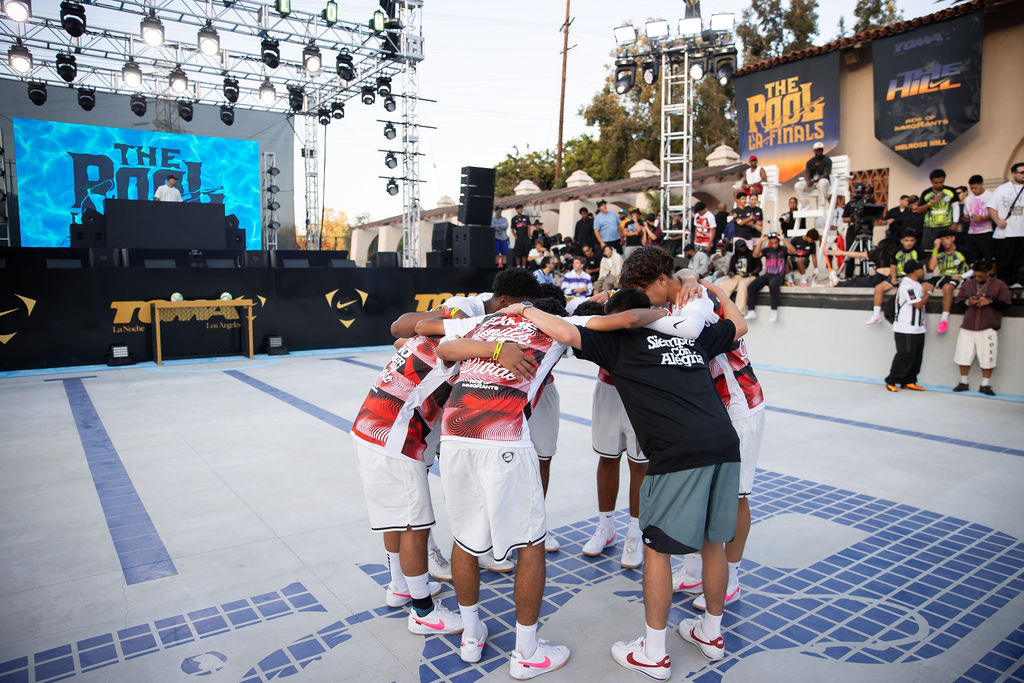
On Sunday, June 7, as the World Cup arrived in North America, over 150 of the top young street soccer players in the world took over Griffith Park Pool in Los Angeles for TOMA Live. Simultaneously, parallel events ran in Mexico City and New York City. According to Nike, the livestream broadcast on Amazon Prime Video, Twitch, and Amazon Music.
TOMA El Juego, which translates to “Take the Game,” is Nike’s free, community-led street soccer platform. Small-sided games of 1-on-1, 3-on-3, and 4-on-4 replaced traditional stadium formats. Artists including Ryan Castro, Chino Pacas, Clave Especial, and Young Miko performed throughout the night. Nike transformed Griffith Park Pool into a custom-built small-sided football arena under the lights. Zlatan Ibrahimović, Clint Dempsey, and DeMar DeRozan attended to witness what street soccer looks like when the world is watching.
The movement started in Los Angeles, in places like Compton, the 6th Street Bridge, Venice Beach, and Melrose Hill, and has since expanded to more than 20 cities across six continents, including Seoul, Santiago, Lima, Casablanca, and beyond. The overall finals come to New York in mid-June.
Also ahead of the World Cup, more than 5,000 athletes just broke a Guinness World Record to protect the fields where kids learn to play.
On June 6, 511 soccer players gathered in Miami Beach and broke a Guinness World Record for synchronized ball juggling. They were not alone. More than 5,000 people across the United States, Mexico, Canada, Brazil, and the United Kingdom juggled a soccer ball in unison for 10 seconds on the same day. According to Reuters, Where Football Lives, a global environmental campaign focused on protecting future generations of soccer players from extreme weather, organized the multi-city event.
The urgency behind the gesture is real. According to Where Football Lives, parents across the United States estimate that their children lost an average of one full week of practices or competitions in 2024 due to extreme temperatures, wildfire smoke, flooding, and unpredictable winters. “Soccer belongs to everyone: to the kids playing in the parks of Miami, the communities gathered around a screen in Kansas City, and the volunteers keeping grassroots teams alive all across the U.S.,” Jenna Lamb, U.S. Director of Where Football Lives, said in a press release. “But extreme heat, flooding, wildfires, and poor air quality are putting all of that at risk.”
Venezuelan football freestyler and world champion Laura Biondo took part in the Miami event. “To be part of a global moment like this, here in Miami, one of the most heat-exposed World Cup host cities, and to help protect the places where football lives, is incredibly special,” Biondo said. Proceeds will support upgrades to grassroots soccer sites across the United States and Mexico, as well as the launch of adaptation toolkits designed to help youth soccer communities facing extreme weather.
Ms. Rachel just spent an evening outside Delaney Hall. She sang with the children whose parents are locked inside.
Last month, detainees at Delaney Hall, an immigration detention center in Newark, New Jersey, owned by for-profit prison company Geo Group, launched a hunger strike, according to Cosecha, an immigrant advocacy group. Detainees reported medical neglect and moldy, expired food in overcrowded conditions, according to PBS News. In recent weeks, protesters gathering outside the facility faced pepper spray and arrests from local law enforcement and ICE agents.
Among those who showed up this week was Rachel Accurso, known to millions of children as Ms. Rachel. Inside the activist-created “Radical Hospitality Zone,” she hugged children, heard their families’ stories, and sang with them. Together, they performed “Sing Them Home,” a song she wrote with the group Peace Poets alongside children detained at the Dilley Detention Facility in Texas. The lyrics: “I’ll sing from here / and you sing from there / together, we’ll sing down the walls everywhere / with love in our hearts / rising up like the sea / together, we’ll sing until everyone’s free.”
“I can’t say enough wonderful things about the children and families whose loved ones are inside,” Accurso wrote on Instagram. “I can’t say enough about how this cruelty is harming and traumatizing precious children who should get to just be kids.” She also shared the GoFundMe for a family whose father, a truck driver who has lived and worked in the United States for 20 years, remains detained at the facility. The campaign reached its goal of $10,000. “I will always stand with these families,” she wrote. “Why are we traumatizing kids?”
In Wisconsin, flowers are blooming out of sidewalk cracks this Pride Month. Each one represents a young LGBTQ+ person who fell through the cracks.
Across Wisconsin this June, residents and visitors are finding colorful flowers in unexpected places: sidewalk cracks, restaurant patios, and street corners in Appleton, Madison, Milwaukee, and Racine. Courage+, a nonprofit that provides housing for LGBTQ+ youth, planted all 75 installations as part of a campaign called Courage to Grow.
According to the National Network for Youth, LGBTQ+ young people are 120 percent more likely to experience homelessness than their non-LGBTQ+ peers, often because of familial rejection or abuse at home. The installations, ranging from individual daisies in sidewalk cracks to full garden arrangements outside local businesses, represent the young people who fall through the cracks of an overstressed system. Each one includes a QR code linking passersby to resources, a map of other installations, and opportunities to help.
“We’re using the flowers coming out of the sidewalks and cracks as a symbol of the resilience and the bravery of these queer youths who continue to persevere,” Brad Schlaikowski, co-founder of Courage+, told the Milwaukee Journal Sentinel. “They’re defying the odds by coming out of the cement.” Courage+ also owns and operates Wisconsin’s first and only licensed group homes for displaced LGBTQ+ youth.
Finally, the world’s largest wildlife overpass is almost finished in California. The mountain lions are next.
Southern California’s wildlife, including mountain lions, mule deer, foxes, bobcats, black bears, and desert bighorn sheep, has long faced a landscape fragmented by highways and freeways. The Pew Research Center estimates 1 million to 2 million wildlife-vehicle collisions occur every year in the United States, causing about 200 deaths, 26,000 injuries, and more than $8 billion in associated costs.
California broke ground on the Wallis Annenberg Wildlife Crossing over the ten-lane Route 101 in Agoura Hills in 2022. After four years of construction and thirty years of planning, it will reach completion in early December 2026. When finished, it will support native vegetation and resemble a natural habitat, providing wildlife with a safe corridor over one of the busiest freeways in the country. On May 31, the project’s Facebook page announced its first visitor as workers completed the overpass’s secondary structure. “We saw our first hummingbird on the habitat in the 101 structure,” the team wrote.
“You’re going to see this ecological transformation,” said Beth Pratt, California’s regional executive director for the National Wildlife Federation. “And that part of it is going to be over one of the busiest freeways in the world. That, to me, is just such a hopeful statement for what’s possible. We can redeem a freeway.”