

Good News This Week: DoorDash Pays Up, a Book Trolley in Baltimore, and a Baby Elephant Rescue
Another Monday, another stack of headlines we would rather not read before our first cup of coffee: war threats, a nor’easter flooding the Northeast, and a midterm race that seems to get more expensive by the hour. That is exactly why, every Monday, we look for the people and places proving things can still go right.
After all, who doesn’t need a win to start the week?
Here’s what we found.
DoorDash just agreed to a $131.5 million settlement for underpaying New York City delivery workers
DoorDash will pay $131.5 million to settle claims that it underpaid delivery workers in New York City, Mayor Zohran Mamdani announced last Tuesday, in what officials described as the largest worker settlement in the city’s history, according to the Associated Press. Most of the settlement will be returned to more than 260,000 workers who were underpaid, not paid, or paid late for their deliveries, according to City Hall. The company will also pay about $16 million in civil penalties and other costs to the city. It must submit to a new monitoring system to ensure it complies with the city’s delivery worker pay laws.
“When a worker earns a wage, they deserve to be paid that wage – not tomorrow, not after a lawsuit, but on time and in full,” Mamdani said in a statement. “DoorDash underpaid more than 260,000 workers, and today we are getting that money back.” DoorDash admitted the errors, attributing many of them to “technical bugs” and complicated deliveries, such as orders that went outside city boundaries or were canceled or only partially completed. “Simply put, we screwed up,” the company said. “Dashers should be paid in full, on time, every time. We are sorry to the Dashers we let down.”
Last year, DoorDash agreed to pay almost $17 million to settle claims that it used customer tips to subsidize its delivery workers’ wages in New York instead of letting drivers keep those tips on top of their guaranteed pay, the AP reported.

California lawmakers just passed a bill that would pay environmental reparations to families living beside an LA oil field
As a child in the 1950s and ’60s, Regina Martin assumed every kid grew up next to oil pumpjacks and a rotten-egg smell that made everyone “sick to [their] tummy,” Capital B News reported. Only as an adult did she begin to see a possible connection between growing up beside the nation’s largest urban oil drilling field and her own illness, as well as the asthma that affected her sister.
California lawmakers have now passed AB 1661, which would direct $5 million collected from penalized oil wells in Inglewood into direct cash aid of up to $5,000 each for 1,000 nearby households with qualifying respiratory or reproductive health impacts, according to Capital B. The bill, introduced by Assemblymember Isaac G. Bryan, is expected to be signed by Gov. Gavin Newsom by October, and it would serve households within 2.5 miles of the Inglewood Oil Field, which is surrounded by some of LA’s Blackest suburbs and neighborhoods, including Inglewood, Ladera Heights and Baldwin Hills. The money would come from a community repair fund that receives penalty revenue under Bryan’s earlier law, AB 2716, which Newsom signed in 2024 and which requires the oil field to close by 2030. Under that law, operators are charged $10,000 per low-producing well each month, Bryan said.
Bryan and other supporters are calling it environmental reparations. “The community … [is] due this repair, and it’s been long overdue,” Bryan told Capital B. “We know one of the biggest tools against an increasingly unaffordable society is to just put more money in people’s pockets.” Three dozen community groups backed the legislation, and no group publicly opposed it. With tens of thousands more households living near the field, the program would reach only a fraction of them. Still, Tianna Shaw-Wakeman, environmental justice program director at Black Women for Wellness, sees it as a model for the rest of the country. “I see how grassroots organizing has created long-term change in our local communities, and I see that that can be and is being replicated all over the country,” she said.
Sandy Hook Promise just marked its 20th prevented school shooting since 2018
Sandy Hook Promise’s anonymous reporting system and prevention programs have helped prevent at least 20 planned school shootings since 2018, the organization announced. Its 20th verified intervention came in Arkansas, where an anonymous tip submitted through its Say Something Anonymous Reporting System, combined with swift action by law enforcement, helped stop a potential school shooting before it could happen.
“When one of those schools is yours, 20 isn’t just a number. It means your child came home that day,” said Nicole Hockley, the organization’s co-founder and CEO, whose 6-year-old son, Dylan, was killed in the 2012 shooting at Sandy Hook Elementary School. Co-founder Mark Barden added, “Preventing 20 planned shootings demonstrates that prevention works.” According to a Marist Poll survey of 1,003 U.S. adults conducted Aug. 13 to 17 and cited by Sandy Hook Promise, 96% of parents say training students, teachers and staff to recognize and report warning signs is effective.
More than 90% of female Marines in combat roles are passing the tougher fitness test Hegseth ordered
When Defense Secretary Pete Hegseth ordered sex-neutral fitness standards for troops in combat roles last September, he said he didn’t want his son serving “in combat [units] with females who can’t meet the same combat arms physical standards as men,” according to The War Horse. Since January, Marines in combat specialties have had to score at least 210 out of 300 points on the physical fitness test, which consists of a 3-mile run, pushups or pullups, and an abdominal plank, graded on the same scale for men and women. Marine Corps data obtained by The War Horse shows that 91.38% of the women in combat arms who have taken the test have met or exceeded the standard, compared with 96.53% of men.
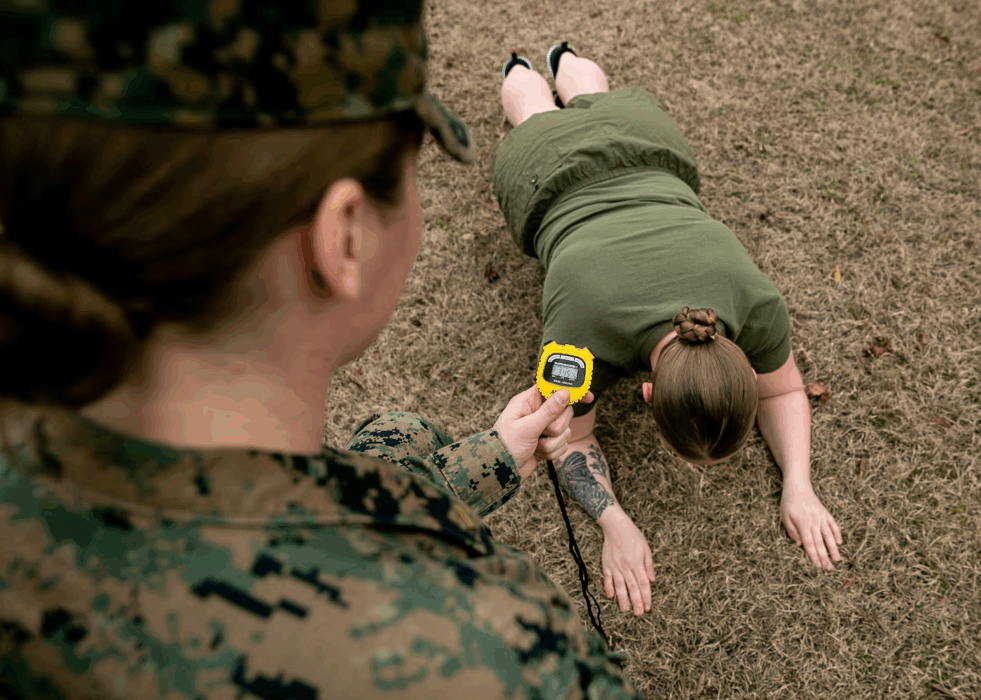
“The women prepare, and they train, and they’re ready,” said Kris Fuhr, co-founder of the Women in the Service Coalition. “If you tell a woman what the standard is, she will do the work to not only meet it, but often exceed it.” According to the Marine Corps, 422 women serve in combat specialties, and 400 of them have taken the test under the new scoring, a sample small enough that experts caution against broad conclusions. “Making generalizable conclusions from this is very, very difficult,” said Kyleanne Hunter, a Marine veteran who leads Iraq and Afghanistan Veterans of America. However, she added, “It still tells the story that the vast, vast majority of the women who are in this career field are doing just fine.” A woman who would have earned a perfect 300 under the old female scale now receives roughly 240 points for the same performance, The War Horse reported, and Hunter warned that “it can create unnecessary promotion problems.”
A Texas Gulf Coast county now has a map showing who is most exposed to climate risks
As the climate warms, Nueces County on the Texas Gulf Coast can expect more extreme heat, floods, and storms, and people already carrying financial and health burdens are often most at risk, according to Yale Climate Connections. During a heat wave, for example, low-income residents may not be able to afford air conditioning. “So what do they do when we’re in triple-digit days, day after day, week after week?” said Katya Wowk of the Water Institute, who helped create an online map showing flood risks, air pollution data, poverty levels, disease prevalence and more for each census tract in the county.
Officials could use the map to see where cooling centers will be needed during heat waves, and a hospital plans to use it to help its doctors better understand their patients’ challenges. “They can ask more informed questions to their patients … about the conditions that they may be facing that may be impacting their health outcomes,” Wowk said.
135,000 shelter pets just found homes through NBC and Telemundo’s Clear The Shelters
NBC’s annual Clear The Shelters campaign helped 135,000 dogs, cats and other animals find homes this year, according to Good News Network, with more than 100 NBC and Telemundo stations highlighting adoption events at more than 1,000 participating shelters across 47 states, Washington, D.C., Guam and Puerto Rico. The campaign, which ran from July to September, also raised $480,000 for participating shelters, and over its 12 years it has helped 1.5 million pets find new homes and channeled more than $6 million to shelters.
“Clear The Shelters demonstrates what’s possible when our communities come together to help pets in need,” said Meredith McGinn, NBC Local’s executive vice president of original production, in a news release.
Also this week: rangers pulled a baby elephant out of a water trough and reunited it with its mother
Good Good Good shared the story of a rescue from September 2025, when an elephant calf fell into a water trough and became trapped while its mother stood by, unable to help. Rangers from the Sheldrick Wildlife Trust, a conservation group that has worked in East Africa since 1977 and is best known for rescuing and rewilding orphaned elephants and rhinos, came to the scene. “As we have seen too many times in these situations, a mother elephant will only wait around for so long before abandoning a hopeless situation,” the trust wrote in a YouTube video caption.
“We honked and revved the engine to buy us some time to approach the trough,” Roan Carr-Hartley, a pilot for the trust who assisted with the rescue, told The Dodo. After several attempts, the rangers pulled the 200-pound calf out of the trough and scrambled back to give the mother room to return to her baby. “There’s nothing better than seeing a mother and calf reunited, especially when the odds are against them,” Carr-Hartley said. “That’s our primary mission: to keep wild families together.”
Finally, a Baltimore “radical street librarian” is bringing free books to kids on a trolley
The idea came to Ms. Maze, known as Storybook Maze on social media, in 2024, after she was reading to her nieces on her Baltimore front stoop and other children gathered around and repeatedly encouraged her to keep reading, she told TODAY.com. “I was like, ‘OK, you guys can go home and read a book.’ And they told me they don’t have any books at home,” she said. “My street in Baltimore was one of the worst book deserts.”
Ms. Maze eventually quit her full-time librarian job to take to the streets as a self-described “radical street librarian,” giving away books from her trunk before launching a green-and-gold trolley with a “Polar Express”-themed trial run last holiday season and a full rollout this summer. In a single day, anywhere from 50 to 130 readers can board the trolley to pick out a book at stops like football practices in Baltimore’s Park Heights and nearby parks, she said, and she relies on an online wish list and a GoFundMe when her supply runs low.
“Kids want to read so much, and you would think that they don’t, especially competing with screens and iPads,” she said. “But when we come through, and we present it in the way that we do on a trolley, I feel like it’s the hottest thing on the block.”