
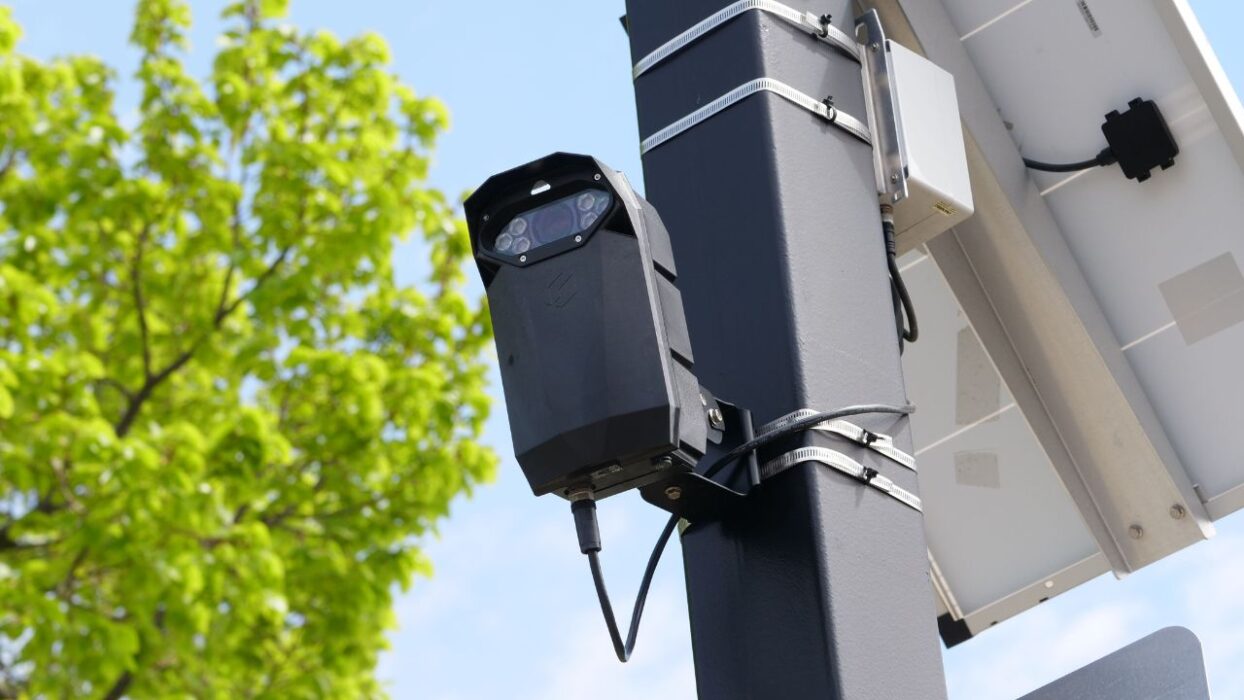
Flock Cameras Are Everywhere Now, and People Are Fighting Back
Somewhere in Houston, Oakland, or Grand Junction, Colorado, someone is currently cutting down, spray-painting, or, in at least one documented case, shooting a small black box bolted to a traffic light pole. That box is a Flock camera, one of roughly 120,000 the company says it has installed across 49 states. And people are destroying them fast enough that how-to videos are spreading online. And if that sounds like an overreaction to a “simple” traffic camera, it really isn’t. In fact, there’s now a website, HaveIBeenFlocked.com, where you can type in your own license plate and find out if it’s already inside a database of more than 240 million searches.
Here’s what these things actually are, and why the backlash has been so widespread.
So What Exactly Is a Flock Camera?
Flock cameras are automated license plate readers. They are small AI-assisted cameras made by Flock Safety, an Atlanta-based company now valued at $8.4 billion. They photograph every car that passes, logging the plate number, make, model, color, and details such as bumper stickers or body damage. Then, they feed it all into a searchable national database. Flock says it has around 120,000 cameras installed across 49 states, everywhere but Alaska, under contract with roughly 7,000 law enforcement agencies, about 40 percent of every police department in the country.
However, DeFlock.org, a crowdsourced tracker built by privacy advocates, counts even more. In fact, they count upward of 130,000, though that figure tracks automated license-plate readers broadly, not just Flock’s own cameras.
Founder Garrett Langley started the company in 2017 after his own Atlanta neighborhood kept experiencing car break-ins and police told him they couldn’t do much without license plate numbers. As it often happens with community-inspired initiatives, Flock sold to homeowners’ associations at first. But soon, police contracts started in 2020, the same year Langley’s own SUV was stolen and, he says, Flock’s cameras helped find it. Departments now pay around $3,000 per camera per year for the installation, the maintenance, and access to the database.
How Police Actually Search the System
To run a search, an officer picks a crime type, from animal cruelty to homicide, enters a plate number or vehicle description. Then, he chooses a location, or just leaves it on the default, which is creepier, to be honest: every camera in the network. The system returns matching cars along with exactly when and where it spotted them and whose camera caught them.
In theory, the system deletes the photos after 30 days by default, though individual departments can hold onto them longer. If a department wants to search other agencies’ cameras, it has to open its own to the same kind of searching. And most agencies choose to share nationally rather than keep their footage local.
Now, there are some built-in walls. Officers have to acknowledge they won’t search for anything related to “reproductive care” in 17 states and Washington, D.C. However, a Flock spokeswoman told The New York Times that officers can still run abortion-related searches in states where abortion itself is illegal. Nine states similarly block searches tagged as immigration enforcement. Immigration and Customs Enforcement can’t access Flock’s system directly. But the ACLU says local police have run searches on the agency’s behalf anyway.
The Cases Flock Loves to Talk About
Flock’s pitch is that this is the tool that finally catches people who used to just drive away. Langley told USA Today the cameras helped solve 1,000 missing-persons cases and 22,000 stolen-vehicle cases in July alone. The company says its network has aided roughly 1 million police investigations and helped locate about 10,000 missing people over the past year.
For its part, Boulder, Colorado credits its 31 cameras with a 34.5 percent drop in motor vehicle theft. A Flock camera helped lead police to a Florida man who’d threatened a mass shooting in Louisiana. And another helped find the man later convicted in the 2024 assassination attempt against Donald Trump. Langley has also pointed to the disappearance of Nancy Guthrie, telling Vanity Fair that if Flock cameras had been operating in Pima County when she vanished, “we would have solved that case.”
The one independent-sounding number, a 2024 study finding Flock cameras raised case clearance rates by 9 percent, turns out to be less independent than it sounds. Flock partnered directly with the researchers and picked which agencies were included, a setup 404 Media and others have criticized as exactly the kind of study you’d expect a company to produce about its own product.
The Cases Flock Would Rather You Forget
The other file on Flock is a lot longer. The Washington Post found 46 officers who’ve been charged or accused of misusing the system for “unauthorized purposes,” several of them allegedly to stalk women.
Similarly, three Georgia deputies were arrested for allegedly using Flock cameras to track people they knew. Two officers in Reynoldsburg, Ohio resigned after an internal investigation found one of them had searched for a former domestic partner more than 40 times. In Arizona, three cities are currently investigating officers over suspected misuse, including one case where an officer is accused of using the cameras to track down his own wife.
And in Texas, an officer ran a nationwide search across Flock’s network to track down a woman suspected of self-administering an abortion, following her movements across state lines.
Why Conservatives and Liberals Both Want These Cameras Gone
What makes Flock unusual as a political flashpoint is that almost nobody defends it along party lines. Lago Vista, Texas, a town that voted for Trump by 20 points in 2024, unanimously voted to end its Flock contract. Similarly, Bandera, a conservative Hill Country town of about 900 people, canceled its contract too, after at least one of its cameras was vandalized.
For its part, liberal Austin ended its own Flock contract in 2025, and its Democratic mayor said this past May that having the cameras could have helped police track down suspects faster during a citywide shooting spree. Denver dropped Flock in February in favor of a different vendor with tighter data rules. And in Fargo, North Dakota, protesters from opposite ends of the political spectrum showed up at the same demonstration and, according to News Nation, clashed over the technology. Republican Congressman Keith Self introduced a bill in July that would require federal agencies to obtain a warrant before accessing state and local license plate data. “We have a surveillance state happening,” he told The New York Times. “This is not a left issue, not a right issue. It is a personal issue.” The ACLU’s Chad Marlow added: “Whether you’re libertarian, conservative, MAGA, progressive, everybody has an objection to Flock.”
DeFlock, the volunteer mapping project that lets people plot camera locations, has become Langley’s favorite target. He once called it a “terroristic organization” whose “primary motivation is chaos,” a line that even Tucker Carlson and The Blaze mocked him for this month. Langley has since apologized for his comment. He didn’t apologize for the cameras, though.
So Should You Actually Be Worried?
To be honest, even the courts aren’t fully settled on this. A federal judge who heard a lawsuit over 172 Flock cameras in Norfolk, Virginia, ruled that this kind of network could one day become so total it amounts to an unconstitutional dragnet search, “but not today.”
For his part, Barry Friedman, who directs the Policing Project at NYU’s law school, thinks that day is closer than departments admit. “This is indiscriminate data collection, not targeting specific crimes,” he said. “The reason we have a Fourth Amendment is that they didn’t think the government should just be able to go after anybody even if they did nothing wrong.”
University of Virginia law professor Danielle Citron added: “We all want, expect, and deserve privacy. The problem is that we typically cannot feel, see, or experience the loss as it is happening. Seeing those cameras is a punch in the gut.”
On the other side, Flock says it’s responding by cutting the default retention window from 30 days to 7 in some places. It adds that it is requiring a specific case code and offense type for every search, making misuse flagging mandatory. And allowing departments to block certain agencies from searching immigration cases.
However, while Flock began rolling out those changes on August 13, with the new retention default set to take effect January 1, DeFlock isn’t impressed. “No guardrails [or] regulations. No ‘only if they really need to’ pinky promises,” the group posted on X after the announcement. “It’s a 4th Amendment violation. Full stop. They are coming down.”