Facial Recognition Is Everywhere but It Is Raising a Lot of Privacy Concerns
Living in the United States comes with growing concerns about safety at major events. Gun violence is a unique problem in the US with seemingly no end in sight. Large-scale events such as the Super Bowl and the NBA All-Star Game often raise various public safety and security issues. Technology has evolved to meet the needs of organizers and venues, but it is raising privacy concerns. As facial recognition technology becomes a more common part of life, what does it mean for fans? We all deserve to be safe when we gather, but with little privacy legislation, it is a tricky situation.
Facial recognition to enter sporting events or even airports isn’t new
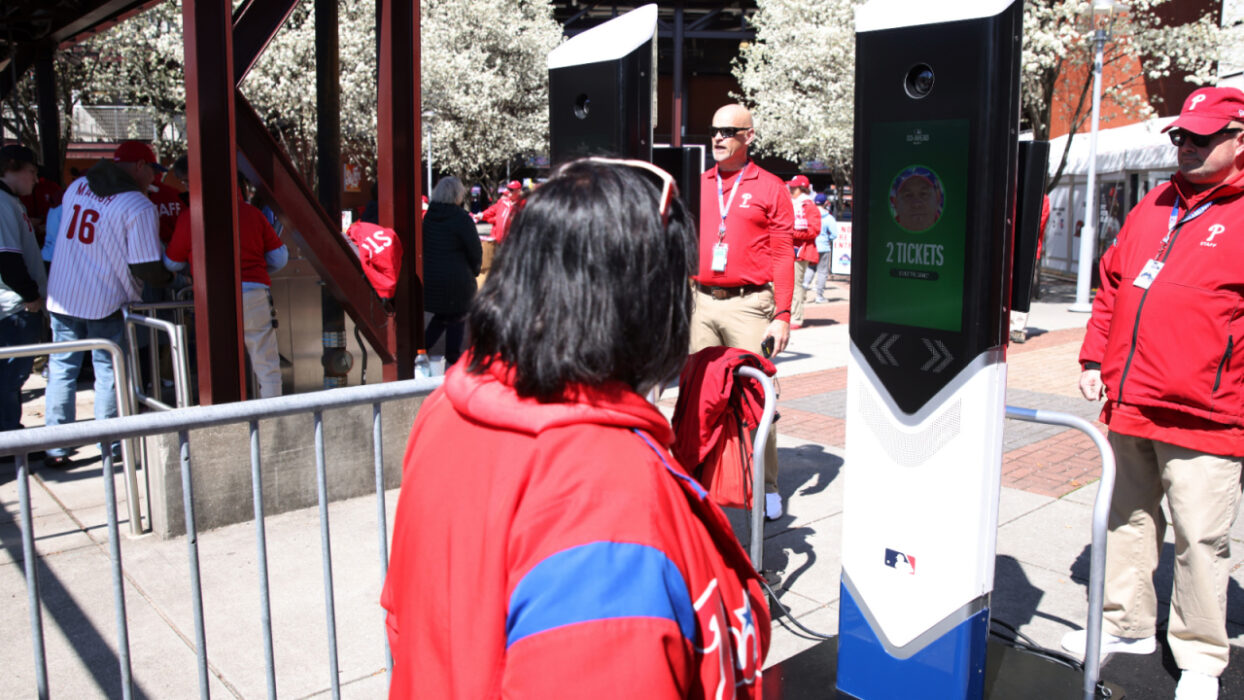
MLB first began using facial recognition last year for its Go-Ahead Entry. The technology uses a facial scan as a ticket for entry to the sporting event. It is being billed as a way to make getting into the stadium faster by streamlining the process. The process is simple. Fans walk up to a kiosk with a camera that scans their face and confirms their entry into the stadium.
You have also seen this technology if you have traveled by plane recently. TSA has been using the technology since it began testing it in 2020. By 2023, it was in 25 major airports across the country. Again, the process is simple. The passenger approaches the TSA agent, who is verifying their documents, while a camera snaps a photo to confirm the passenger’s identity.
This seems like a convenient way to decrease wait times and keep things moving. But what happens with your photo? The way it is stored and collected isn’t uniform across companies and industries. Some places, like TSA, have disclaimers stating that photos are immediately deleted after identity verification, but that isn’t the standard.
Because there is no federal law limiting the capture of biometric data, some companies are scraping it without your consent and retaining it permanently. One company is Clearview AI. Clearview AI uses publicly available information, such as social media posts and news articles, to collect billions of images of people. That information is used by law enforcement in a shared database. It is also used by Immigration and Customs Enforcement (ICE) through a government contract.
Yet, there are growing concerns about privacy
The rapid expansion of facial recognition across daily activities has made it a matter of global significance. The concern is rooted in what happens with the images after they are captured and the instances when facial recognition gets it wrong. Facial scans are as unique as fingerprints, and in some cases, we are exposed to facial recognition without the ability to opt out.
One problem is potential hacking. The images captured are vulnerable to hacking. Like your fingerprint, your face can be a key to unlock so many sensitive things. If misused, facial recognition data can enable unauthorized access to financial accounts or lead to identity theft.
Currently, there is no federal law specifically addressing potential privacy issues related to this technology. Instead, the US relies on a mix of industry-specific regulations, like the Health Insurance Portability and Accountability Act (HIPAA) of 1996, and state laws. For example, the California Consumer Privacy Act (CCPA) gives Californians greater control over their data than in other states. It allows Californians to access their data held by other entities and gives consumers an option to opt out.
However, without federal law, people in the US remain susceptible to data breaches. As technology advances, elected officials must work to protect people in the US from the abuse of their biometric data. Until then, the state you live in and the companies you interact with are the best ways to keep your data safe.