
Why Does It Feel Like the World Is Falling Apart This Year? A Record-Breaking El Niño Is Only Half the Story
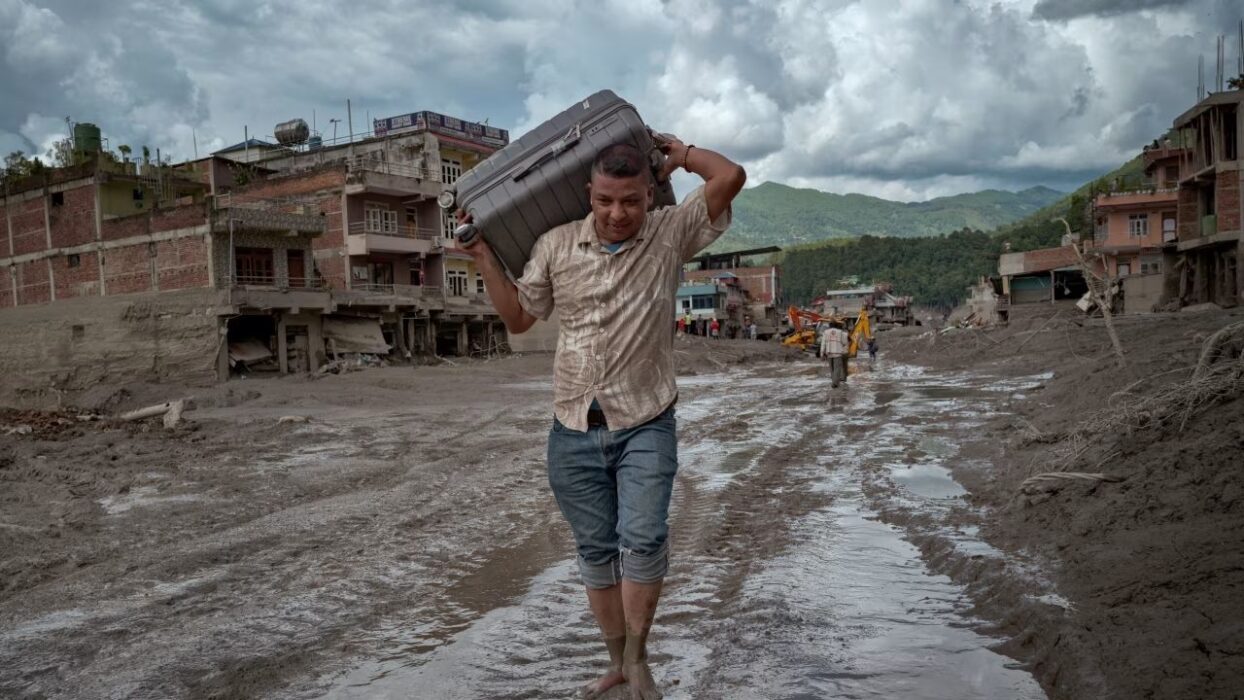
Glaciers just collapsed into a flood that’s killed more than 900 people in Nepal and Tibet. Over 4,400 are still missing. Rivers across Europe dropped to record lows this August, forcing Romania to shut down a nuclear plant. Wildfire smoke from Canada lingered over New York and Philadelphia for weeks. A heatwave in June killed close to 6,000 people in France alone. And somewhere in the middle of the Pacific Ocean, the water has been running a fever that’s about to make all of it worse.
And this time, the news channels cannot distract us from the climate apocalypse knocking at the door. However, we still need to know: what the hell is going on?!
The short answer we keep reading everywhere is that El Niño is back. And scientists insist this one is shaping up to be the strongest ever recorded. The longer answer is that El Niño is not just another natural phenomenon Mother Earth gestures against humankind. It is, in fact, a complex weather event hitting a planet that’s already running hot. And the combination is producing a year most climate scientists didn’t expect to see quite this soon.
First, What Even Is El Niño?
El Niño is the warm phase of a Pacific Ocean cycle called El Niño-Southern Oscillation, or ENSO, which the National Oceanic and Atmospheric Administration calls “arguably the most influential climate driver on Earth.”
Under normal conditions, trade winds blow warm surface water from South America west toward Asia. And cold, nutrient-rich water rises up to replace it off Peru’s coast, a process called upwelling that feeds one of the world’s most productive fishing grounds. During El Niño, those trade winds weaken, the warm water sloshes back east toward South America instead, and the upwelling shuts down. All that extra ocean heat is released into the atmosphere, which then reshapes weather patterns thousands of miles away. The opposite phase is called La Niña, in which trade winds strengthen, and cold water expands.
But according to NOAA, El Niño requires sea surface temperatures in a stretch of the central and eastern Pacific called the Niño 3.4 region to be at least 0.5°C above normal for five consecutive overlapping three-month periods, plus visible atmospheric follow-throughs, including weakened trade winds and eastward shifts in rainfall. El Niño typically shows up every two to seven years and lasts nine to 12 months.
And if you are wondering where the name comes from, it dates back to the 1600s. It was then that Peruvian fishermen noticed a warm current wrecking their catch around Christmastime and named it El Niño, Spanish for “the child,” after the Christ child.

This Year’s Isn’t a Regular El Niño. Scientists Are Calling It a “Super El Niño.”
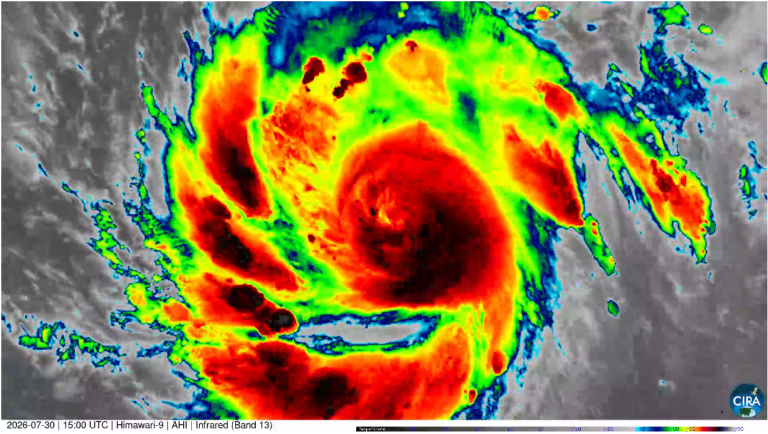
The current El Niño began in June 2026 and is expected to run into 2027, according to Carbon Brief’s ENSO explainer. Its analysis of forecasts from 14 different modeling groups found that 96% of runs predict this will be the strongest El Niño in the modern observational record, with peak Pacific sea surface temperatures expected to blow past the previous record of 2.75°C above average, set during the 2015-16 event.
“Super El Niño,” while an unofficial scientific term, is just shorthand that’s caught on in headlines. But the forecasts back it up. Back in June, NOAA put the odds at 63% for a “very strong” El Niño forming by winter that would rank among the largest since 1950, according to NPR. By August, that confidence had only grown, with the UK Met Office saying 2026 will be remembered for an “unprecedented” El Niño, possibly the largest since the 19th century. And predicting 2027 will likely replace 2024 as the warmest year on record.
“This could be a very significant event in 2026 and lingering into 2027,” Daniel Swain, a climate scientist, told NPR.
How El Niño Messes With Weather on Every Continent
The weakened trade winds don’t just move water around. They shift the position of the Pacific jet stream, which reroutes storm tracks worldwide.
In the US, that typically means wetter winters across the southern states and milder, drier conditions up north and in the Pacific Northwest. In the Atlantic, El Niño tends to suppress hurricane formation, since the wind shear it creates tears developing storms apart. It does nothing, however, to calm the Pacific. And it offers zero protection against the one storm that does make landfall, especially with Atlantic waters themselves running hotter than ever from climate change.
South America gets split down the middle. Peru, Chile and Ecuador see record rainfall, while northern countries like Colombia, Venezuela and Brazil face a higher risk of drought and wildfire. Southeast Asia and Australia are usually drier, a pattern already evident this year in Indonesia’s worst wildfires since the last major El Niño in 2015, according to Greenpeace. India can see extreme early-year heat followed by a weakened summer monsoon. And this year’s monsoon is already running at its weakest in nearly two decades.
Even marine life gets rerouted. Warmer water pushes fish that anchor Pacific fisheries, including Peru’s anchovy fishery, the largest in the world by volume, to migrate toward colder water, sometimes as far north as the Gulf of Alaska during strong events.
But El Niño Isn’t Working Alone Here
El Niño is a natural, recurring cycle. Evidence of it shows up in coral, ice cores, and tree rings, and one study of preserved coral proxy data puts ENSO-like variability at a minimum of 130,000 years old, per Carbon Brief. So, in short, El Niño did not invent extreme weather.
What’s different is the planet it’s hitting this time. Earth has already warmed roughly 1.44°C since the early 1800s, according to the Associated Press, inching toward the 1.5°C threshold the Paris Agreement was built around avoiding. “If we have a big El Niño on top of the long-term warming trend, that just really enhances the probability that we’ll see a new record global mean temperature,” NOAA meteorologist Nat Johnson told NPR.
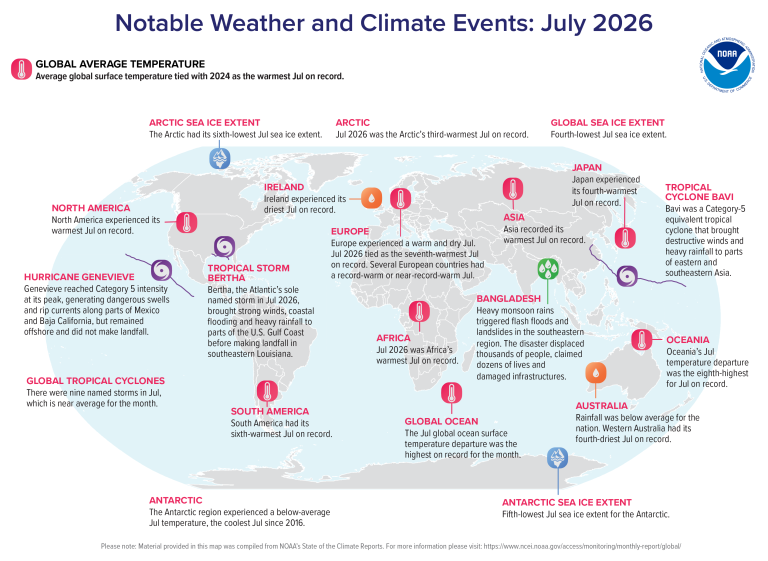
July 2026 already tied July 2024 for the joint-warmest July ever recorded globally, according to NOAA data cited by the World Meteorological Organization. The 10 warmest Julys on record have all happened since 2016, and the last four years alone, 2023 through 2026, claimed the top four spots. Berkeley Earth puts the odds that 2026 becomes a new record-hot year at 69%. And the same forecasters expect 2027, with El Niño’s heat still working through the system, to top even that.
The trend holds even in years without a strong El Niño.
2025 ranked among the top three hottest years ever recorded despite comparatively quiet ENSO conditions, per NPR.
And, of course, it shows up in dollar terms too. The US logged 12 separate billion-dollar weather disasters in just the first half of 2026, totaling at least $31.9 billion in damage and 183 deaths, according to Climate Central, the fifth most disaster-heavy first half of any year since record-keeping began in 1980. In the 1980s, the country averaged about three billion-dollar disasters a year. Over the last decade, that jumped to 20 a year, and the average gap between disasters shrank from 82 days to just 16.
Atmospheric CO2, the underlying driver of all of it, hit a monthly record of 432.3 parts per million in May 2026 at Hawaii’s Mauna Loa Observatory, about 50% above pre-industrial levels, per Greenpeace. And there’s reason to think this only gets worse. A 2022 modeling study in Nature Communications found that continued loss of Arctic summer sea ice could push the frequency of the strongest El Niño events up by 35% by the end of the century, since a warmer, more open Arctic strengthens the exact wind patterns that let Pacific heat build up in the first place.
Whether climate change is already making El Niño itself more frequent remains a genuine subject of debate among scientists. The IPCC’s 2021 assessment found that El Niño intensity and the frequency of the largest events have increased since 1950 compared with the centuries before. But older proxy climate records, stretching back 11,000 years, show so much natural variation that pinning today’s changes squarely on human warming remains hard to prove. A New York Times survey of 16 climate scientists in June 2026 found that half said they see compelling evidence that climate change is already intensifying El Niño events.
The Disaster List So Far This Year Is Already Long
March brought a heat dome to the southwestern US that scientists later determined would have been “virtually impossible” without human-caused warming, according to research cited by climate scientist Michael Mann in The Guardian. May brought a matching heat dome to the eastern US, smashing records as far up as Philadelphia.
Then came June, when a European heat dome killed more than 3,000 people in Paris and close to 6,000 across France. It was only the first of four back-to-back heatwaves that, combined, killed more than 35,000 people across Europe by summer’s end. The heat and dryness fueled wildfires severe enough to rank as the European Union’s fourth-worst fire season on record by early August, while Canadian wildfire smoke blanketed the US Northeast and Midwest for weeks.
July tied as the joint-warmest month ever measured globally, with ocean surface temperatures the hottest ever recorded for that month, and Typhoon Noul forced the evacuation of 700,000 people in China. In August, a historic “derecho,” a fast-moving band of straight-line, hurricane-force winds, tore across the Midwest with gusts over 100 mph, leaving nearly a million people from Illinois to Virginia without power. Days later, Typhoon Dolphin, the season’s 13th, triggered mass evacuations across China. Europe’s major rivers, the Rhine, Danube, Po, and Loire, hit record lows, forcing Romania to shut down a plant that normally supplies a fifth of the country’s electricity and Hungary to cut its main nuclear plant to a fraction of its output.
Then, as the summer closed out, the glacial collapse in Nepal and Tibet occurred in late August. That disaster, of course, wasn’t caused by El Niño. However, it does trace back to the same long-term warming destabilizing frozen ground across the Himalayas, Alaska, the Andes, and Greenland, according to Guardian science writer Bill McGuire, a reminder that El Niño explains a lot about this year, but not everything.
Who Actually Pays for This
Climate disasters don’t tend to be coherent, nor is their impact even around the world. In the US, communities of color and low-income communities face disproportionate exposure to wildfire smoke and flood zones, along with slower, under-resourced recoveries, according to the World Wildlife Fund, which cites research from the NAACP and Columbia University finding Black communities are “far more frequently and severely impacted by flood events.”
Globally, this same El Niño will probably hit Latin America directly, not just abroad. Central America and tropical South America are both at risk of low rainfall this cycle, alongside the already weak Indian monsoon, according to Greenpeace. Similarly, the UN Food and Agriculture Organization warns that El Niño conditions have historically triggered failed harvests, livestock losses, rising household debt, and migration in search of food and water.
Local weather coverage doesn’t always connect these dots for viewers, either. Meteorologists cite tight broadcast segments and, in some cases, political pressure from station owners as reasons climate change rarely comes up on air, even during the extreme weather segments where it’s most relevant, according to reporting from Poynter. That gap is evidence of the pattern connecting any single flood or heatwave to the bigger picture is exactly the story most people never hear.
Finally, scientists aren’t promising this is the ceiling, either. “It’s natural to think that some bigger shocks are on the way,” Tim Lenton, a climate science professor at the University of Exeter, told the AP. Whether 2026 ends up the hottest year ever recorded or merely one of the hottest, forecasters already expect 2027 to be in the running too, with El Niño’s heat still working its way through the system long after the ocean itself starts to cool.