
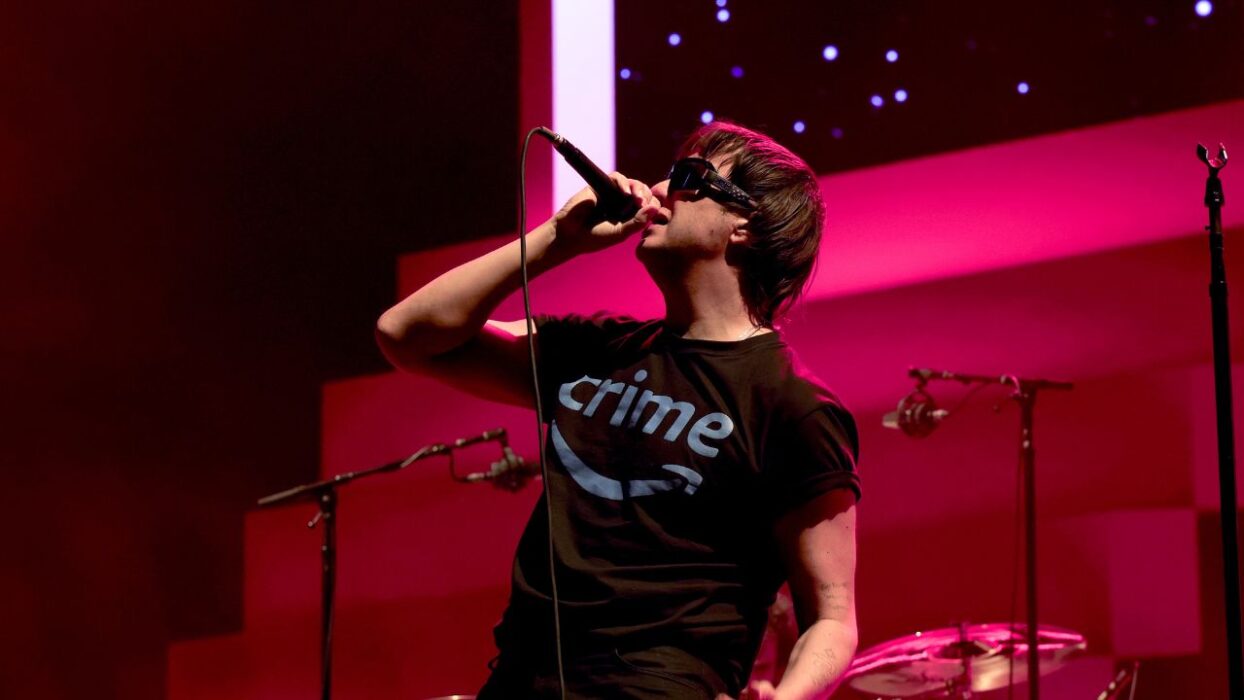
Why The Strokes Are Officially Invited to the Carne Asada After Coachella Weekend 2
The Strokes have always carried a certain kind of downtown cool. Detached enough to make boredom look elegant, but precise enough to make disaffection sound amazing. For years, that was part of the appeal. They were the band that made ennui feel cool.
Then Coachella Weekend 2 ended, and they reminded everyone that cool without a spine is just, well, bs.
Closing their set with “Oblivius,” a song they had not performed live since 2016, the band ran a montage accusing the CIA of involvement in coups and regime change in countries including Chile, Bolivia, the Democratic Republic of the Congo, and Iran.
The video then shifted toward footage from Gaza and Iran, ending with images tied to the destruction of universities there. At the same time, Julian Casablancas repeated the song’s central question: “What side you standing on?”
Why The Strokes are def invited to the carne asada
Because Latino audiences know the difference between a band making noise and a band naming names.
There is a long history in American music of artists gesturing vaguely toward justice while keeping the actual architecture of power conveniently blurry. The Strokes did not do that on Saturday. According to Pitchfork and Rolling Stone, the montage explicitly referenced Mohammed Mossadegh, Salvador Allende, Juan Torres, and Patrice Lumumba, placing U.S. intervention at the center of the narrative rather than in the margins.
For anyone raised on the political afterlife of coups, disappearances, and Washington’s habit of calling domination “stability,” that kind of clarity gives hope in a world that feels hopeless.
And yeah, that’s why we would def invite The Strokes to a carne asada. After all, an invitation to a Latino barbecue is never really about the folding chair itself. It is about trust. It is about whether somebody knows how to come correct, whether they understand the room, whether they can hold humor and history in the same hand. The Strokes closed their set by pointing directly at a lineage of imperial violence that Latin America knows too well, and they did so on one of the country’s most commercial stages. That, my friend, buys you a plate.
This did not come out of nowhere
The montage may have surprised people watching Coachella from the couch, especially because it did not appear in the band’s Weekend 1 set. Still, the political posture itself was hardly random. Pitchfork noted that during Weekend 1, Casablancas had already needled the crowd with, “You guys excited about the draft? Oh, wait, not the NFL draft.”
Rolling Stone also pointed out that Casablancas signed a 2021 petition calling for a free Palestine and previously hosted a Rolling Stone interview series, S.O.S. — Earth Is a Mess, where he discussed American imperialism, Marxism, wealth inequality, and democratic reform with left intellectuals.
Now, too many political statements at major events feel reverse-engineered for virality, as if the artist discovered conviction five minutes before set time and ran it through a branding team. The Strokes avoided that trap because Casablancas has been telegraphing this ideological terrain for years, and because the imagery onstage connected to positions he has already taken publicly, including support for Palestinian rights and repeated criticism of U.S. political and media power.
The badass part was not just the message. It was the venue
A lot of bands can sound radical on Spotify. Fewer are willing to do it at Coachella.
That is what gave the performance its charge. Coachella is one of the most mediated music spaces in the world. During this festival, aesthetics often arrive pre-packaged, and politics usually survive only if they can be folded into the brand ecosystem. Variety noted that the montage came as a surprise because it changed the emotional architecture of the set’s ending, and because the festival’s livestream clearly showed the visuals rather than cutting away from them. In other words, the band used a stage built for spectacle to deliver an indictment.
And they did it while returning to a song that had been absent from live performance for a decade. Stereogum and Rolling Stone both highlighted that “Oblivius” had not been played since 2016, which made its reappearance feel deliberate. The refrain, “What side you standing on?,” was crystal clear.
Beyond a standard rock-band protest
The Strokes are not a minor band trying to force relevance through outrage. They are one of the defining groups of early-2000s guitar music. The New York band helped trigger a broader garage-rock and post-punk revival with its 2001 debut, Is This It. Similarly, its 2020 album, The New Abnormal, won the Grammy for Best Rock Album. They have enough institutional legitimacy that they did not need to risk this. They chose to anyway.
And the timing speaks volumes, too. The band is preparing to release Reality Awaits on June 26 and has already lined up a world tour across North America, Europe, and Japan. By every industry measure, this would have been the easier moment to keep things sleek, focus on the comeback arc, play the hits, and let the new single “Going Shopping” do its work. Instead, according to Pitchfork and the band’s official site, they paired this career re-entry with one of their most overt political statements in years.