
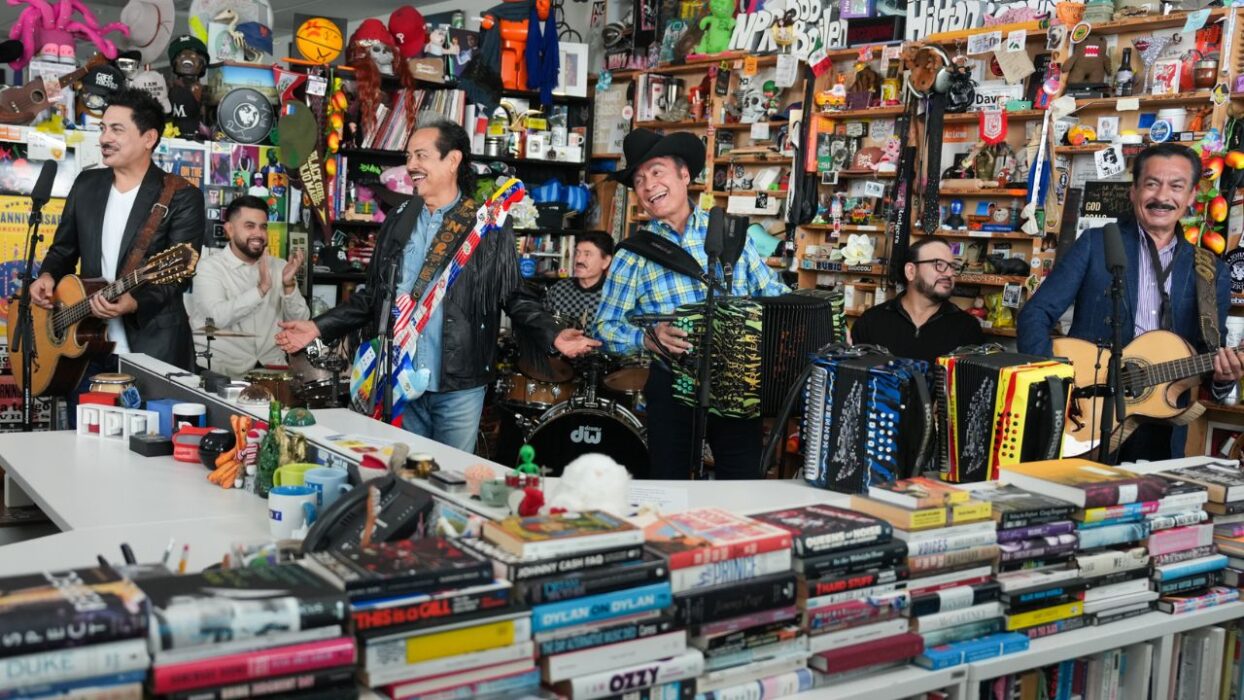
Was Felix Contreras’ Intro to Los Tigres del Norte’s Tiny Desk Censored? Here’s What Really Happened
When NPR published Los Tigres del Norte’s Tiny Desk concert on Thursday, Oct. 15, the video included an emotional introduction from Felix Contreras, co-host of NPR’s Alt.Latino and the coordinator of El Tiny, the Tiny Desk’s Hispanic Heritage Month series.
By Friday, viewers had noticed that the YouTube version was missing most of his words. Within days, the edit drew accusations of censorship, a statement from NPR, and a video from Contreras himself.
In the Tigres del Norte NPR Intro, Felix Contreras Went Back to 1848
The concert was recorded at NPR’s offices in Washington, D.C., and, according to the Los Angeles Times, was the last of this year’s El Tiny sessions. It began with remarks in Spanish from Anamaria Artemisa Sayre, the other Alt.Latino co-host, who produced the session. “I know many of you came with your parents, your family. Because, well, you are like family to millions of people,” Sayre said.
Contreras spoke next, his voice breaking. “Our community is under attack, and it’s not the first time. You can go back to 1848 when they changed the border. You can go back to after the Second World War during the so-called Operation Wetback. It takes away our humanity,” he said. He went on: “For as long as I can remember, these gentlemen have been giving us back our humanity.”
The year 1848 marks the end of the Mexican-American War, when Mexico lost roughly half its territory to the United States. Operation Wetback, a militarized mass deportation campaign carried out by the U.S. government after World War II, took its official name from a slur for Mexican migrants.
Los Tigres then opened with “Somos más americanos,” their 2001 song about the large share of the U.S. that once belonged to Mexico. The Los Angeles Times wrote that the song “flips jingoist U.S. narratives about who can call themselves American.” Four more songs from the 1980s and 1990s followed, among them “La Puerta Negra” and “Ni Parientes Somos.”
The Tigres del Norte NPR Video Kept Every Song and Lost Most of the Speech
The first YouTube video kept Sayre’s remarks and all five songs, including “Somos más americanos,” but it cut most of Contreras’ introduction. In the edited version, viewers heard him say only that “it’s a really big honor for us” before calling the band to the stage, according to journalist Fernando Hurtado, who covers U.S. Latinos and posted a video showing the jump cut where the speech had been.
By Friday, the full introduction was still up on NPR Music’s Instagram account. NPR later confirmed that it had also taken the introduction down from its website for a time.
On NPR’s accounts, many viewers pushed back. “What cowards!” one person wrote in Spanish. Others asked NPR to restore the speech, and one argued that Contreras’ message was powerful because it described the lived experience of millions of people, not an opinion.
NPR Called the Topic “Emotional and Complex” but Didn’t Say Who Made the Call
NPR responded in comments under its posts and in a statement it sent to Hurtado. “As our longtime fans of Tiny Desk know, we don’t typically publish introductions for our concerts,” NPR said. “We’ve restored this one on the NPR website after temporarily removing it for editorial review, acknowledging the topic shared is emotional and complex, and something many listeners and newsroom staff are grappling with. We hope to have the YouTube video updated soon.”
The statement does not say who decided to remove the remarks, what the editorial review found, or why Sayre’s introduction stayed in the YouTube video while most of Contreras’ was cut. NPR has not said whether it received political pressure to cut the speech, and none of the reporting we reviewed points to any.
Contreras Says His Intro “Wasn’t Meant for Publication”
Contreras addressed the controversy in a video posted on NPR Music’s TikTok. “Over the last couple of days, our Tiny Desk concert featuring the legendary Los Tigres del Norte has generated a lot of conversation online,” he said. “We’ve read your comments, we hear your concerns and your disappointments and even anger. I totally get that.”
He explained that his introduction “wasn’t meant for publication, but when we included it in the concert video, it resonated in ways we couldn’t have imagined.” He added, “Bottom line, we’ve since restored the full original video on NPR’s website, and it will be back on YouTube very soon.”
Contreras said he had never felt so much support for his work at NPR, “but it’s not really about me. It’s about the sense of familia that happens when we get together to share music here at the Tiny Desk.” He asked fans to turn their attention back to Los Tigres and the other artists featured during the month, and signed off with, “And hey, check it out. I did this without crying this time.”
Los Tigres del Norte Have Sung About Immigrant Life for Decades
The band began in the late 1960s in Rosa Morada, a town in Sinaloa, Mexico, and later made San José, California, its home, according to the Los Angeles Times. Brothers Jorge, Hernán, Eduardo, and Luis Hernández play alongside their cousin, Óscar Lara, in the current lineup. Their records, which have sold in the millions, tell stories of drug smuggling, heartbreak, and life as an immigrant in the U.S. The group has won multiple Grammys and Latin Grammys and sold out Madison Square Garden in 2025.
In 2024, the band appeared at a campaign rally for Kamala Harris. This September, Minneapolis Mayor Jacob Frey proclaimed Sept. 9 Los Tigres del Norte Day. The Times reported that the city recognized the band’s decades of immigrant advocacy and its support for Minneapolis after federal immigration agents carried out a major enforcement operation there earlier this year.
Jorge Hernández, the band’s director and lead singer, told the Times that the Tiny Desk “was something beautiful and historic for us which should’ve happened 10 to 15 years ago.” He said the band wanted to use the Tiny Desk to bring immigrants’ struggles to an audience different from the one Los Tigres usually plays for. “We performed songs that talk about the problematic systems [in the U.S.] that have been around for years, but that are right now worse than ever before,” he said.
Hernández also told the Times he hopes the band shows younger artists that political songs can strengthen a career instead of holding it back. “You can’t stay quiet. Your songs should talk about your problems so that through your work you can connect with and inform people,” he said.