
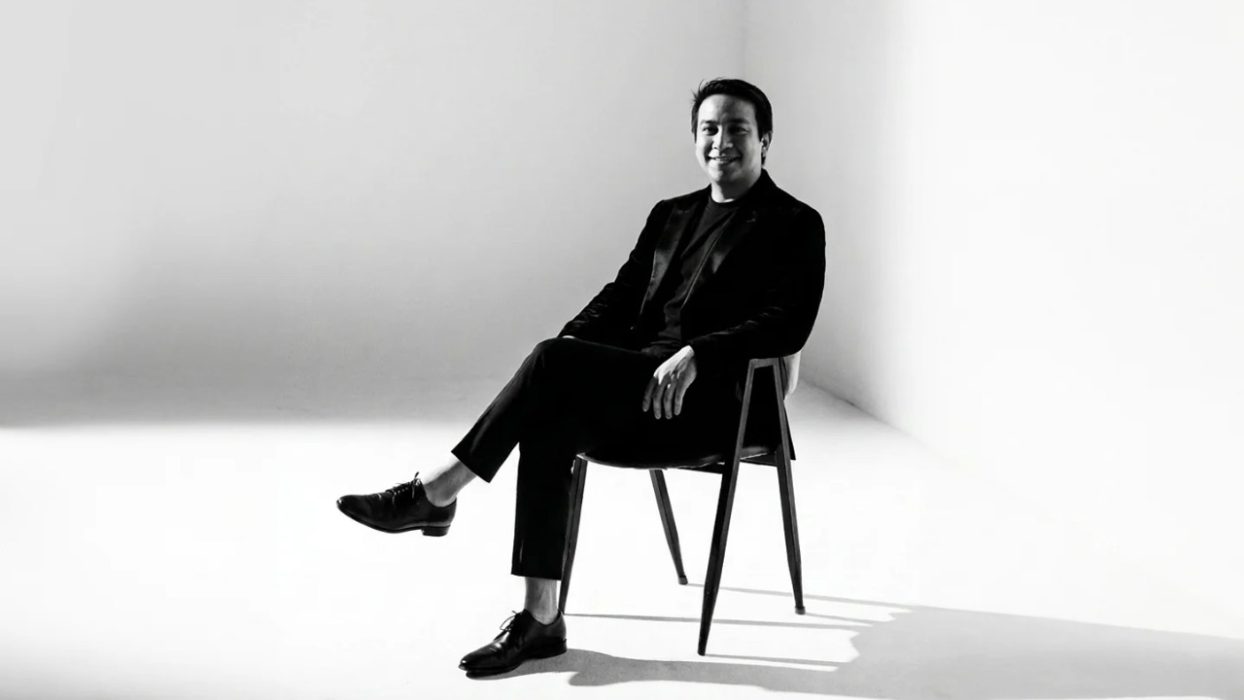
René Mejía Grew Up Under El Salvador’s Starry Skies. Now He’s Taken His Space Collection to Paris
As a boy in San Ramón, a small town in El Salvador’s Cuscatlán department, René Mejía spent his nights looking up. Electricity wasn’t always available there, and at night the sky was filled with stars. “I would spend hours looking up at the universe, wondering what existed beyond what I could see,” he says. “I remember asking my mother questions about space that neither of us had the answers to.”
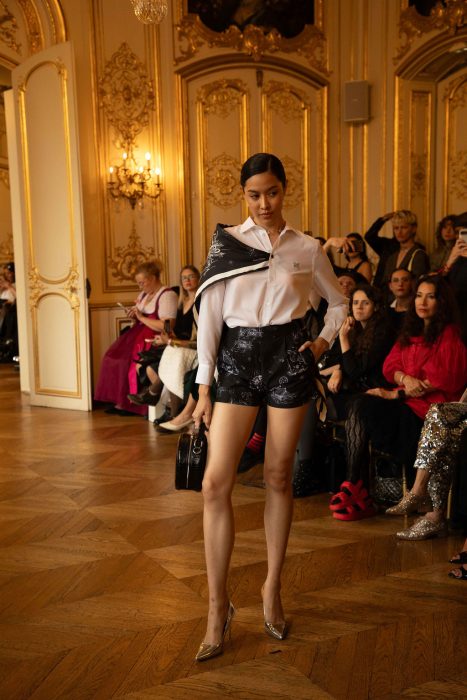
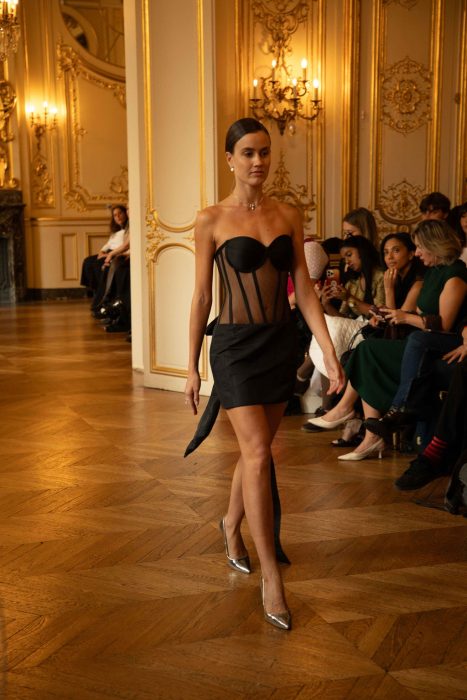
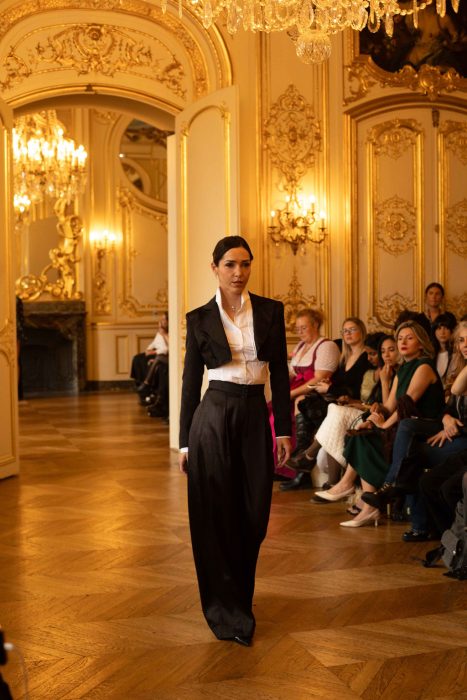
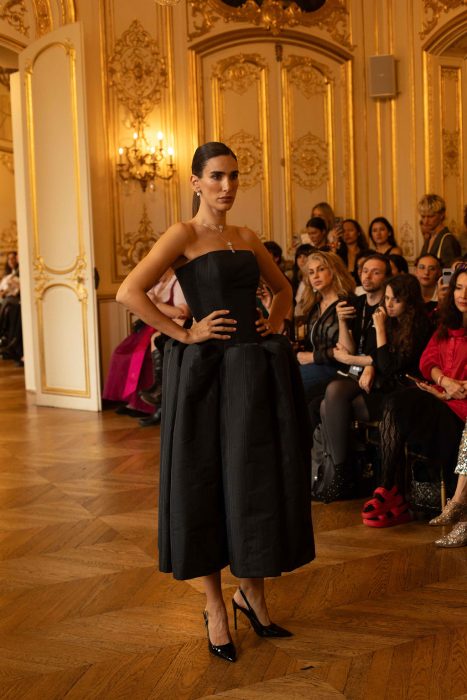
Two decades later, the Miami-based designer brought that sky to Paris. On Oct. 7, Mejía presented his Spring/Summer 2027 collection there, built around a question his team posed in its announcement: What do clothes become when life is no longer confined to Earth? His answer is a wardrobe of black moiré and printed toile for a woman who lives in space.
If his name sounds familiar, his work has appeared in Vogue, ELLE, Glamour, WWD, and The New York Times, and People magazine once named him a designer to watch.
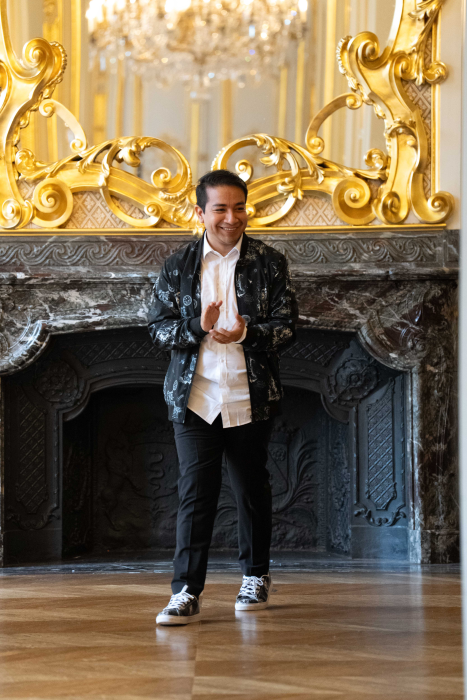
René Mejía Left El Salvador at 10, Almost Overnight
Mejía spent his first 10 years in San Ramón. In 2006, his family left. “My family was forced to make the difficult decision to leave everything behind almost overnight due to the intense violence affecting the country,” he says. The family crossed several countries on the way to the United States, a journey he says taught him resilience, “not only as a fashion designer but also as a person.”
As a child, arriving meant learning a new language and a new culture. In South Florida, his mother worked 12-hour shifts at a restaurant to pay for an efficiency apartment with no air conditioning, he told the outlet Canvas Rebel in 2023. Watching her do everything she could “to make sure we had enough to survive the next day,” he said, then gave him “a driving force that not many people have.”
His mother was also a seamstress, and that is where the designer started. “Growing up, I watched her sew garments for her clients, working tirelessly to make sure we had enough money to put food on the table,” Mejía says. “I remember observing her hands as she worked, watching pieces of fabric become something entirely new. Without realizing it at the time, those moments were my first introduction to fashion design.”
New York Fashion Week Came Early, and Mejía Took a Step Back
Mejía studied fashion design and, at 21, was one of six student designers chosen to show their work at New York Fashion Week on behalf of his school. The experience gave him his first taste of an international runway, and a lesson. “It also taught me something equally important: I wasn’t quite ready to launch my own luxury fashion label,” he says.
So he kept studying the business side of fashion before building his own. His label, René Mejía, has focused on made-to-measure clothes for private clients, including ready-to-wear and special-occasion pieces, he told Canvas Rebel. Today, he still runs much of it himself. “For the most part, I am a one-man operation,” he says. “I handle so many aspects of the brand myself, from designing collections to developing the business and presenting my work internationally.”
He doesn’t believe in waiting for the right moment. “Even today, I don’t know if there is ever a perfect moment to start a brand,” he says. “But one thing I know for certain is that I want to do this, and I want to do it now.”
The First Time in Paris Felt Surreal
Mejía had hoped to show in Paris as early as 2020, before the pandemic derailed those plans, he told Canvas Rebel in 2023. “The first time I presented a collection in Paris was surreal,” he says. “Growing up in a small town in El Salvador, I never imagined that one day I would cross the Atlantic Ocean to present my designs in a city with such a remarkable fashion history.”
Asked how the industry there receives a Latino designer, he says he rarely thinks about it in those terms. “I have always been so focused on building my brand that I rarely stop to question how the industry perceives me because of my background,” he says. “I am proud of what I have accomplished so far, especially knowing where I started. There is still so much I want to achieve, but being able to represent my work, my heritage, and my vision on a platform like Paris Fashion Week is something I will never take for granted.”
Why René Mejía Keeps Returning to Space
Space recurs in Mejía’s work. “Space has become a recurring inspiration in my collections because, to me, it represents possibility, discovery, and the unknown,” he says. For this season, he imagined a woman for whom living off-planet is ordinary. “She isn’t traveling there as a tourist. It is her world,” he said in a statement. “She has a spacecraft, she has a life there, and tonight she has been invited to the most exclusive gala in space. The collection begins with the question of what she chooses to wear.”
“We are getting closer to a future in which traveling beyond Earth could become part of human life,” he says. “I find that possibility fascinating, and I genuinely hope I am here to witness it.”
How a Childhood Atlas Led to Black Moiré
At the center of the collection is black moiré, a fabric with a rippling, watery finish that has been around for centuries. “The flowing, almost fluid patterns reminded me of a topographic map,” he says. “That visual connection immediately brought me back to my childhood in El Salvador. I had an atlas that I was completely obsessed with, particularly the pages featuring topographic maps.”
The collection also brings back the label’s signature print, Space Toile de Jouy. Mejía found traditional French toile, with its illustrated pastoral scenes, in 2019 while researching his graduating collection, drawn by what he calls “its ability to tell stories through illustrated scenes.” He swapped the countryside for space-exploration scenes.
Both fabrics, as he points out, have long been used to decorate homes, toile in wallpaper and moiré in upholstery, and that is part of their appeal to him. “I have always thought of clothing as a form of shelter, something we carry with us throughout our everyday lives,” he says. “In the same way that we decorate our homes with furniture, wallpaper, and textiles to create an environment that reflects who we are, I believe we use clothing to construct a personal space around ourselves.”
René Mejía Carries His Mother Into Every Collection
When asked whether anything in the collection carries El Salvador, even when no one else can see it, Mejía says, “Absolutely.” Part of it is the curiosity he developed as a child. Most of all, it is his mother.
“That connection to clothing goes far beyond aesthetics for me. It represents sacrifice, determination, and love,” he says. “No matter where my career takes me, whether I am designing in Miami or presenting a collection on a runway in Paris, that part of my story will always be present in my work. It is something I will carry with me for the rest of my life.”