
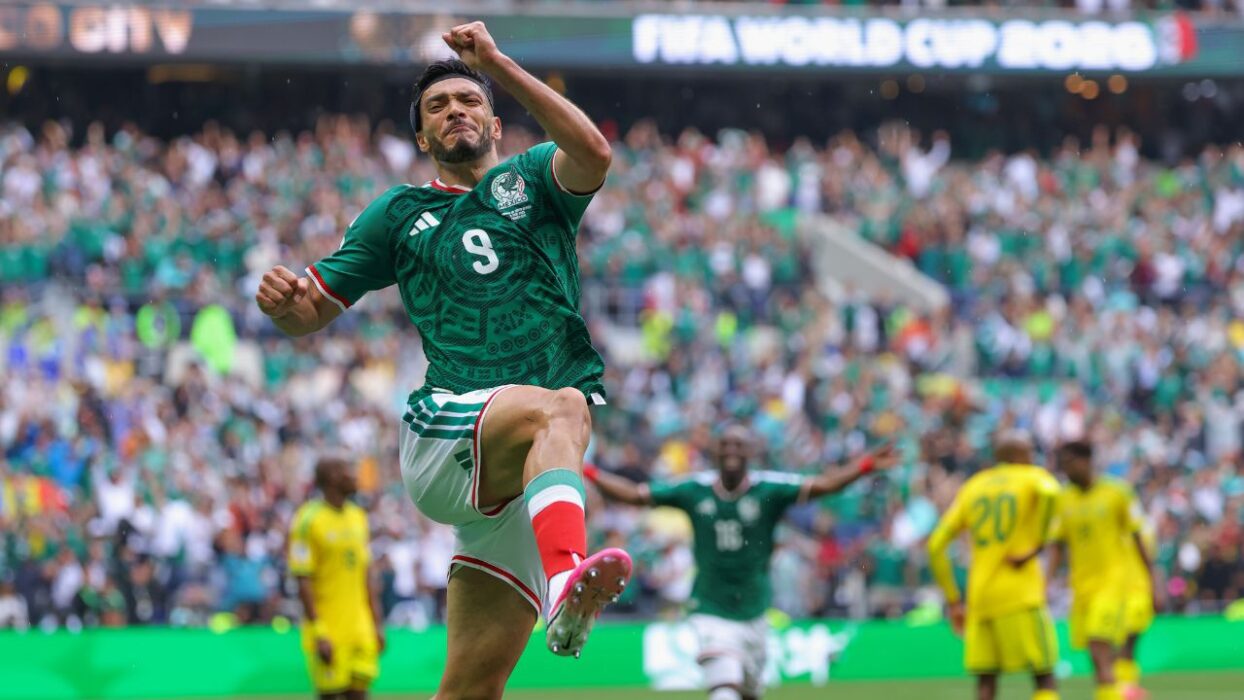
Raúl Jiménez Promised His Father a World Cup Goal. Today, He Kept His Word
When Raúl Jiménez scored with a header in the 67th minute at Estadio Ciudad de México on Thursday, his celebration showed what it meant. He raised both hands to the sky, spotted his family in the stands, and made a heart with his fingers. Tears welled up in his eyes. His father, Raúl Jiménez Vega, had died in March and could not be there.
The one thing they still needed
During the 2025 Copa Oro, in which Mexico won the championship, Raúl Jiménez’s father told the media, “We’re missing a goal at the World Cup,” he said, according to ESPN Deportes. “That’s all we’re missing.”
It was more than a wish. It was a promise. Jiménez had played for Mexico in three World Cups before but had never scored. His father always believed he would get another chance.
Three months after his father died, Raúl Jiménez started in the tournament his father always thought would define him.

Three World Cups and a growing sense of unfinished business
Jiménez played in his first World Cup in Brazil in 2014 at 23, with high hopes as a talented striker. He did not score. In Russia 2018, he came off the bench in two of Mexico’s four games but did not score. At Qatar 2022, he had a groin injury that nearly kept him out. According to ESPN Deportes, he was a substitute in all three group stage matches and did not start. He did not score.
After three World Cups, not scoring became part of Jiménez’s story. But people also talked about how he was one of the best strikers Mexico had seen in years. He led the attack for Wolverhampton and Fulham in the English Premier League and had succeeded at every level except scoring at a World Cup.
His father kept a different count.
November 29, 2020, was the day everything changed for Raúl Jiménez
On November 29, 2020, Jiménez collided head-on with Arsenal defender David Luiz during a Premier League match for Wolverhampton Wanderers. He lost consciousness on the field. Emergency crews took him to St. Mary’s Hospital in London, where doctors found he had a fractured skull and a brain injury that could have been fatal, according to CBS Sports. According to USA Today, Jiménez now wears a custom protective head guard and will continue to wear it for the rest of his career.
According to ESPN Deportes, the doctors told him returning to professional football was almost impossible.
Jiménez later told ESPN: “I don’t remember anything from that day, only how we arrived at the stadium. After that, it’s as if nothing existed for me. I knew I was going to come back.”
His exact response to the doctors, according to ESPN Deportes, was two words: “We’ll see.”
The comeback nobody could argue with
Eight months after the injury, Jiménez returned to the pitch in August 2021. He rebuilt his game at Wolverhampton, then moved to Fulham, where he recovered the form that had made him one of the Premier League’s most dangerous forwards. His return to the Mexican national team under coach Javier Aguirre settled any remaining debate about his place in the squad. According to ESPN Deportes, under Aguirre, the question of who starts does not exist: Jiménez is the starter. He lined up from the first whistle against South Africa on Thursday.
His father died in March, three months before the tournament began. According to CBS Sports, when Jiménez scored his first goal for Fulham following his father’s passing, he also pointed both hands to the sky and dropped to his knees in tears. The celebration at the Azteca on Thursday was the same gesture.
The goal his father waited twelve years to see
Julián Quiñones put Mexico ahead in the ninth minute, dispossessing Sphephelo Sithole and driving the ball through goalkeeper Ronwen Williams’s legs, according to The Guardian. South Africa lost Sithole to a red card early in the second half and finished the match with nine men after Themba Zwane’s dismissal seven minutes from time. The result was never in serious doubt.
The turning point came in the 67th minute. Roberto Alvarado sent a cross into the box, and Jiménez arrived unmarked at the back post. He headed it past Williams and into the net.
It was his 46th international goal for Mexico. It was the first in a World Cup. What’s more, it came at the Estadio Ciudad de México, the ground where he began his career.