
Meet Las Paleteras, the Queer Latinx Podcast Built on Joy
“When I meet my creator,” José Richard Avilés says, “I will ask them to make me queer and queer again in every lifetime. I’ve learned to love this hard in the name of the ancestors who had to love in secret.”
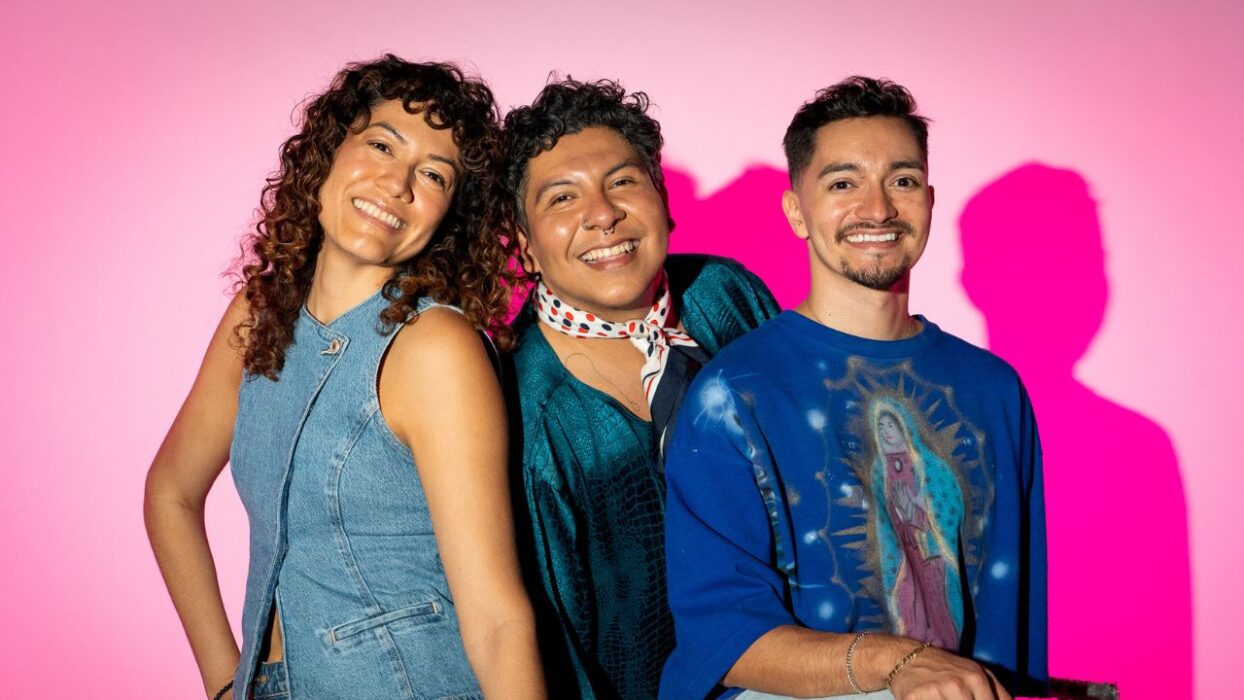
Avilés, who goes by Nalgona, is a poet, dancer, social worker, and activist of Salvadoran descent. And they are one of three co-hosts of Las Paleteras, a podcast now in its third season that is rethinking its approach to the Latinx media landscape. Instead of watering down the beauty and complexity of queer Latinidad, they are creating a space where queer joy is the substance of the conversation, examined and celebrated with the seriousness it deserves.
Not that joy came easy. As Avilés and their co-hosts, César Camacho and Ana Sheila Victorino, make clear across their episodes, arriving at something like genuine pride required what Ana Sheila calls “a lot of healing, a lot of self-work.”
While the joy might look effortless and like a constant party from the other side of that work, it is not.
Las Paleteras and the Podcast Industry That Don’t Recognize A Core Audience
In 2026, Forbes published its list of the 20 highest-paid podcasters in the United States. The list runs from Joe Rogan at $82 million down through more than a dozen other names, covering nearly every corner of mainstream American media. Not a single Latino or woman-of-color podcaster appears on it. And mind you, we are talking about an industry where Latino listenership has grown significantly in recent years, reaching 43%-60% of adults. Similarly, according to Sounds Profitable, 67 percent of LGBTQ+ podcast listeners made a purchase after hearing a podcast ad in the prior three months, compared to 58 percent of podcast listeners overall. In other words, the audience is there, but the investment is not following it.
Las Paleteras sits inside that gap, and it’s determined to push forward. Ana Sheila, who had run an earlier project, said that left her with a specific sense of what was missing. “What I wanted to bring to Latine audiences was queer joy,” she told mitú. “Sin, sin límites, sin… Just that full expression, que es messy, que es hermoso, but that also really shows the work that we’ve had to do to be able to connect with our joy.”
For his part, César arrived from a background in entertainment marketing and a student podcast he had co-hosted with Univision in Chicago, called Entre Primos. When Ana Sheila and Nalgona brought him the project, he recognized something he had been looking for. “It felt like we were working with primos,” he said. Avilés had previously hosted a solo project called Fruta Fresca and knew exactly what they wanted to do differently: share the room. “It’s always fun to be in conversation,” they said. “It’s just a different format when you’re the only host.”
When the team was complete, all that was missing was the name. And Las Paleteras felt like a natural fit. “We truly are like paletas,” Avilés explained. “We come in different flavors and different shapes.”

More Than Who We Sleep With
The first thing Avilés wanted to avoid when they launched was a show that reduced queerness to a checklist. “The one thing I didn’t want to become was another podcast that said, ‘Here are five tips to be a better bottom,’” they said. “We need to expand beyond the sexuality and what the type of content is that we’re creating.”
If you are straight or accustomed to heteronormativity, this might not sound like something important. But if you look back to the history of LGBTQ+ media, hypersexualization has often been the norm. Challenging the conception that we are more than sexual beings is nothing short of revolutionary.
One of Avilés’ favorite installments dealt with aging as a Queer person. Through the conversation, the three hosts recognized themselves as elder children. If you are Latino, you know the disproportionate weight that comes with being the firstborn. Now, add a layer of queerness to that, and you’ll see the struggle before the joy.
From there, the discussion moved through the specific weight of being the eldest, the first to go to college, the one expected to achieve, in a family that may not yet have had the tools to understand and accept you for who you actually were. “These are not the things that you’re gonna see go viral,” Avilés said. “But it’s like, amiga, we’ve been trying to be more than who we sleep with since the ’80s. It’s why the term queer was invented in the first place.”
In consequence, the show takes history seriously. Not only the one that took us generations to record, but the one newer generations have taken for granted. In one conversation, Avilés raised the story of the Blood Sisters, a group of lesbian organizers who, during the AIDS epidemic, donated blood to gay men at a time when almost no one else would. He offered it as the history behind why the L goes first in the LGBTQ+ acronym. “That show of intersectional coalition building, I think we need now more than ever,” he said. Las Paleteras understands that queer Latinx history is oral history, and the show has made itself a record of it.
Ana Sheila describes their approach as “accountability con grace.” The goal, after all, is calling in, not calling out. “We’re gonna tell you the things,” she said, “but we’re gonna call you in.” The show approaches its audience with the cultural humility of hosts who are still learning from each other, and who make no secret of it. “We also kinda come to the show with that cultural humility,” Ana Sheila said, “that todo esto ya estamos aprendiendo.”
The “Queer But” Becomes the “Queer And”
Ask all three hosts whether, given the choice, they would be queer again in another life, and the answer is immediate. César: “100%. Without a doubt.” Ana Sheila: “If I could choose, I would choose to be queer in every lifetime.” Avilés answers in a poem.
The more revealing question is what it took to get there. Avilés describes a journey from “I’m queer, but” to “I’m queer, and,” one where the “but” carried all the labor of justification, and the “and” carried the freedom of not needing it. “I’m no longer doing the code switching,” he said. “If anyone’s doing the code switching, it’s the Institute. So I can show up in a room full of architects and engineers, hella queer, hella brown, and hella hood. Like, I’m done.” They talk on the podcast about their sobriety, the adult relationship they have built with their parents, and their father, who calls them Juanga, a nickname Avilés takes as a form of love. “I’m grateful that you call me a famous cantautor mexicano,” they have said of their father. “I take it.”
For his part, César started therapy during the podcast’s run. “It was nice that I could share these experiences and then go to my therapist,” he said. The show opened things that had been closed. After three seasons of recorded conversation, Nalgona joked about the possibility that they had all corrupted each other. Almost immediately, all three arrived at the same question at once: “Or have we freed each other?”
Ana Sheila described her own season of questioning, asking herself which boxes she still inhabits out of habit rather than choice. “Where am I maybe still putting myself in boxes that come from heteronormativity, from capitalism, from patriarchy?” She still identifies as a lesbian, though she prefers queer. She described watching Avilés’ evolution across three seasons as something she found “really beautiful to witness in real time.” “Zero expectations but mil posibilidades,” Avilés said.
Joy, Berlin, and What the Queer Latinx Community Needs Right Now
The interview happened against a specific backdrop. Days earlier, Berlin, one of the cities most identified with queer community globally, had suffered an attack against that community. I asked all three hosts how they kept celebrating queer joy with so many forces working against it.
Avilés cited Gloria Anzaldúa, who argued that queer people, by virtue of having lovers across every form of lived experience, get to be the bridges between communities. They said what they do when something tries to silence them is become louder. “Con más bulla, más desmadre, más jotería,” they said. “Let me be times 25.”
Ana Sheila’s answer was simpler and no less political. “The only way we can continue to create the worlds that we want for each other is to stay connected to joy and to hope and to radical imagination,” she said. Queer people and Black people, she noted, have had their rights stripped and their imagination suppressed alongside them. “They didn’t want us to exist. They didn’t want us to imagine the world we want for ourselves. And I think that’s why I stay committed to staying connected to joy in the midst of suffering and grief that we have to see and experience every day.”
César kept it close to community. “We have to find joy in the little things that bring us together,” he said. “And then also make sure that we’re there for our community when they need us.”
Las Paleteras is not yet on the Forbes list. The show continues in an industry where no Latino podcaster has cracked the top 20 earners, where LGBTQ+ Latinx voices remain among the most underinvested in the medium despite some of its most engaged audiences.
But Las Paleteras shows up anyway. Three seasons, con cariño and wholeheartedly unapologetic.