
This Viral Clip of Koreans in Mexico Is Peak Hospitality Energy (America Take Notes)
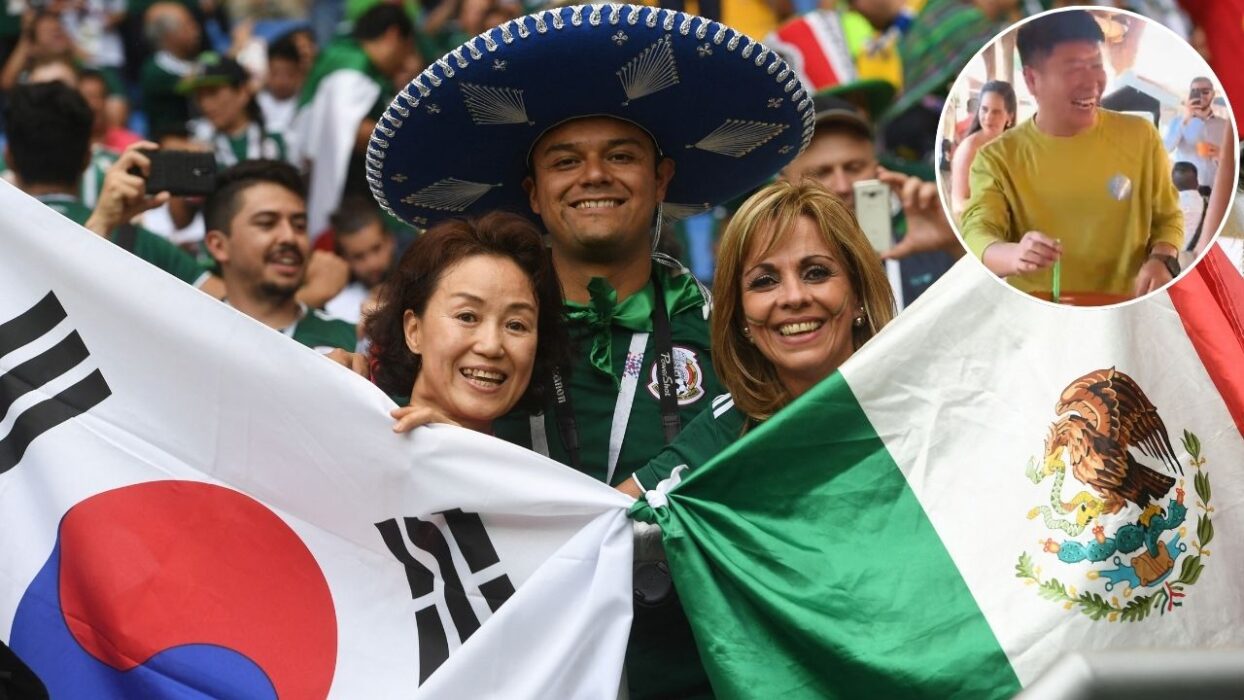
A video that went viral last week tells you everything you need to know about what’s happening as the World Cup arrives. The clip features a Korean soccer player at Cantaritos El Güero, a legendary bar in Guadalajara, Mexico, being lifted and turned upside down to drink from a clay pot through a straw. Around him, Mexican strangers are cheering and laughing.
It was a symbol of what soccer should mean. Furthermore, it shows how Latinos, despite being persecuted north of the border, know how to welcome foreigners with open arms.
It all happens amid one of the most chaotic World Cups in history. Expensive tickets that even Donald Trump wouldn’t buy, hotels calling the tournament a “non-event” because nearly 80 percent of bookings in major U.S. cities are tracking below forecasts. Visa denials for journalists and fans from Iran, Haiti, Senegal, and the Ivory Coast. And that’s just the tip of the iceberg.
However, upon Korea’s arrival in Mexico, the nostalgic feeling of unity and universalism resurfaced.
A Revealing, Unplanned Welcome
Hundreds of Korean fans arrived in Guadalajara this week. And just as any foreign traveler should do when they enter a different culture, they absorbed every piece of it.
According to El Universal, the footage showed exactly what happened when cultures actually meet without borders getting in the way. The clip spread across social media, and observers marveled at how excited the Korean tourists were about Mexican traditions. Some joked about what other experiences awaited them across the country. And yes, some were embarrassed. But that’s the beauty of it all—the possibilities.
After all, this is what integration looks like when it happens naturally.
A 120-Year Relationship Built on Sacrifice
What the viral video doesn’t tell you is that Korea and Mexico have known each other for more than a century. The first Korean immigrants arrived in Mexico in 1905. Since then, these two countries have built a relationship that goes beyond tourism and trade. They built what Korean Ambassador Jooil Lee calls “a relationship based on mutual respect, collaboration, and human ties.”
But the deepest connection runs through blood. During the Korean War in 1950, Mexico sent soldiers to fight alongside South Korea. They fought under the United Nations flag and died on Korean soil. And Korea has not forgotten.
On June 7, during the Guadalajara Koku Fest celebrating Korea Day, Mexico honored those veterans. Roberto Sierra Barbosa, a Mexican-American survivor of the 1950 war who is turning 98, was approached one by one by young Korean citizens. They bowed and thanked him for his service. “Mexicano, hermano, ya eres coreano,” they said.
Sierra Barbosa told El Heraldo de México that the moment moved him to tears. “The survivors feel as much Mexican as Korean because we left our blood there,” he explained. “They treat us with great admiration. From the young people, we receive respect.”
This is what tournaments like the World Cup should encourage.
The Diplomatic Exchange Reveals Genuine Reciprocity
“Our two countries have shared more than 120 years of friendship, solidarity, and human bonds,” Ambassador Lee said. He emphasized that this World Cup moment is significant not as a sporting event, but as an opportunity for younger generations to build their own connections.
In 2018, after a memorable match, a phrase emerged in Mexico: “Coreano, hermano, ya eres mexicano.” In translation: Korean brother, you are already Mexican. In 2026, he predicted, it would flip. “Mexicano, hermano, ya eres coreano. Mexican brother, you are already Korean.”
Lee emphasized that what matters most is that young Mexicans and Koreans will see each other, exchange, and then take those stories home.
Korean Journalists and Players Embedding Themselves
Meanwhile, Korean media descended on Mexico with a different mission. According to Infobae, Korean journalists arrived at Mexico’s training facility to document the Tri’s preparations. They set up with cameras, microphones, and laptops. They asked about specific players, identified coach Javier Aguirre on the field, and documented formations and strategies.
But this wasn’t surveillance of the Cold War variety. This was a “scouting-meets-cultural-immersion” kind of thing. The Korean national team chose Verde Valle, Chivas’ training facilities, as their World Cup base in Guadalajara. For their part, the Mexican club went above and beyond to welcome their colleagues. They added signage welcoming the Korean team, created what they called “Korea House,” and equipped the fields with technology similar to that used in Mexico’s World Cup stadiums.
Similarly, thousands of Korean fans are arriving daily, not just to watch games but to participate in a country more than happy to include them. They drink tequila, learn Spanish, get lifted upside down at bars, and wear Mexico jerseys with Korean flags.
Latin America’s History of Opening Doors
Mexico’s willingness to receive, celebrate, honor, and integrate is rooted in centuries of Latin American history. The region became a refuge for people fleeing catastrophe for centuries. Between the 19th and early 20th centuries, millions of European immigrants arrived in Argentina, Brazil, Uruguay, and Cuba. Over 90 percent of European migrants settled in these four countries, fundamentally reshaping their demographics and cultures.
Why? Because Latin American governments understood that growth requires generosity. Argentina, Brazil, and Uruguay offered land and promised free education, facilitating integration. Between 1870 and 1930, these policies transformed the region.
Similarly, during World War II, Latin America offered refuge to Jews fleeing Nazi persecution. During the Cold War, Mexico and Venezuela received exiled dissidents escaping military dictatorships in Chile, Argentina, and Uruguay.
And no, this isn’t a perfect history. Many in these countries sometimes pushed racist or xenophobic agendas. But the practical reality was always integration.
Meanwhile, Across the U.S.-Mexico Border, the Same World Cup Is Becoming a Study in Exclusion
Ticket prices are just the beginning. Journalists from Iran, Africa, and other countries have been denied visas to the U.S. The International Sports Press Association documented “countless cases” of regularly accredited journalists turned away. Some from eligible countries can only enter the U.S. once. If their team plays in Canada or Mexico, they cannot return. Fans from Iran, Haiti, Senegal, and the Ivory Coast are effectively barred by the Trump administration’s travel bans, even though all of these nations qualified for the tournament.
Fifty countries require a $15,000 visa bond. And not just countries from the Global South. Two Scottish brothers had ESTA authorizations revoked without explanation, even though they were approved in December.
Meanwhile, nearly 80 percent of U.S. hotel bookings in major host cities are tracking below forecasts. The American Hotel and Lodging Association surveyed over 200 hotels. Their conclusion? This World Cup is a “non-event.” Not for lack of excitement. The problem is that the welcome is too conditional.
However, Mexico is showing what the World Cup should really be about.