
Karol G, Mariachi Reyna, and the Hard Question Latino Culture Keeps Asking Itself
Karol G’s Coachella headlining set gave Latino audiences a moment that felt overdue and unmistakably historic. She became the first Latina woman to headline the festival. Karol G used that stage to frame the performance as both personal and collective, tying her own ascent to a broader Latino story unfolding in a deeply hostile political climate.
At a moment when Latinos keep being cast as the problem in a national political script designed to obscure far uglier power projects, Karol G delivered a spectacle built around female force, pan-Latin ambition, and public solidarity. The set made room for Becky G, for immigrant affirmation, for mariachi, and regional pride. And for the idea that Latin America could take the biggest stage in the desert without first shrinking itself.
Then the harder conversation arrived
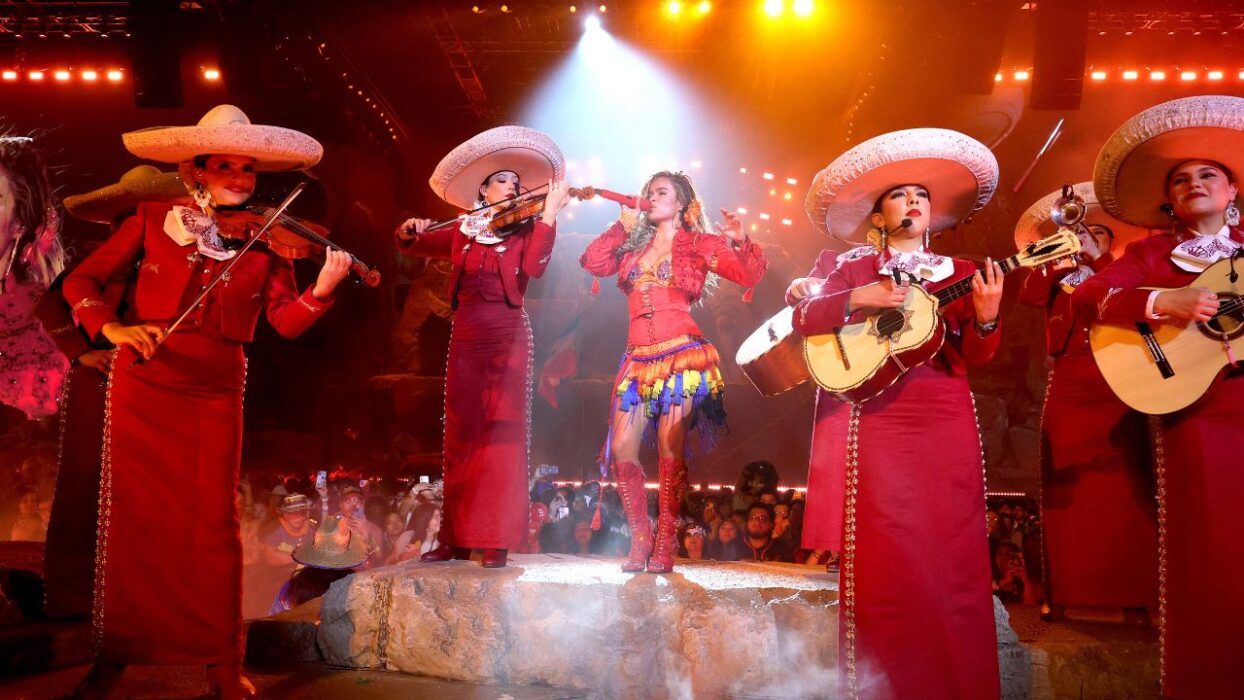
Amid the celebration, viewers began asking questions about one of the set’s most powerful visual choices: the inclusion of Mariachi Reyna de Los Ángeles. The all-women ensemble joined Karol G for “El Son de la Negra,” “Ese Hombre Es Malo,” and “MAMIII.” According to CALÓ News, the backlash intensified after online users highlighted Teresa Hernández’s political affiliations. She is the president of the Conservative Lincoln Club and led efforts to recall Governor Gavin Newsom. Hernández also appeared in a circulating video describing the group’s invitations to conservative figures, including Ron DeSantis and Tucker Carlson. CALÓ also reported that José Hernández founded Mariachi Sol de Mexico in 1981 and Mariachi Reyna in 1994. During Coachella, the group performed while Becky G expressed support for immigrants before leaving the stage.

That collision is what makes this story worth sitting with. A history-making Latina performance became the site of an argument about lineage, political inheritance, artistic labor, and the limits of communal accountability. And unlike the lazy internet version of this debate, the real tension here is not difficult to name. When a cultural institution has opened doors for women in a historically male-dominated genre, what exactly should a community do when the politics attached to that institution feel hostile to the very people those doors were supposed to empower?
Karol G’s stage made room for a real pan-Latin image
Part of what made the mariachi moment so potent was its immediate visual sense. Karol G’s set was already being read as a major Latino cultural statement. And the arrival of an all-female mariachi band inside that framework amplified the symbolism. It signaled a bridge, not just between Colombia and Mexico, but between genres, women, and Latin American traditions that too often get watered down into marketable sameness in the U.S. mainstream.
According to The Desert Sun, Crystal Hernández said the performance allowed them to represent “women, Latino women, our music and our culture with pride.” She described the crowd’s reaction as a “roar of excitement.” Hernández also told the paper that Karol G’s musical director reached out to the group. Karol had been preparing for the set since November. Mariachi Reyna rehearsed for about a week with the headliner and her team. In other words, this was part of a carefully built segment inside a months-long production.
Therefore, the easier fantasy some people rushed toward online, namely that once criticism appeared, Karol G could simply swap the group out between weekends as if nothing on a Coachella main stage requires arrangement, rehearsal, trust, and technical precision. The more plausible reading is the less satisfying one for social media: even if concerns emerged after Weekend 1, a change at that level would not have been simple.
The backlash targeted women standing on that stage
NBC reporter Amber Frias asked Crystal Hernández about reports that people affiliated with the group held political views that may not align with fans’ views. Her publicist interrupted her. She then answered, “Being up there on that stage, people know where our hearts are at.” CALÓ also reported that the official statement from the group said: “The founder and director of Mariachi Reyna has not made public statements endorsing any political candidate.”

That answer did not resolve the matter. But it did expose the actual fault line.
Because the online backlash quickly began treating “Mariachi Reyna” as a singular moral object. However, the reality onstage was a group of women musicians whose labor, visibility, and artistic achievement are not reducible to one family’s politics.
That is what reporter and writer Tomás Mier tried to convey on Instagram. His point was that the women on that stage had earned their place individually, and that the people who assembled the institution should not automatically be treated as a full reflection of every musician inside it.
That distinction can sound evasive if used badly. Here, it is not. It is the beginning of a serious question the community actually has to answer: are adult children professionally and morally accountable for their parents’ politics in all cases, even when their own public positions are not equivalent? And when they step onto a stage as working artists inside a legacy institution, what exactly are we judging: the lineage, the labor, or both?
Let’s make one thing clear: Mariachi Reyna’s legacy is real. So is the political discomfort
According to the California Museum, which inducted the group into the California Hall of Fame this year, José Hernández founded Mariachi Reyna in 1994 through an open audition call issued by the Mariachi Heritage Society. The Museum describes the ensemble as a defining force in a historically male-dominated genre. It notes that in 1998, Mariachi Reyna became the first all-women mariachi group signed to a major record label. They released Solo Tuya that same year, and the group has since released six more studio albums.The Museum also records that Compañeras earned GRAMMY and Latin GRAMMY nominations. Similarly, Alma de Reyna 30 Aniversario received a 2024 Latin GRAMMY nomination. What’s more, the group has performed for Tom Cruise, Oprah Winfrey, and Barack and Michelle Obama.
This chapter in history explains why so many people felt pride seeing the group onstage with Karol G. The group has, by any reasonable standard, helped transform the cultural imagination of women in mariachi. It has served as proof that a genre men have long guarded could be reshaped by women with ambition, skill, and command.
At the same time, it is fair to say that some branding around that legacy has long simplified the broader history of female mariachi. PBS SoCal notes that Los Angeles was already a major site of innovation for women in mariachi. Scholar Leonor Xóchitl Pérez told the outlet that “during the ’50s and ’60s, all-female groups played at the Million Dollar Theatre downtown.” The same piece maps a wider female mariachi movement in Southern California that includes Mariachi Divas, Las Colibrí, Mariachi Las Catrinas, Mariachi Lindas Mexicanas, and the Mariachi Conservatory All-Female Ensemble.
That does not erase what Mariachi Reyna built. It does, however, correct the cleaner myth that women’s mariachi began in 1994 because one man decided it should. The actual history is older, messier, more collective, and far more instructive than that.
The criticism also exposed how selective people can be about purity
One reason this debate spiraled so quickly is that cultural politics online often reward the cleanest moral trial. Even when the actual infrastructure underneath a major event is filthy from top to bottom.
As Mier explained, if the criticism is going to become so exacting that any political contamination attached to an institution is disqualifying, then the conversation cannot stop at Mariachi Reyna. As Le Monde reported in 2022, Coachella owner Philip Anschutz has long donated to deeply conservative causes and organizations, including groups opposed to LGBTQ rights.
That does not absolve anyone else. It does expose the way outrage often narrows itself around the most legible Latino target in front of us while leaving the larger machinery intact. If the standard is that no artist should ever work within compromised systems, then the indictment quickly becomes much wider. And if that standard is only being activated with full force once the compromised institution in question is a Latina artist’s choice on a historic night, then selective criticism becomes part of the story, too.
That does not mean the backlash was meaningless. It means some of it was trying to do several jobs at once. Some people were making a legitimate accountability argument. Others were collapsing individual women into the politics of their elders. At the same time, others practiced a kind of moral precision that they did not consistently apply elsewhere.
The real question is not whether the community should care. It is how it should care
This is why the most honest version of this piece cannot end in a clean verdict.
mitú reached out to Karol G’s public relations team for comment and did not receive a response. That leaves two questions hanging: Did Karol G know about the founders’ political affiliations when her team booked Mariachi Reyna? And if she did not, what, realistically, could they have changed once the production was already underway? Those are not minor questions. They go to responsibility, due diligence, and what public solidarity demands when a symbol onstage suddenly becomes politically unstable.
But there is another question underneath them. And it is the one the community seems to be wrestling with in real time: what stance should a community take against itself?
That question is not, by any means, abstract. A Colombian artist who is not a U.S. citizen takes the Coachella stage as the first Latina woman to headline the festival. She uses that moment to speak to Latinos under pressure in the United States. She brings out an all-female mariachi institution that helped open doors in a male-dominated genre. Then, viewers discover that the founder’s household is tied to right-wing politics. And many in that same community experience it as violent. Suddenly, the historic image fractures.
Still, the fracture itself tells you something useful. The Latino public is no longer willing to let representation alone settle the argument. That is a sign of political maturity, not weakness. It means the community is asking sharper questions of its own symbols. It means people are no longer satisfied with surface pride when the structure underneath it feels compromised.