
Are We Ready to Talk About the Corruption Inside FIFA?
In 1962, Brazil’s Garrincha was sent off in a World Cup semifinal for kicking an opponent in retaliation after being fouled throughout the game. The Chilean president backed a petition on his behalf. Peru’s president reportedly called the referee to soften his testimony. FIFA’s disciplinary committee let Garrincha off with a warning, and he played in the final. Brazil won.
For 64 years, it remained the only time in World Cup history that a red-carded player had played in his team’s next match.
Then, in 2026, Donald Trump called Gianni Infantino. And the issue shifted from a questionable moment in history to the present.
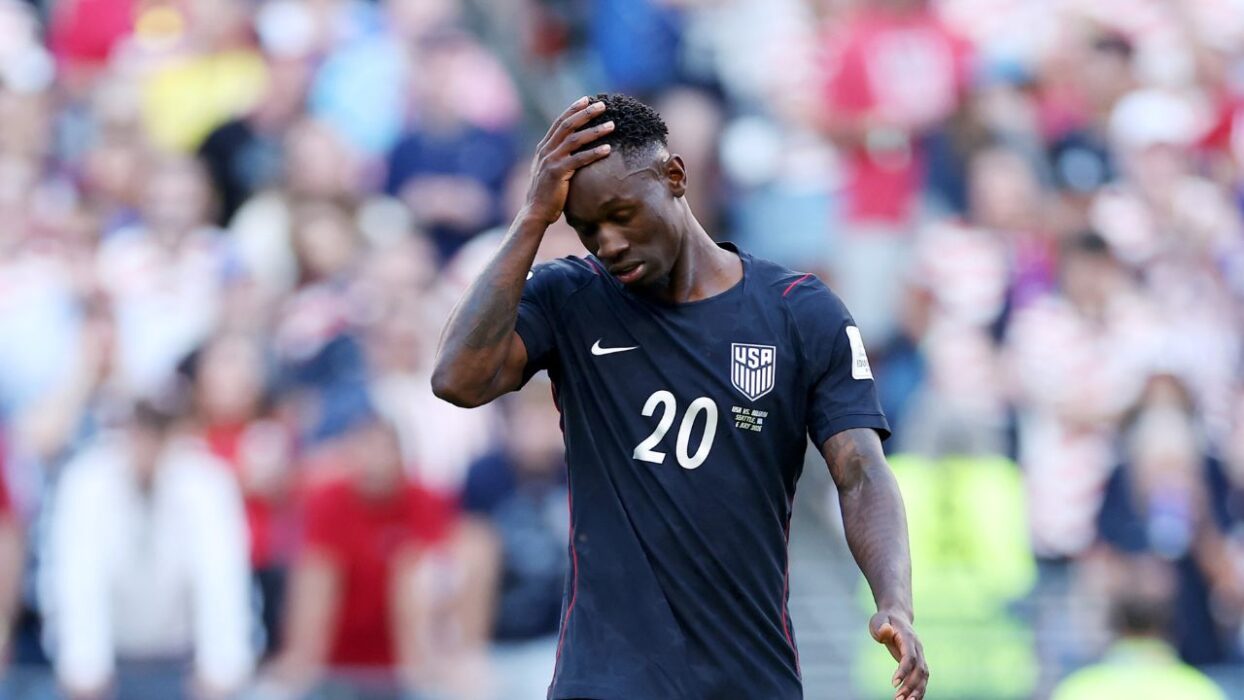
On July 1, U.S. striker Folarin Balogun stepped on Bosnian defender Tarik Muharemović’s ankle during the United States’ Round of 32 win. He was sent off in the 64th minute after a VAR review.
Under FIFA’s own disciplinary code, a red card for serious foul play carries an automatic one-match ban. Four days later, after Trump requested a review and confirmed the call to reporters, FIFA suspended Balogun’s ban. The Federation issued a $40,000 fine and placed him on a one-year probationary period under Article 27 of its Disciplinary Code.
Balogun played Monday’s Round of 16 against Belgium in Seattle. Trump immediately posted on Truth Social. “Thank you to FIFA for doing what was right and reversing a great injustice,” he wrote. The United States still lost the match 4-1.
But in this context, the result of the match is beside the point.
Before Balogun, FIFA Had Already Pardoned Four Other Players at This World Cup
Last November, Cristiano Ronaldo received a red card for elbowing an opponent in a World Cup qualifier against Ireland. Under standard disciplinary procedure, the offense carried a three-game ban. To handle Ronaldo’s case, FIFA introduced a concept it called probation. Ronaldo served one mandatory suspension in Portugal’s final qualifying game. The Federation deferred the remaining two games of his ban for one year, clearing him to play in Portugal’s opening World Cup match.
In May, FIFA informed three additional players (Argentina’s Nicolás Otamendi, Ecuador’s Moisés Caicedo, and Qatar’s Tarek Salman) that they could serve their qualifying bans in a future competition rather than at the World Cup. The rule banning carryover into the following competition has governed the sport for decades. FIFA quietly reversed it.
Then there is South Africa’s Themba Zwane. During South Africa’s opening game against Mexico, Zwane received a red card for a similar offense to Ronaldo’s. There was no probation. Instead, FIFA imposed a three-game ban. Zwane did not play again at the World Cup.
Players including Lionel Messi, Morocco’s Achraf Hakimi, and Portugal’s Bernardo Silva faced comparable physical challenges at this tournament. They received either no card or a yellow card.
FIFA’s pattern, laid out in sequence, reeks of inequality. And you know what thrives in inequality? Corruption.
Gianni Infantino Has Spent Years Building the Relationship That Produced This Phone Call
Infantino confirmed he received Trump’s call without hesitation. “Yes, I regularly discuss matters related to the FIFA World Cup with the President of the United States. On this matter, I did receive a call from President Donald Trump, just as I receive calls from heads of state, government officials, football stakeholders, and business executives from around the world on many different issues,” he said in a statement.
However, that relationship goes beyond a single call. In 2025, Infantino publicly described Trump as “a close friend,” according to Newsweek. He reportedly bypassed FIFA’s own 37-member council to unilaterally create and award Trump the inaugural FIFA Peace Prize during the World Cup draw, a cringy gesture that arrived after Trump had been rejected for the Nobel Peace Prize he sought.
Similarly, a financial disclosure reported by CNBC and cited by Newsweek shows Infantino gave Trump 10 tickets, valued at $15,000, to the FIFA Club World Cup final at MetLife Stadium. Infantino has already announced that Trump will return to MetLife Stadium on July 19 to present the World Cup trophy.
For their part, 50 members of the European Parliament responded to the Balogun decision. They did so by formally demanding that FIFA investigate Infantino for violations of the body’s own neutrality rules. And by backing a complaint filed by the human rights organization FairSquare. Mark Pieth, the Swiss attorney who served as FIFA’s anti-corruption adviser and chaired its Independent Governance Committee, called Trump’s phone call “a blatant abuse of power.” He also told Newsweek: “It demonstrates how President Trump and Mr. Infantino are playing the power game at the expense of football and fans.”
The People Calling Out FIFA’s Decision This Week Make for an Unusual Coalition
After FIFA cleared Balogun, the condemnation was immediate, and it came from places that do not often agree on much.
UEFA, European football’s governing body, released a statement calling the decision “unprecedented, incomprehensible and unjustifiable.” It added that FIFA had “crossed a red line.” “When the certainty of rules is no longer guaranteed by its guardians, the integrity of the game is at stake,” UEFA said. Norway coach Ståle Solbakken told reporters: “It’s a bad, bad, bad, bad, bad decision that will hurt the World Cup.”
For his part, England coach Thomas Tuchel asked the question now hovering over the rest of the tournament: “Who overturns this decision, then? And when? And on what grounds? How far does this go now?”
Belgian coach Rudi Garcia was more dry. “I didn’t know that in the offices of FIFA the fifth of July was the first of April in Europe,” he said. Belgium’s federation confirmed that FIFA had dismissed their appeal, ruling the RBFA had “no standing” as “not a party to the proceedings.” Belgium said FIFA had not provided them with the decision, the reasoning behind it, or the referee’s report before the match kicked off. They also alleged that FIFA had “deliberately removed” language about automatic player suspensions from materials presented at a coordination meeting.
Then came the statement that said the most about where FIFA has ended up. Sepp Blatter, the man who led FIFA from 1998 until his resignation in 2015 amid the broader FIFA corruption scandal and who was himself acquitted twice on fraud charges, posted his verdict on social media: “Red cards are not overturned by political phone calls. They are overturned by rules, evidence, and independent bodies. If a U.S. President intervenes with the FIFA President — and a player is suddenly cleared before a World Cup knockout match — the question is unavoidable: Quo vadis, FIFA? Football must never become a playground for political power.”
When Sepp Blatter is the loudest voice for institutional integrity in the room, you know FIFA really screwed up.
FIFA’s History of Corruption Did Not Start With Trump’s Phone Call
The 1962 Garrincha episode was not the beginning. In 1930, a Brazilian referee blew the final whistle six minutes early in an Argentina-France match. It was just as a French winger broke clear on goal.
In 1973, Chile was scheduled to host the Soviet Union in a World Cup qualifying playoff at Santiago’s Estadio Nacional, the same stadium General Augusto Pinochet’s military government was using as a detention center, where thousands of political prisoners were held, tortured, and killed. The Soviets refused to travel. FIFA sent inspectors who declared the ground fit for football. Prisoners were reportedly hidden during the visit. Chile walked the ball into an empty net. FIFA registered a 2-0 win.
Five years later, in 1978, Argentina hosted the World Cup under the military dictatorship of General Jorge Videla. In a critical final group game against Peru, Argentina needed to win by four goals to advance. They won 6-0. Videla reportedly visited the Peruvian dressing room before the match. Allegations of a fixed result, involving reported grain shipments to Peru and unfrozen Peruvian assets, have followed that game for nearly fifty years. Nothing has ever been proven, and players from both sides have denied collusion.
Fast-forward to 2015, the U.S. Department of Justice unsealed a 47-count indictment in Brooklyn charging 14 defendants with racketeering, wire fraud, and money laundering. Prosecutors alleged that defendants had paid “well over $150 million in bribes and kickbacks” across international soccer. Swiss authorities arrested FIFA officials in Zurich. As a result, Sepp Blatter resigned, and Gianni Infantino became FIFA president in February 2016.
Similarly, when FIFA voted in December 2010 to award the 2018 and 2022 World Cup hosting rights to Russia and Qatar, six FIFA executive committee members were later found to have accepted cash for their votes. When Qatar hosted the 2022 World Cup, organizations including Human Rights Watch and Amnesty International documented extensive exploitation of migrant workers under grueling conditions. FIFA collected the revenue.
This World Cup Has Generated Its Own Parallel Controversy
In May, the attorneys general of New York and New Jersey subpoenaed FIFA over ticketing practices at MetLife Stadium, including allegations of dynamic pricing, fake scarcity, and buyers being misled about seat locations, according to Courthouse News. New Jersey Attorney General Jennifer Davenport said FIFA had turned buying a ticket “into a gauntlet of confusion, fake scarcity and impossibly high prices.” New York Attorney General Letitia James said fans “deserve a fair shot at affordable tickets” and that “no one should be manipulated into paying sky-high prices.” Yet, FIFA declined to comment.
Irish MEP Barry Andrews, who had already filed a formal complaint calling for Infantino’s investigation before the Balogun decision, told Politico after the reversal: “It confirms, in my view, that FIFA is a profoundly corrupt organization. Unfortunately, there’s a decades-long litany of examples of FIFA’s corruption of sport at the highest level. It’s just a further chapter in that litany.”