
WTF Is an Aura Battle? Let’s Break Down Latin America’s Weirdest New Trend
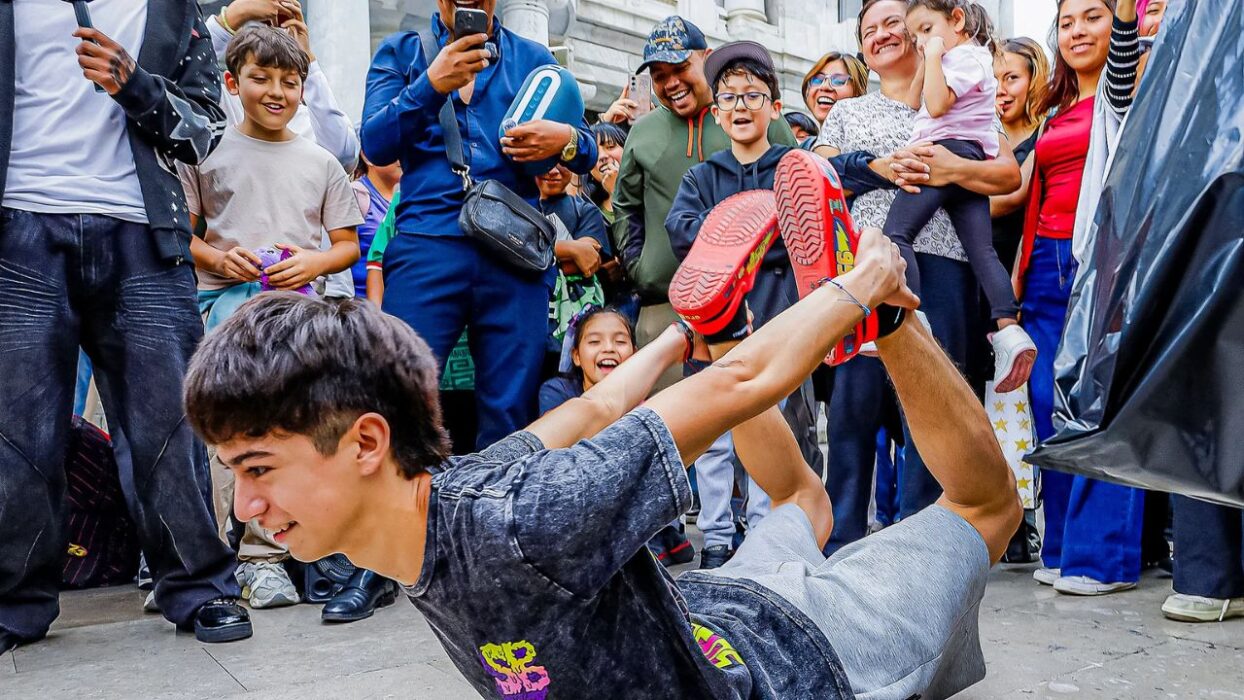
Picture a beach in Lima on a recent Saturday. A guy in full Shrek costume, green face paint and all, squares off against a Superman impersonator, a Jack Sparrow lookalike, and someone doing a dead-on Nicolás Maduro, gray tracksuit included. Dozens of teenagers ring around them, phones out, screaming every time someone lands a move. Nobody’s really fighting. They are not even touching. Instead, they’re “farming aura.”
WTF is aura farming, you ask? Fair question.
So What Exactly Is an Aura Battle?
In short, two people face off and try to “out-charisma” each other through dance, poses, and whatever gesture reads as confident, weird, or cool enough, while a crowd decides the winner by how loud it screams. It’s called an “aura battle.” And in the space of a few months, it has spread from Brazilian sidewalks to a beach in Lima, the Obelisk in downtown Buenos Aires, and public squares across Spain.
“It’s not about being popular,” María Paula Martínez, a professor at Colombia’s Universidad de los Andes, told the Associated Press. In fact, she explains, “it’s about showing off good vibes, and having others recognize that.”
As for what “aura” even means here, soccer star Lamine Yamal explained to Spain’s El Mundo it’s “what someone gives off when they walk into a room. Or like when you see someone in a movie and go, ‘Wow.’ Like Brad Pitt or Cristiano.”
How “Aura Farming” Went From TikTok Meme to Street Battles
The phrase “farmear aura” has been floating around TikTok since 2024. It mashes up “farming,” the video game term for repeating an action to rack up points, with “aura,” which the Real Academia Española defines simply as “favor, applause, general acceptance.” For a while it lived entirely online. Videos of someone tripping in public cost minus 5,000 aura points. On the contrary, if someone catches a falling cup without looking, they earn plus 10,000.
In time, the trend left the phone entirely. Fernando Lícito, a 25-year-old content creator in Lima, saw a video in June of an aura-farming contest in the Brazilian city of Juazeiro do Norte and decided to bring it home. He’s since organized three battles in the Peruvian capital.
“They are simply farming their aura,” Lícito told the AP. “And whoever gets the crowd to make more noise wins.”
Now, competitors imitate Cristiano Ronaldo’s “siuuu” goal celebration. They also trace a finger along their jawline, or repeat “six, seven” while moving their hands, a gesture borrowed from U.S. rapper Skrilla’s song “Doot Doot” that has traveled so far it reportedly made it to Pope Leo XIV, who did it in public at the Vatican and again during a visit to Spain.
How Aura Battles Spread From a Lima Beach to the Vatican
Per the AP, two winners in Quito took home $100 each at Ecuador’s first tournament. And Mexico City battles have played out at the Monumento a la Revolución. Buenos Aires organizer Cielo, known online as Cieloween, put together a battle in the Belgrano neighborhood after videos of an earlier one in Mar del Plata went viral. She told CNN en Español the goal is less about winning than about getting people in one place. “Making friends, laughing. That’s what we’re going for.”
And now, the trend has traveled the Atlantic. In Spain, events have popped up in Madrid, La Coruña, Burgos, and Zaragoza. And on the more surreal end, one of the most-watched clips out of Mexico, per Cosmopolitan, shows Rosalía in the crowd, filming an aura battle with the same curiosity as everyone else around her, which sent fans digging up old footage of her dancing as a kid as proof she’s been farming aura since childhood.
Even Chayanne got in on it. Per Cadena Dial, the Puerto Rican singer posted a video from his current tour’s choreography and challenged fans to an aura-battle dance-off, a decades-deep résumé of hip movements and stage command that has fans wondering if anyone can actually beat him at his own game.
Not Everyone’s Here for It
As it often happens with trends, some aura battles have hit resistance. Officials in Lima’s Miraflores district canceled one, citing missing permits, and the same happened in the Mexican municipality of Ignacio de la Llave. In Cuiabá, Brazil, Mayor Abilio Brunini denied a permit outright, telling reporters, “What’s the public interest here?” The event simply moved to a university campus instead.
Costa Rica’s Ministry of Education banned aura battles in public schools altogether, arguing the trend “affects school coexistence, puts someone at risk, or interferes with learning.” For its part, Mexico took the opposite approach. Education Secretary Mario Delgado posted a video embracing the trend, saying he was “farming good education” for the country, according to the AP.
Online, the backlash gets, of course, pettier. One Instagram commenter dismissed participants as “a bunch of losers” who “used to breakdance in the streets,” per Cosmopolitan. But if we’ve learned something from history, it’s that the more the backlash, the more the popularity. Breakdancers faced the same scorn in the late 1970s and early ’80s for claiming sidewalk space and spinning on flattened cardboard. Look where that ended.
What’s Actually Going On, Psychologically
Miriam González, a psychologist with Madrid’s Colegio Oficial de Psicología, told CuídatePlus that the appeal comes down to a basic instinct. “We’re deeply social beings,” she said. “We don’t just need to bond with others. We also need to feel like we hold a valuable place within the group. How others see us matters, because we build our identity partly through that gaze.” Charisma, she added, “works like a kind of social capital. Whoever has presence, confidence, humor, or the ability to capture attention gets recognition from the group.”
González was careful to point out that the underlying need isn’t at all new. People have always performed confidence through clothes, humor, or dance. “What’s new here isn’t the psychological need. It’s the way of performing it, and scoring it,” she said.
That scoring is exactly what worries some experts. Emma Minguet, a psychologist and founder of Spain’s EMVI center, told Cosmopolitan that teens raised on followers, likes, and rankings would eventually try to quantify something as subjective as charisma. The risk shows up, she said, “when it stops being a game, and someone feels like they always have to come across as interesting, attractive, or funny to be accepted.” González made a similar distinction, adding that farming aura doesn’t mean someone has low self-esteem, and can even be a healthy expression of confidence. What matters, she said, is how emotionally dependent someone is on winning and on the crowd’s approval.
Both psychologists stop short of the panic some adults are showing. Isa Duque, known online as @lapsicowoman and the author of the bestseller “Acercarse a la Generación Z,” takes a similar view. She told Cosmopolitan she tried a battle with her own family. Surprisingly, a boomer won. Duque’s bigger point is that these battles pull Gen Z and Gen Alpha off their phones and into public space, in a culture, she argues, that gives young people fewer and fewer places to exist that aren’t built around spending money.
The Kids Are Fine, Actually
Not every teenager involved needs a psychologist evaluation. Naia, 15, told Cosmopolitan she uses “farmear aura” to describe someone who pulls off something hard without showing off about it after. She goes to watch the battles for the people, not the competition. “You don’t always like whoever does the hardest move. You like whoever you vibe with,” she said. “Someone can move worse but do something funny that makes you laugh.”
Underneath the costumes, the “six, seven,” and the made-up point system, the “kids these days” cliché misses a crucial point. A few hundred teenagers standing together in a plaza, laughing at the same thing at the same time, in person, is actually a sign of hope. As González sees it, the real risk shows up when a generation raised on rankings stops asking who they are and starts asking only how they’re seen. For now, on a beach in Lima or a corner in Zaragoza, it still just looks like kids having fun, in a trend that, for once, started in Latin America and spread everywhere else instead of the other way around.