
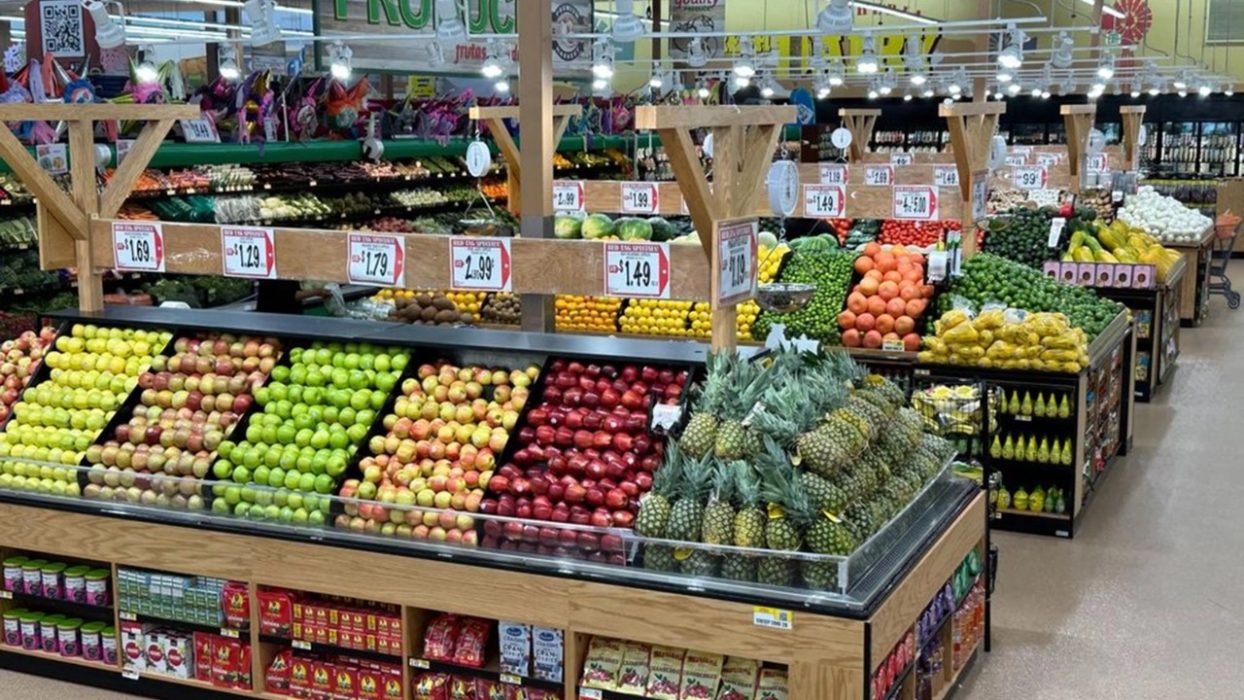
How Superior Grocers Became a Latino Staple in South Central LA
In July, TikTok creator Henry Gallardo, who posts as @chatz5, stood in front of a Superior Grocers in South Central Los Angeles and pointed to the lack of healthy grocery stores as one of the things keeping the neighborhood down. In the video, part of a series on what keeps South Central “up or down,” he said that “coming here as an adult, and now that I shop at Sprouts and Whole Foods, I understand that there’s a lack of healthy food right here.” “There is no grass-fed beef. There’s no alternatives to bread. There’s no alternatives to cereal,” he said.
The video drew more than 3,000 comments, and a reply from Superior Grocers’ own account collected about 13,900 likes. “We work hard to keep good, affordable options available for our community but okay, noted, we’ll go double check the broccoli just in case,” the company wrote. Between the jokes, the exchange reopened an argument South Central has been having for decades over what counts as healthy food and who gets to decide.
Commenters Answered the Superior Grocers Video With Their Grocery Budgets
Many of the replies came back to price. “Families are trying to stay fed, go to work safely, and have a roof over their heads. You really think grass feed beef, no seed oils, and super triple organic veggies is on their minds?” one user wrote. Another, who said they work as a nurse in the area, wrote, “People in this area are focused on survival and affordability. I’m a nurse that works in south central. Most of these people can’t afford to feed a family on a sprouts or Whole Foods budget.”
Other commenters listed what the premium chains don’t carry. “Sprouts and Whole Foods don’t got flor de calabaza or quelites huauzontle, or verdolagas,” one person wrote, and another asked, “ok but what about my mamey, loroco, chipilín, nance, guanábana, jocote, zapote, or fresh tamarind?” Several of the most-liked replies accused the video of asking for gentrification.
A few commenters agreed with part of the argument. “I’m gonna give you the benefit of the doubt and assume what you meant was that food isn’t as accessible in predominantly lower income areas which is true, there aren’t as many larger groceries stores/farmers markets,” wrote one user who said they used to live in South Central. “Now viewing Whole Foods & Sprouts as the epitome of health is just not it.”
Superior Grocers Grew Where Other Supermarkets Had Struggled
Mimi Song arrived in Los Angeles from South Korea in 1977 and started out ringing up customers at a Korean market. In 1981, she opened the first Superior Grocers in Covina, in a former Smith’s Food King in a “less than prime location.” According to FoodChain Magazine, Superior “prospered in neighborhoods where others have tried and failed,” that almost all of its stores serve Hispanic communities, and that Superior was the only retailer to keep its stores open and serving shoppers during the 1992 unrest in Los Angeles.
In 2022, Superior bought Numero Uno, a chain of 22 Hispanic supermarkets across Southern California, bringing it to 70 stores and placing it among the biggest Hispanic grocery chains in the country without a corporate parent, Abasto reported. “We are proud to serve this community, which is our lifeblood. We hire from that community, and we participate in that community. We are that community,” Richard Wardwell, the company’s president, told the magazine. By 2025, the chain operated 74 stores with more than 4,500 employees and had expanded beyond California for the first time, opening a store in Las Vegas, according to Hispanic Executive.
“While we offer select products, such as grass-fed, choice beef and a variety of over 40 organic produce items, our power actually lies in our basics,” Wardwell told FoodChain Magazine in 2022, adding that the chain carries more than 400 produce items. Those claims come from the company and date to 2022. However, they do contradict the idea that the chain doesn’t sell grass-fed beef at all. Superior also holds health fairs with free screenings at its stores.
South Central Was Losing Supermarkets Decades Before the Video
Food retail in South Central began a steady decline after the 1965 Watts uprising, driven by white flight and a grocery industry that turned its attention to suburban supermarkets. Losses accelerated after 1992, Princeton anthropologist Hanna Garth wrote in a 2026 study in American Anthropologist. By the start of the 2000s, the area was widely labeled a “food desert,” meaning a place where healthy, affordable food is hard to reach, according to Garth.
South Central, long the center of Black Los Angeles, became increasingly Latino from the 1980s on, and by the 2000 census, Latinos made up 58% of its population and Black residents 40%, historian Josh Sides found, according to a 2017 KCET history of the neighborhood by Mike Sonksen. In 2003, the city officially renamed the area South Los Angeles, KCET reported.
In July 2008, Los Angeles council members voted unanimously to freeze the opening of fast-food outlets in South Los Angeles for a year, The Washington Times reported, after a Community Health Councils report found that 73% of the area’s restaurants were fast food, compared with 42% in West Los Angeles.
A 2020 study in the CDC journal Preventing Chronic Disease, led by Denise Payán of the University of California, Merced, with RAND Corporation researchers, mapped three low-income South LA neighborhoods in 2016 and found that 10 of the 18 food retail stores there sold no fresh fruits or vegetables. Conditions varied from one neighborhood to the next: one neighborhood scored moderately well, while the researchers found no healthy food source in another. Among the stores that did stock produce, six of eight carried mostly higher-quality fruits and vegetables.
Citing the 2021 California Health Interview Survey, Garth reported that 79.3% of Black residents and 74.9% of Hispanic residents in South Central are overweight or obese.
Researchers Question Who Gets to Define Healthy Food in South Central
The term “food desert” brought money and attention, and with them came a wave of outside activists, many of them white and middle-class, Garth found over the years she spent following food justice groups in the area. Many of their programs assumed residents needed to be taught to eat local, organic food, even though people in South Central had been fighting over unequal food retail long before those groups arrived, she wrote. A 2024 grant solicitation she cites stated that “fresh fruit and vegetables are almost non-existent in South Los Angeles food retail stores,” which Garth called false.
However, commenters who read Sprouts and Whole Foods as a sign of gentrification were echoing an older fight. In 2017, young activists in South Central were already organizing against luxury development, while longtime residents worried about USC’s expansion around the neighborhood, KCET reported. “We are not against development, we’re against luxury development,” Donna Liseth Quintanilla, a co-founder of the youth collective South Central Dreamers, told the outlet.
Over time, some organizers swapped “food desert” for “food apartheid,” a term Karen Washington and Leah Penniman have argued better describes deliberate discrimination in the food system, according to Garth. Andrés, a neighborhood organizer whom the study identifies only by his first name, told a food justice gathering that the “food desert” label had always seemed confusing and contested to residents. “Kind of felt like some white liberal came up with that term while they were making some vegan, organic food and making sure that there were none of our foods present because, for us, it didn’t feel like a desert,” he said.
“But for us, it was never really about a desert. We use the term food apartheid because we felt that the allocation of food, and healthy food, was a system by design that creates unequal access for communities that are flooded with death-selling businesses—alcohol outlets and fast-food restaurants—while grocery stores, farmers markets, and healthy restaurants are abandoned in other parts of the city,” Andrés said.