
Why Your Tío Is Dancing Around With a Broom, and Other Latino Wedding Traditions Explained
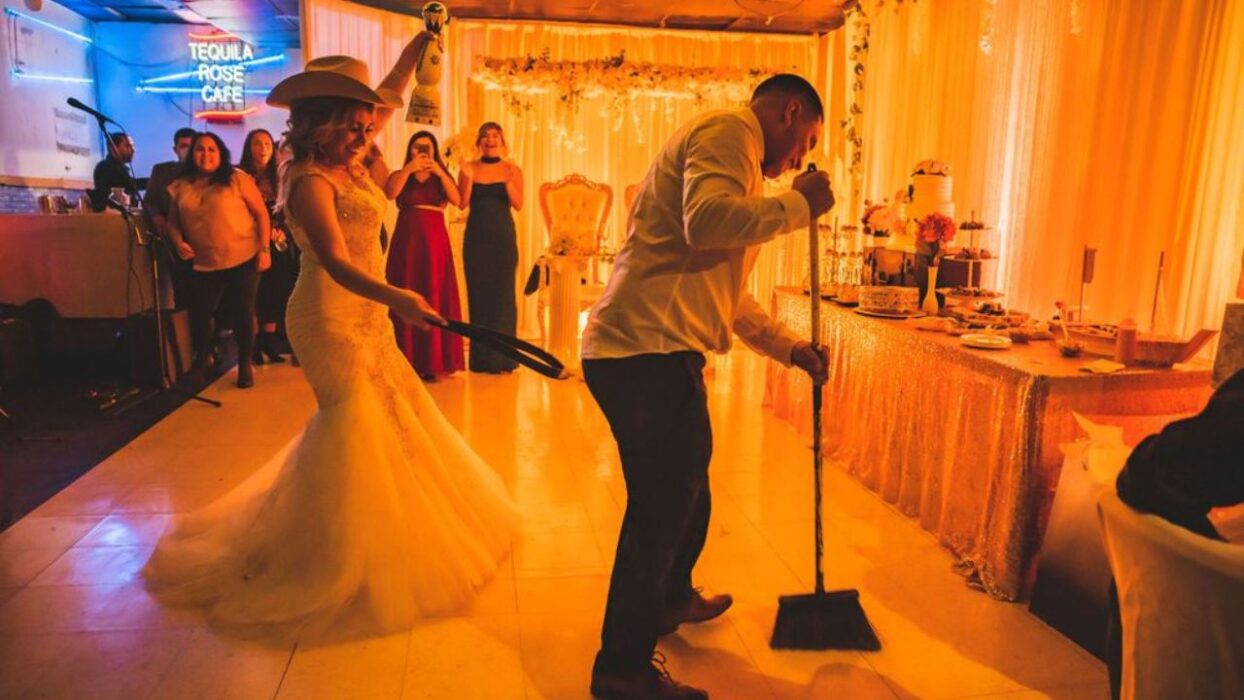
It’s officially wedding season. Which means it’s only a matter of weeks before you’re standing in a half circle, watching the groom run laps around the dance floor with a broom and a baby doll while the bride chases him in a sombrero and a fake mustache. But have you ever stopped and wondered where these traditions come from?
That’s the thing about Latino wedding traditions. We grew up watching the bride launching the bouquet into a crowd of cousins, grown men hoisting the groom into the air like a coffin, and strangers pinning twenty-dollar bills to a wedding dress. Yes, we know the choreography by heart. The history is the part nobody passed down.
The Mandilón Dance, One of the Most Recognizable Latino Wedding Traditions
So, the groom puts on an apron, grabs a broom, and a baby doll. Soon, he gets chased around the dance floor by a bride dressed as a cowboy, complete with a hat, a belt, and sometimes a fake bottle. It usually follows “La Víbora de la Mar.” The louder and more exaggerated everyone acts, the better.
The word “mandilón” loosely translates to “henpecked” in English. At a wedding, it works as a compliment instead. It is an affectionate term for a husband who fully supports his wife and shares in the housework. The dance flips traditional gender roles into a joke that’s really a toast to partnership. In fact, Banda Machos built an entire song around it. Which is why “El Baile del Mandilón” still shows up on nearly every wedding playlist.
The Bouquet Toss Wasn’t Always One of Our Latino Wedding Traditions
Now, the bouquet toss, most of us assume, is a Mexican wedding staple. In fact, it originated in England. Wedding guests used to tear pieces of the bride’s clothing and steal her flowers to share in her good luck. So brides started throwing the bouquet at the crowd to escape them. Somewhere along the way, the meaning flipped. And the woman who catches it today is supposed to be the next to marry.
Mexican weddings later added their own twists. There are some versions where the bouquet sits behind a locked glass box or a birdcage. And single guests draw keys, hoping to find the one that opens it. Or where people tie ribbons to the bouquet, and the bride cuts them one by one, blindfolded, until only one ribbon and one future bride remains.
Why Guests Pin Money on the Bride and Groom
The “baile del billete,” or money dance, exists for one practical reason: to help the new couple start married life without an empty bank account. The bride and groom dance from table to table while guests pin or tape cash to their clothes, then finish with one final dance in the middle of the floor. In Andean countries, the same custom goes by “la danza del billete” and often opens right after the couple’s first dance. These days, plenty of couples skip the pins altogether and just ask guests to fund the honeymoon directly instead.
The Garter Game’s Surprisingly Old French Past
The garter toss traces back to 16th-century France. Back then, a torn piece of a new bride’s trousseau was considered good luck. And guests would chase her down to rip off a piece of her dress. Eventually, that chaos got replaced with a safer version: the groom earned the honor of removing the garter himself and throwing it to the single men. Historically, the garter symbolized the bride’s purity, which is why the tradition took place before the wedding night.
La Víbora de la Mar Is Really About Surviving Marriage
The newlyweds climb onto two chairs, join hands or hold the bride’s veil between them, and guests dance underneath in a line, trying to shake them apart. This way, every guest passing beneath represents a problem the marriage might face. And if the couple lets go, those problems win. You can trace the ritual to an older dance of flowers and notes, in which the people physically holding the couple up represent the support system that keeps a marriage standing through it all.
The Lazo and Las Arras: Latino Wedding Traditions Rooted in Medieval Spain
Not every tradition is loud. During the church ceremony, the bride’s parents or chosen padrinos drape a figure-eight cord over the couple’s shoulders, according to Remitly. This is “el lazo,” and it symbolizes a bond that can’t be broken. The custom dates back to medieval Spain and was carried across the ocean during the colonial era, according to US Language Services LLC.
Right alongside it comes “las arras,” thirteen coins the priest blesses and the groom hands to the bride during the ring exchange, according to US Language Services LLC. Remitly describes the coins as a promise that the couple will share their money and look after their home together, a small, literal down payment on the marriage itself.