

What If Your Dating Profile Had Reviews? Hinge’s New Feature Is *Almost* There
If you have ever sent a screenshot of your Hinge profile to a group chat at eleven at night and typed some variation of “does this make me look like I’m trying too hard,” you have already used Friend’s Take.
Well, almost.
Dating as a team sport has always been the reality, even when the apps would prefer you believe otherwise. Sex and the City ran six seasons on the premise that no romantic decision gets made without three other people in the room. How I Met Your Mother spent nine years demonstrating that this is part of the compromise we make with our real friends, for decades. The truth is, nobody really does this alone. Not completely, at least.
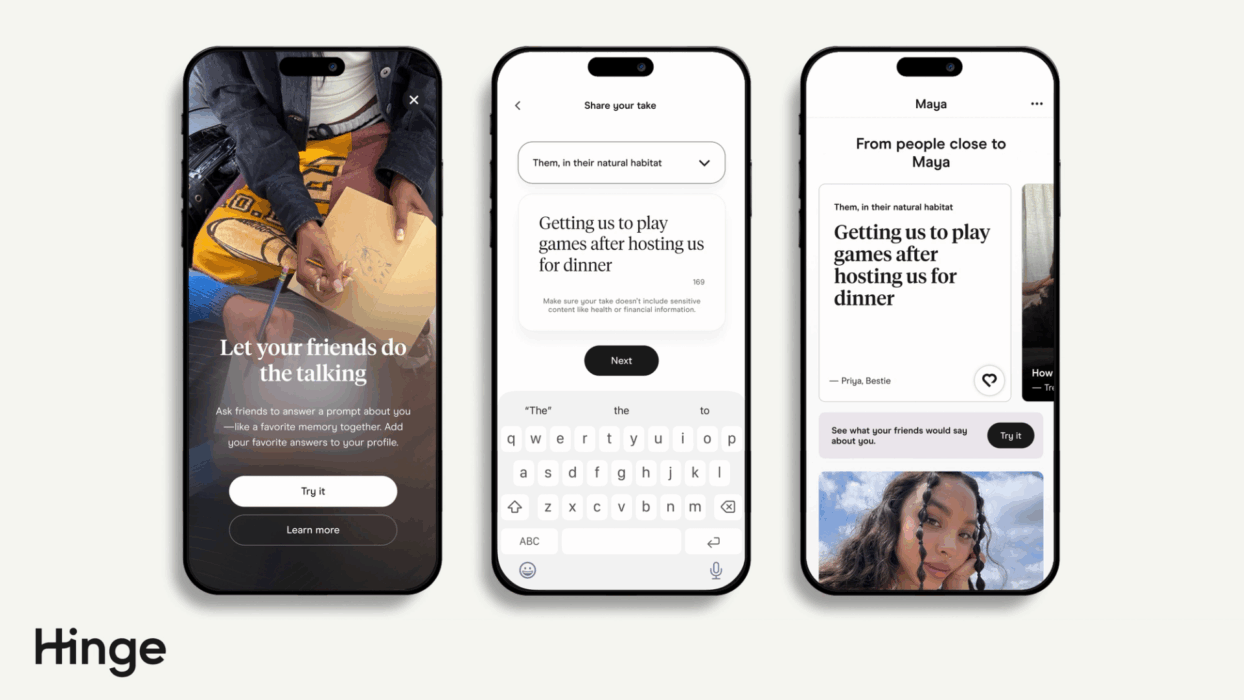
Now, Hinge decided to make it official. On July 15, 2026, the app launched Friend’s Take, a feature that lets the people who know you best contribute directly to your dating profile in text, voice notes, videos, or photos, offering potential matches a version of you that you would never think to write yourself.
Hinge’s Friend’s Take Is the Group Chat Feature We’ve Always Needed
The feature works through a shareable link that users send to anyone in their life, no Hinge account required. The link expires after 72 hours or ten responses, whichever comes first. Recipients choose a prompt to answer and submit whatever format feels right. The dater then reviews everything in a private hub that holds up to 50 takes. They can select up to 3 to display on their profile and swap or remove them at any time.
Interesting, right?
Logan Ury, Hinge’s lead relationship scientist, explained that “Your friends see you clearly, often more clearly than you see yourself. They know the qualities you’d never think to mention like, ‘She’s the sweetest dog mom,’ or ‘He’d never admit this, but he’s the person everyone calls in a crisis.’ Friend’s Take finally gives your community a place to share these special details about you.”
The feature formalizes a behavior that was already happening across WhatsApp chats and voice memos that turn into podcasts. According to Hinge’s research, 79% of its daters already turn to friends and family for advice about their dating lives. What’s more, 71% of Hinge daters say they want help with their profiles, but only 46% actually seek it out.
Why Dating Profiles Have Always Been the Hardest Part of Dating Apps
Decades ago, we used to meet people in bars, cafes, concerts. Life seemed simpler then. Despite all the mistakes and walks of shame, we had a different way of choosing our target of interest. As we all know, dating apps, the obsessive need to stay forever connected, and, yes, the pandemic, changed all that.
However, there’s an intrinsic part of dating that hasn’t changed. It’s about how we communicate ourselves.
Sex researcher Justin R. Garcia, PhD, writing in Oprah Daily, makes the case that humans are, by nature, dreadful at articulating what they want in a partner. This happens both online and off, reducing potential matches to lists of composite traits that don’t necessarily reflect genuine desire. The same limitation shapes self-presentation. We tend to date aspirationally, Garcia notes, seeking partners with higher perceived status than ourselves. This complicates the already uncomfortable task of writing five prompts, choosing three photos, and making it all look effortless.
The impulse to blame all of this on apps runs into what social historian Stephanie Coontz called the nostalgia trap: the romanticization of “the way things never were,” per Garcia’s piece. Dating has never been easy to navigate on your own, and the evidence that apps have made it meaningfully worse is thin. Garcia cites a PNAS study showing that people who met on dating apps have higher marital satisfaction and more stable relationships than those who met elsewhere, and notes that apps now connect people with dates more effectively than school, work, church, or nightclubs. More than 100 million single adults in the United States use them regularly.
The persistent skepticism, Garcia argues, is driven not by lived experience but by perception. People who have never tried dating apps are more likely to have negative views of them than people who actually use them. The real conundrum is what the technology asks of people: to represent themselves accurately and to trust that someone else will do the same. Friend’s Take might actually wash away that anxiety.
Your Biggest Fans Already Know What to Say
On Yelp, a stranger with no stake in the outcome gives your restaurant three stars because the soup was lukewarm. On Hinge, a Friend’s Take comes from someone who has known you for a decade and wants you to find love. These are not in the same input category, and they’re not trying to be.
A review system built on stranger opinions and star ratings would be a disaster for dating, a mechanism for cruelty dressed up as transparency. What Friend’s Take offers is crowdsourced advocacy, not neutrality. The people submitting takes are supporters, and the angle from which they see you is the angle a potential match might never encounter in a first message or a first date.
And hey, the feature doesn’t solve every problem in online dating, and it doesn’t try to. It doesn’t prevent misrepresentation, guarantee chemistry, or close the gap between the profile and the person. What it does is open a small window into a life as others experience it, which is a different kind of information than a well-chosen photo and a witty response to “I know the best spot in town for…” That difference, quiet as it sounds, might be the most honest thing a dating profile has ever offered.