
Beyond Cancún: Hidden Gems Across Latin America Worth Visiting
You’ve already been told to go to Cartagena, and you’ve probably seen the Machu Picchu photos. Most importantly, you know by now what Tulum has turned into. But what you might not remember is that Latin America is enormous, wildly diverse, and full of places that haven’t been overrun yet. These ten are the ones that experienced travelers quietly add to their own lists and never quite shout about loudly enough.
Pack smart. Then go.
Boipeba, Brazil: The Island That Doesn’t Want You to Leave
If you need someone to define paradise for you, send them to Boipeba. This small island off the coast of Bahia runs on sand streets, zero cars, and a pace that makes you forget you own a phone. Travel writer Samira Holma, who has spent the better part of two decades exploring Latin America, notes that visitors walk around without shoes as if it were the most natural thing in the world.
Start your morning with a walk to Morere beach before the tide rises, and the day-trip tourists arrive from neighboring islands, spend the afternoon in the natural pools at Ponta dos Castelhanos, and end the day at a seaside restaurant watching the sun collapse into the Atlantic.
The beach here is so pristine that you’ll want to leave it exactly as you found it. Our hack? Carry a sand-remover mitt with you at all times, so you can move from beach to boat to dinner without tracking half of Bahia with you.
Bacalar, Mexico: The Lake That Outshines the Caribbean
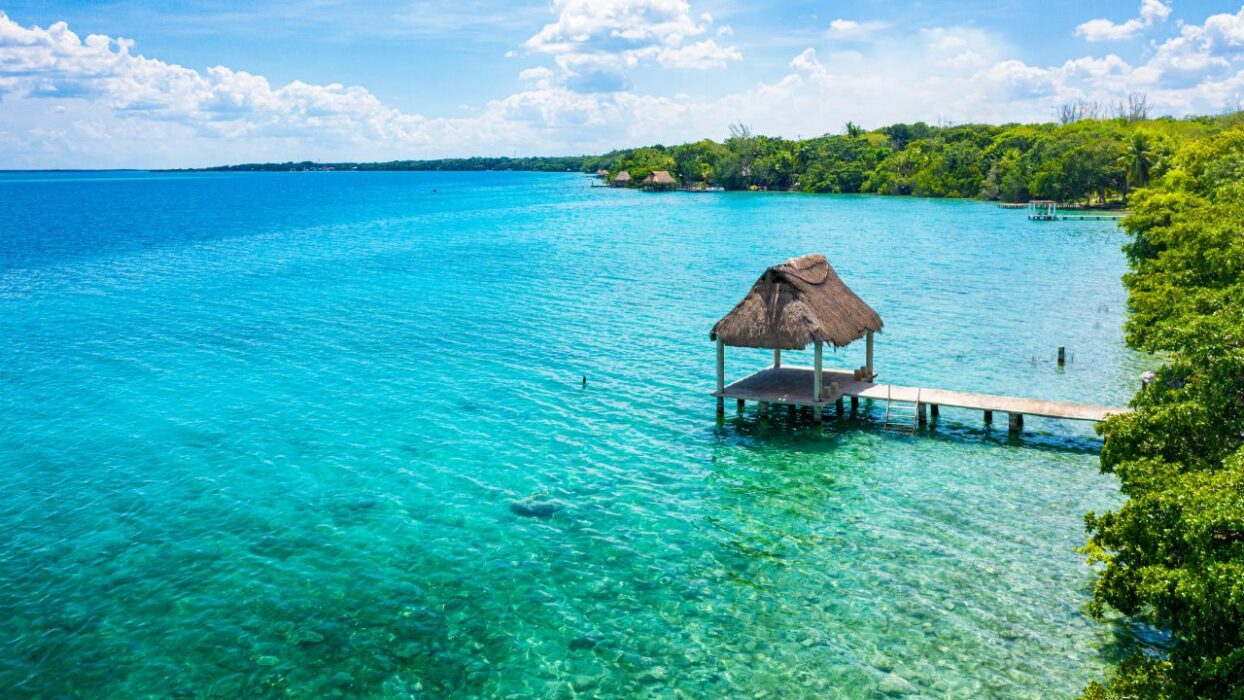
While everyone fights for towel space in Tulum, Bacalar sits a couple of hours south in Quintana Roo doing absolutely nothing wrong. The town wraps around Laguna de Bacalar, a freshwater lake that shifts through distinct shades of blue depending on where the light hits. There are no all-inclusive resorts, no cruise ship day-trippers. There are local sailboats, cenotes accessible by kayak, and a quiet that resort towns spend millions of dollars trying to manufacture.
Digital nomad Vitalii Bulyzhyn, who has lived across Latin America for five years, singles out Bacalar for its genuine vibe and connection to nature, without the price tag of the overcrowded coast.
Now, in our experience, when your entire trip is built around being in the water, your packing has to be smart. We learned the hard way to keep swimsuits separate from dry clothes with packing cubes, so everything is visible without tearing through your bag every morning. Bacalar is the kind of place where you unpack once and live small.
Barichara, Colombia: The Prettiest Town You’ve Never Googled
North of Bogotá, in the Santander region, Barichara sits on a hillside and dares you not to photograph every cobblestone. The streets are white. The houses are whitewashed. The cafes serve goat meat and corn arepas and feel like someone’s living room. Every experienced traveler puts this town on their lists independently, which is about as reliable a travel endorsement as you can get. The highlight is the Camino Real, a six-kilometer stone path that descends through canyon views to the neighboring village of Guane. The Colombian sun on that trail is unforgiving.
Our hack for this trip? Pack a mist spray bottle in your daypack, fill it before you set out, and thank yourself halfway back up the climb. The fine, continuous mist is the difference between surviving the heat and actually enjoying it.
Semuc Champey, Guatemala: The Emerald Pools Nobody Warned You About
From the town of Lanquín, you board a truck and spend 40 minutes on roads that charity would describe as rough. What awaits on the other side is a natural wonder that Guatemala does not advertise nearly enough: turquoise limestone pools stacked atop one another inside a jungle canyon, fed by a river that disappears underground before resurfacing below.
Rosie Kay hiked to the viewpoint before cooling off in the pools. The cave tour is for the bold, the guide handing you a candle at the entrance and leading you through underground tunnels, swimming pools, and passages you slide through on your stomach.
Now, gentle warning: you will come out of those caves caked in red clay and river mud. That’s why we will be forever grateful for whoever invented the pack-all shoe bag to keep hiking shoes quarantined from clean clothes in your bag. The water-resistant shell means your mud problem stays contained to one pouch.
Cabo Polonio, Uruguay: The Village That Opted Out
Cabo Polonio has 75 permanent residents, no electricity grid, no running water, and no roads connecting it to the outside world. To get there, you board a 4×4 truck that crosses seven kilometers of sand dunes, your bag piled into the truck bed alongside everyone else’s. The village runs on generator power during certain hours and on candles the rest of the time. Sea lions live on the rocks near the lighthouse and treat the beach as their own, because they were there first. Holma calls her off-season stay here “one of the most relaxing of my life,” and strongly recommends avoiding the Uruguayan summer, when the town’s population swells, and the solitude disappears.
Our recommendation: because your bags share a truck bed with strangers on the way in, luggage locks are a must. The cable design threads through any zipper, the combination resets as many times as you need, and if a TSA agent opens them during a layover, the lock re-engages automatically on the way out.
Little Corn Island, Nicaragua: No Cars, No Roads, No Problem
Off Nicaragua’s Caribbean coast, Little Corn Island is exactly what it sounds like: small, quiet, and completely free of vehicles. Travel journalist Victoria Leandra, who spent three years exploring Latin America and documenting her discoveries for Voyagers, recommends the island for its crystal-clear waters for diving and snorkeling and the kind of unhurried Caribbean pace that gets harder to find every year. The source of local pride is rondon, a dish the islanders will insist you try. Eating it by the water is mandatory.
Before you pack your bags, remember that on an island where everything moves by foot or small boat, organization is everything. You don’t want to be unpacking everything on the dock, believe us! Save yourself (and your travel partners) some time with shell zipper cases, and thank us later.
San Blas, Panama: The Archipelago the Guna People Run
San Blas is made up of 365 islands and cays, managed not by a hotel chain or a government tourism board but by the indigenous Guna people, who have maintained autonomous control of their territory with a consistency the rest of the Caribbean might envy. The water is so clear it makes you question whether you have ever actually looked at water before.
Leandra singles it out for the experience of visiting Guna villages firsthand, where you can learn about their traditional way of life, customs, and crafts from the people who carry them on. The only schedule is the one the water sets.
Mindo, Ecuador: The Cloud Forest With the Best Chocolate You’ll Ever Eat
Mindo sits in a cloud forest corridor easily reached from Quito, and it holds more bird species per square kilometer than almost anywhere on Earth. Hummingbirds move through the air like they have somewhere urgent to be. The butterfly farm keeps hundreds of species in flight at any moment. You can tube down the river, zip-line through the forest canopy, and end the day at a cacao farm where they walk you through the full chocolate process and let you taste the difference between each stage. Travel writers at Top Travel Sights call Mindo one of the continent’s best natural destinations, and it is accessible enough for a day trip from Quito yet rich enough to fill several days.
If Mindo is one stop on a longer circuit through Latin America, you will move through countries with different outlet configurations and voltage standards. Please don’t forget your universal travel adapter!
El Chaltén, Argentina: Fitz Roy’s Town
El Chaltén is the trekking capital of Argentine Patagonia and the launch point for the Laguna de Los Tres trail, which ends with Mount Fitz Roy at sunrise. That mountain is on the Patagonia clothing brand’s logo. Seeing it in person, bathed in gold at six in the morning after a 3:30 a.m. departure in the dark, is the kind of thing people describe for years.
Rosie Kay hiked it through darkness, slipped on snow near the summit, and still calls the view unforgettable. The final two kilometers are steep and sometimes snow-covered, and the trail is clearly marked when you’ve reached the point where turning back is the honest choice. El Chaltén itself rewards the effort: an excellent restaurant scene, a cold Patagonia brewery beer after a long day of climbing, and a relaxed energy distinct from the more heavily touristed Torres del Paine circuit across the border in Chile.
Sucre, Bolivia: The Most Beautiful Capital You’ve Never Planned a Trip Around
Sucre is Bolivia’s constitutional capital, a city of around 300,000 people, and one of the most architecturally preserved colonial centers in Latin America. Unlike La Paz, which runs on chaos and altitude sickness, Sucre is walkable, calm, and manageable. Bulyzhyn, who writes from experience in nearly every country in the region, calls it one of the most beautiful colonial city centers, with enough traveler infrastructure to be comfortable, yet not enough of a tourist scene to strip it of local character. He was writing that piece from a tiny coffee shop in the center of the city, which tells you something.