
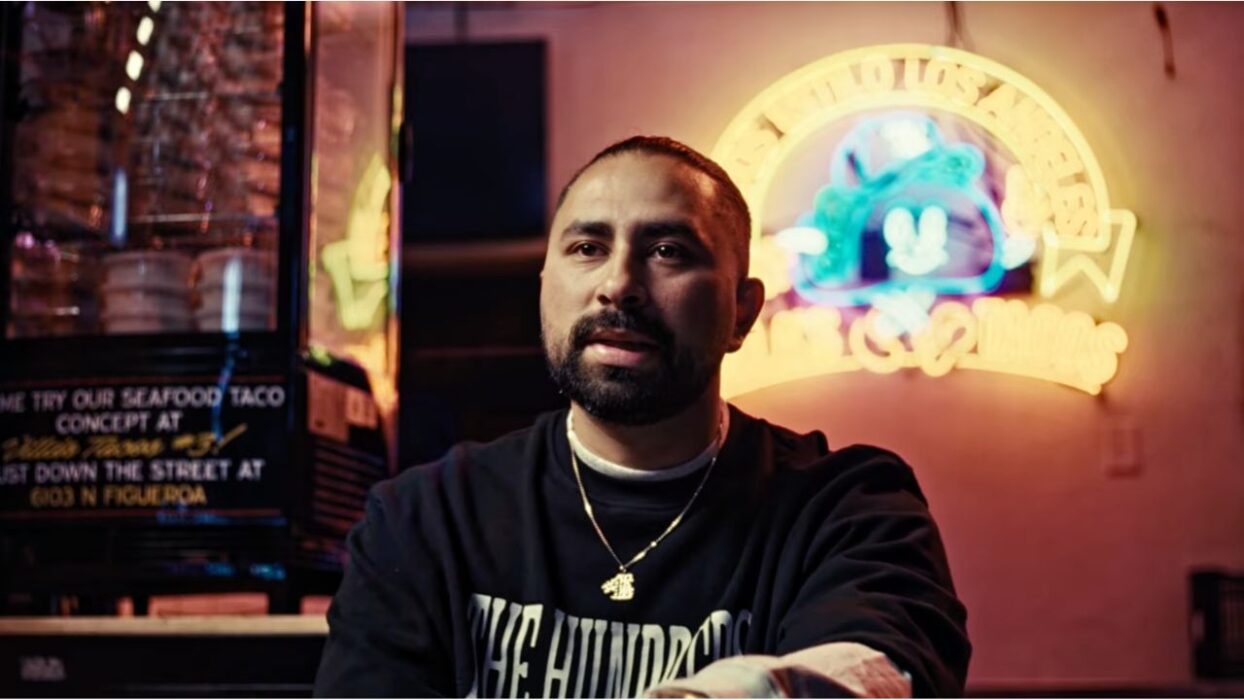
Four Months After Bad Bunny Put Villa’s Tacos on the Super Bowl Stage, Victor Villa Is Still Going Straight Back to the Grill
Victor Villa’s flight landed from New Orleans after the Super Bowl, and he went straight to Highland Park. No detour or celebration dinner. He walked through the door of Villa’s Tacos and found a line out the door, his team holding it down, and his family there.
“It just felt like home,” he told mitú. “I hadn’t been back in almost a month, so there was something grounding about it. My team was there, my family was there, and the community I love was there. That’s what stood out, was just being back, and that’s the love I’m talking about.”
Four months after Bad Bunny chose Villa’s Tacos to represent his community on the Super Bowl LX halftime stage, Victor is still the guy who gets off the plane and goes straight to the restaurant. That, like most things about him, has not changed.
From $500 and a Secondhand Grill to the Super Bowl Stage
Victor Villa is a first-generation entrepreneur who started Villa’s Tacos with $500, a rusted secondhand grill, and his grandmother’s backyard.
When Bad Bunny designed the halftime show for Super Bowl LX on February 9, 2026, he built it as a love letter to Latinidad. He walked through a scene of sugarcane fields and neighborhood vendors, past a table of old men playing dominoes, a piragua stand, a nail salon, and a Villa’s Tacos stand. Victor was behind that grill. The moment made it onto the most-watched stage in American television.
OfferUp has since partnered with Victor as part of its “Dreams Start Here” campaign, a series spotlighting entrepreneurs who built something real from a single secondhand find.
However, for Victor, the campaign is simply the story of how he actually started.
Bad Bunny’s Halftime Show Was Political. So Was Who He Put Behind That Grill.
The show happened during ICE raids in Los Angeles. Bad Bunny, a Puerto Rican superstar, built his performance around the working-class Latino community, the people who don’t make the news until they’re in danger of disappearing from it. Victor Villa, the son of immigrants, stood behind a taco grill on the biggest stage in American television while that same community was being targeted outside.
Four months later, I asked him if that context had faded. He said no.
“Bad Bunny showcased who we are as people,” Victor said. “We’re honest, hard-working people. We like to have fun, we like to dance. That moment meant something beyond the stage. My parents gave me the opportunity to be here through their sacrifices, and I don’t take that lightly, especially standing behind that grill, on a stage like that, while everything else was happening in LA. The business moves fast, sure, but that context doesn’t just disappear for me. It’s part of why I do this, for my people.”
La Chula’s Grandson
Inside Villa’s Tacos, there is a mural of a woman named La Chula. She is Victor’s grandmother, and she is still alive. The mural, then, works as a declaration of identity and belonging.
“My grandmother La Chula is actually still with us, and that mural inside the restaurant is for her,” Victor said. “She taught me the most important thing about cooking. We talk every day, and she always tells me how proud she is of me. But honestly, I’m just proud to be her grandson. Making my family proud is what success means to me.”
The Expansion Was Already in Motion. The Super Bowl Just Opened More Doors.
Before February 9, Victor already had locations moving in South Pasadena, Villa’s Hollywood, and Atwater Village. The Super Bowl did not change those plans. What changed was everything around them.
“Did more opportunities open up? Absolutely,” he said. “Location requests, partnership inquiries, conversations we weren’t having before, a lot of doors opened fast. What caught me off guard was how much I had to catch up on. Being away from my phone during the Super Bowl for that long meant I came back to a flood of emails, calls, DMs, all of it stacking up. But the core plans? We stayed the course.”
The question everyone keeps asking Victor is what changed after the Super Bowl. His answer about what didn’t change is the better one.
“The quality of the food hasn’t changed,” he said. “Todo con amor, always. And the love I have for my community, family, and team. I love what I do, and thank God for giving me the opportunity to do this.”