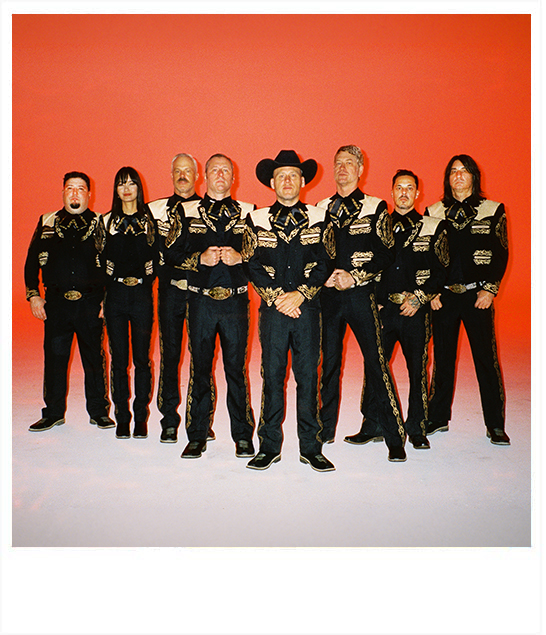
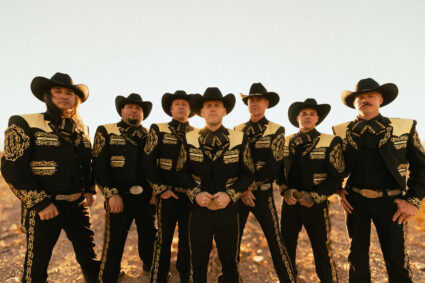
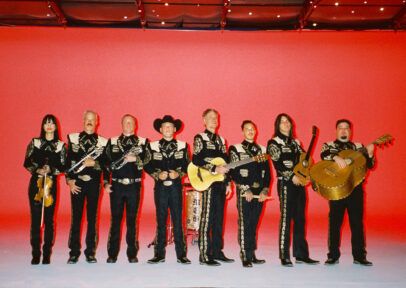
They walked into the studio while the hills of East Los Angeles burned. Inside, violins tuned, trumpets warmed, and eight men in charro suits chased songs that refused to sit still. Outside, the Eaton Canyon fire swallowed neighborhoods less than 15 miles away. Somewhere between grief and a wedding toast, between love and death, IV began to take shape. For a band born as an experiment, that kind of tension feels almost inevitable.
Back in 2008, when the punk band The Bronx decided to step sideways into mariachi, it sounded like a dare. The idea grew from the music that surrounded them in Los Angeles. “Punk rock and mariachi music are very similar in soul,” frontman Matt Caughthran says. “It’s working-class music. It’s real music.”
Seventeen years later, that experiment stands as a bridge between worlds. Mariachi El Bronx has released three acclaimed albums, shared stages with the Foo Fighters and the Killers, played Letterman and NPR’s Tiny Desk, and turned up at Coachella and Glastonbury. They recorded “Little Boxes” for Weeds and “Aqua Something You Know Whatever” for Aqua Teen Hunger Force. Through it all, they kept returning to the same thesis: that the grit of CBGB’s and the romance of Mariachi Plaza speak the same language.
After nearly two decades on the road, Caughthran sees that kinship in sharper focus. “Man, I will tell you what. In no way, shape, or form am I complaining because I’m living my dream and my soul is grateful, but being a musician is a crazy fucking life. The grind is relentless. Now more than ever. You gotta love it — all of it — or you will never last.”
He has toured the world, jumped off stages, gotten signed and dropped, paid and broke. “After 20-plus years of touring around the world… It’s the dedication to life through thick and thin that I respect the most.”
The hustle feels familiar across genres. “Punk rock hustle and mariachi hustle both come from the streets, whether it’s with an electric guitar or an acoustic one. Whether it’s CBGB’s or Mariachi Plaza. You do it because you love it, and you do it because your life depends on it.”
The return did not arrive clean.
Within the year that Caughthran began writing, he lost several loved ones. At the same time, he got married. While the band tracked at producer John Avila’s San Gabriel Valley studio, flames licked across the hills. “We came out of the studio one night, the entire side of the hill was just on fire,” guitarist Joby J. Ford recalls.
Caughthran felt the weight of everything pressing in. “I felt a lot of pressure going into this album — love and death weighing heavily on my heart, social and political unrest everywhere, the uncertainty of the music industry, and the acceptance of the band navigating a hyper-sensitive cultural landscape. Plus, the Eaton Canyon fire burning homes and hillsides less than 15 miles away — it was overwhelming, to say the least.”
Yet, when they stepped into the studio, the chaos transformed. “For us, when we walk inside that studio, it’s a chance to channel all of that energy and create something beautiful together.” Because the members now live far apart, they built most of the record on the spot. “So it was all about coming together and making it happen — song by song, part by part, together as one.”
The songs carry that immediacy. “All Things” stretches into its longest composition, intricate and hard-won. “Songbird” materialized in under 48 hours. “Both songs are super inspired and two of my favorites on the album,” Caughthran says.
Throughout the twelve tracks, gamblers, former playboys, warriors, and lovers step forward as narrators. On “Forgive Or Forget,” Ray Suen’s violin spins a hallucinogenic tone around lyrics that trace someone “who’s completely disheveled and a little washed out, looking back on their life in a way that’s kind of hazy,” Caughthran says. “There’s a little bit of hope there, but it’s pretty dark.”
He chose fiction as a form of growth. “As a writer and a lyricist, I’ve been ‘speaking my truth’ for a long time, and honestly, it starts to feel repetitive, ego-driven, and forced after a while. It’s a total head fuck. There is growth for me in storytelling.”
Every mariachi record they have made has run through John Avila. The charro suits still come from Casa del Mariachi in Boyle Heights, where Jorge Tello has handcrafted them for more than 50 years. Cultural stewardship feels personal.
“For us, it’s all about respect and intent,” Caughthran says. “We have endless respect for Hispanic culture, traditional mariachis, and a life dedicated to friends, family, and music. Our intent is artistic and pure.”
The band understands its position inside a tradition that did not originate with them but shaped them. “All we wanna do is blaze our own path and contribute to a culture and style of music that inspires us.”
That reverence carries into their visual language. They refuse to design new suits without a new album. “Our original suits were made in 2008 and have been taken in or out about 1,000 times over the years. Haha. So we were definitely due for an upgrade.”
Stepping back into the charro suit revealed something simple and profound. “We are all still alive and inspired,” Caughthran says.
A decade passed. The world shifted. The band members grew older. Yet the core held. “Our main responsibility is to each other and the music that we make. If we honor that, everything else has a chance to work out right. If the art doesn’t come from a genuine source, it will never stand the test of time.”
IV sounds like a reckoning and a release. It wrestles with love and death, fire and renewal, exhaustion and defiance. On “Bandoleros,” the record’s battle cry, they close with a promise that cuts through the smoke. “We ride out / No matter how bad it may seem.”
For a band that began as a side project, Mariachi El Bronx now feels like an argument for survival. Working-class music. Real music. Written in a studio where the hills burned, held together by eight musicians who still believe that when you step inside and focus, you can build something beautiful out of the chaos.