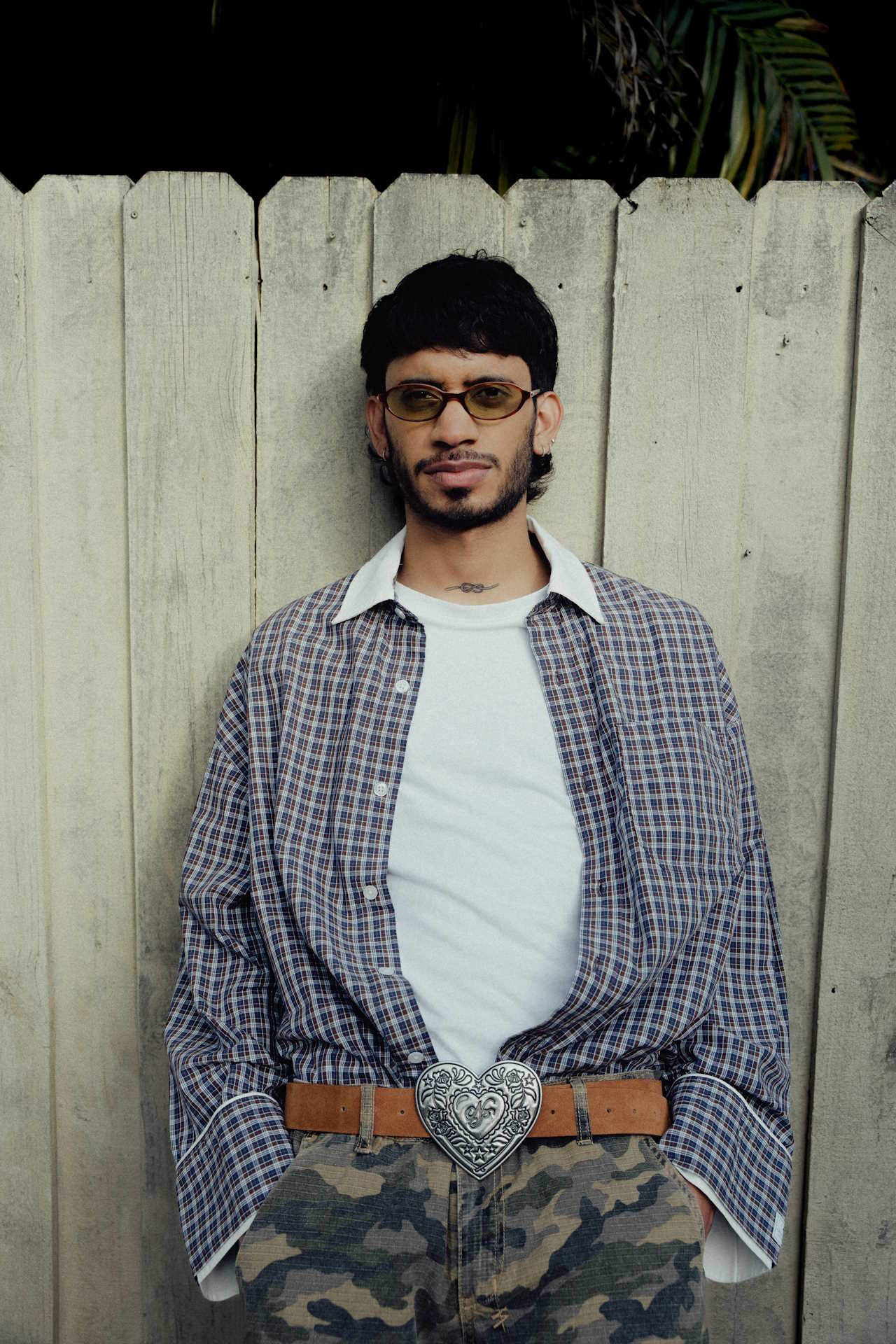
If you were born in Venezuela, you know full well the range of sentimentality (the good kind) we’re born with. Let’s blame it on the climate, the natural beauty, or Leonardo Padrón. The reality is that, from our literature to our rock music, Venezuelans aren’t afraid to embrace their feelings. And don’t get me wrong. It’s a deeply macho country, just like the rest of the continent. The difference, however, is that in our popular culture, sentimentality—particularly among men—wasn’t so off-putting in the collective unconscious.
And if you don’t believe me, listen to the intro of Marcelo Rubio’s latest album, “Vulnerable, más de lo normal.”
Following the tradition of deep emotion, harmonies, and lyrics that truly mean something, Marcelo takes us back to the nostalgia of a Voz Veis or a Sin Bandera through his youthful voice and a soul that seems to have lived for centuries.
“Conversación con mi ex,” the track that launched Marcelo Rubio’s career, was written for a friend, a man who wanted his ex-girlfriend back and needed the right words. And Marcelo delivered. His friend did not get the girl, but Marcelo got everything.
“He asked me to write that song so he could get his ex back,” Marcelo says, still a little amused by it. “It didn’t work. I released it, and it was the song that changed my career.”
When I ask him why that song connected the way it did, he is direct. “It was rare to see a male artist doing that kind of song. Like what Olivia Rodrigo or Taylor Swift do, songs about vulnerability. That wasn’t very common. Especially from a man.”
That friend’s heartbreak, transcribed into lyrics and released in early 2023, became the moment music became a career for Marcelo Rubio. The song went viral on TikTok and earned him a contract with Sony Music Latin. Moreover, it confirmed something he had already suspected about himself: when he wrote from somewhere real, people felt it.
“Not everyone says those things,” he explains. “And the people who were feeling them but couldn’t say them found that song and held onto it.”
He was born 23 years ago in Cumaná, Venezuela, one of the first cities founded by Spain in the mainland Americas and the oldest continuously inhabited Hispanic-established city in South America. He moved to Los Angeles at 13 with his family during the crisis that reshaped the country and scattered its people. He has since relocated to Miami, released two albums, sold out his first European show at Sala Vesta in Madrid, and earned his first Billboard chart entry with “Líneas temporales,” which reached the top 24 on the Latin Pop Airplay chart. Billboard named him an “Artist to Discover” in 2024.
In Spanish, the word “llorón” means someone who cries easily. Marcelo Rubio says it without apology. “In my house, we’ve always been big llorones,” he tells me. “We listened to a lot of Bob Marley, who is one of my biggest references. Sin Bandera, Marc Anthony, and a lot of salsa. All very deep, very lyrical.”
It’s fair to say that his household was his first music school. And Marcelo absorbed all of it.
“I grew up understanding that those things are part of us,” he says. He cannot say with certainty whether that environment made him a songwriter or simply confirmed something already there. He suspects both are true.
However, over time, his influences expanded. Morat, Danny Ocean, Camilo, Reik, and Alejandro Sanz. A lineage of Spanish-language songwriters who placed the lyric (and feeling) above anything else. For his part, Marcelo studied them. He still lists them as goals. Among them is writing a song alongside someone from Sin Bandera, whose harmonies and lyrics have stayed with him since childhood.
“That would be a dream for the little Marcelo,” he says. “I haven’t had the opportunity yet. But we keep working.”
In 2017, Venezuela was in the middle of a political and economic collapse that would become one of the largest displacement crises in Latin American history. Marcelo Rubio was thirteen years old, and his parents decided to leave.
“My parents made the effort to get us out,” he says. “We are three brothers. We went to Los Angeles because an aunt who lived there received us.”
That transit—geographic and spiritual—does not leave a person easily. Marcelo processed it the only way that proved available: he started writing.
“I started writing things that bothered me,” he says. “Feelings I didn’t like. Those negative emotions. It all started because of the change, the cultural change, everything that was happening in Venezuela. All the things that hit all of us.”
He was not yet thinking about an audience, though. He was thinking about getting through the day. But slowly, he would show what he had made to friends and family, watch their faces, and read the reaction. When it was genuine, he took it more seriously.
“I’ve always felt that I have a message, a perspective that I need to get out,” he says. “I have to make my voice heard, regardless of whether I’m an expert or lack formal training. After all, I’m not a scientist. But I have a voice.”
His second album, “Vulnerable, más de lo normal,” was released on April 30, 2026.
The singles that preceded the album each approached the subject from a different angle. “Si no la vuelvo a ver” was a quiet ballad about loss. “Líneas temporales,” a collaboration with Gus and Mazzarri, used synthesizers and electronic production to explore the concept of parallel universes, a stylistic detour that earned him his first Billboard chart placement. “Lo que odias de mí” pressed on the emotional dependency that follows the end of a relationship. “Letras Pequeñas” explored the silent agreements people form with each other, and the slow erosion of self-love that follows when those agreements collapse.
Taken together, they map a singular emotional territory: the private wreckage that men, in particular, are not encouraged to even begin to unveil.
“There are things we keep quiet about,” Marcelo says. “That’s what I say in this album. There’s a lump in the throat that we all carry.”
He wrote every single verse, most of it alone. “I like to take my time,” he says. “Look closely at what I’m saying. Feel it well. Identify everything. Sometimes it takes me three or four days, working from home at different times. If I feel like the inspiration is cutting out, I step away. I have a coffee. The next day, I open the project again. I enjoy that process enormously.”
However, he is quick to credit the producers who shaped the sound around his words. Pipe Bernal, who was among the first people in Miami to give Marcelo a chance when there was no money and no guarantee. Manuel Lara and Félix Lara, two Venezuelan producers who have worked with artists including Bad Bunny and Álvaro Díaz, joined the project for this album. “Pipe is my brother,” Marcelo says. “He told me, ‘I want to make music with you because I like what you do. Let’s make music and figure out the rest later.’ I would always want him beside me, simply for that.”
The turning point Marcelo represents is critical, even though it remains undetected. He is part of a generation that, as he describes it, is learning to speak a language that previous generations actively suppressed.
“We’ve been used for a very long time to the idea that the man is the macho, the one who doesn’t feel, the one who is strong,” he says. “Everyone knows that’s not true. We all feel things. We all have our lump in the throat.”
He tells me about his friends. When they are going through a difficult time, they call each other. They say: “Look, this is happening, I need to tell you because I can’t carry it.” Sometimes they cry in front of each other. Nobody is embarrassed. “And it’s very necessary,” Marcelo says.
What he is describing — men in their early twenties choosing to be emotionally present with each other — is not, in the context of Latin American masculinity, a small thing. It is, in fact, a substantial departure from the cultural inheritance most of them received. The emotionally emasculated dinner table that did not ask how you were feeling. Such silence was passed down as a form of strength, becoming something closer to isolation.
Marcelo’s album addresses that silence directly. His music is not, he insists, therapy. It is something closer to permission.
“I want the people who can’t express themselves, who don’t know what they’re feeling, but they’re feeling things,” he says, “to maybe find something in one line from one of my songs. Something that gives their mind an idea of how to resolve things. Or just makes them feel something while they’re sitting at home. That has always been the goal.”
At the end of our conversation, I asked Marcelo a direct question. Is he, with this album and these songs, reclaiming the value of honest songwriting and masculine sensitivity in Latin music?
He is quiet for a moment. He has, he admits, impostor syndrome about this. He is not sure he is the right person to make that claim.
“I can’t be the one to say that,” he tells me.
His team disagrees. They call him a poet before the call ends, and all agree his songs open emotions that people keep carefully shut. The Los Angeles Times said so. Billboard said so. His sold-out crowd in Madrid said so. And Marcelo Rubio, twenty-three years old, Venezuelan immigrant, son of a family of llorones, a man who arrived in a new country at thirteen with no language and found music as a way to survive, still doesn’t feel comfortable with the title.
And that, right there, is the beauty of sentimental masculinity. The self-awareness of one’s depths dissolves any trace of toxic ego and leaves room only for true, profound lyricism. And that is the foundation of an everlasting legacy.